 “Michael Clayton,” the assured directorial debut of Tony Gilroy, the writer of the “Bourne” trilogy, opens with the voice over narration of Arthur Edens (Tom Wilkinson), a senior partner at a high power law firm. Wilkinson freely admits he is possibly crazy as he eloquently rants about how he feels he is covered in the excrement of the firm. The monologue, delivered quite brilliantly by Wilkinson, is a helluva hook that the movie lives up to.
 In subsequent scenes, the film introduces us to the title character (George Clooney), the firm’s fixer, the man who is sent into clean up legal messes, and in some cases bend and manipulate the truth. Gilroy, who also scripted the film, drops the audience in the middle of events set into motion years before. After Clooney survives a car bombing the film flashes back to four days earlier. It will be nearly two hours before the context of these opening events become clear.
Some will call “Michael Clayton” a thriller – after all it is marketed as such – but those expecting the fast paced action of the “Bourne” movies will be let down. Gilroy is making a different sort of thriller. There are no chases. There are no gun battles. The thrills are smaller ones, but no less enticing. There are verbal battles and power plays in place of bullets and cars.
The plot is intricate and complex, but not confusing. Wilkinson’s Arthur is chemically imbalanced and when he goes off his medications he begins to see clearly that the case he has spent the last six years on is all wrong. His erratic behavior makes the firm uncomfortable especially since they are in the process of being taken over by a British law firm headed by Tilda Swinton (“The Lion, the Witch and the Wardrobe”). Clooney is suppose to keep Wilkinson in check, but soon also sees the error of his ways.
The above description makes the film seem far more generic than it truly is, but to reveal any further details would ruin the film’s rich plot and characters. The film builds slowly, revealing the complexities of its story at a leisurely pace, it may lag in places but the film earns the audience’s patience and time. The ending delivers in a big way and any lulls are quickly forgiven.
As a writer, Gilroy has come a long way from his first screenplay, the figuring skating comedy/drama “The Cutting Edge.” Here his characters go deeper than mere archetypes. Swinton is the villain of the piece and on the surface she is as cold as the Snow Queen in “The Lion, the Witch and the Wardrobe,” but Gilroy’s script and Swinton’s nuanced performance show a woman who is perhaps out of her depth as the head of a major international law firm. In a brilliant sequence we see her practice answers for an interview intercut with the actual interview. It shrewdly reveals a woman with a strong front, but a vulnerable underbelly.
Wilkinson gives one of his best performances as a man who he is crazy, but at the same time completely rational with his gifted legal mind perfectly intact and functioning. The line between crazy and sane is a tricky one to walk as an actor, but Wilkinson walks it gracefully.
As for Clooney, he continues to prove himself to be one of the best actors of his generation. Clooney’s Michael Clayton is worn down by life. He is a failed entrepreneur with debt hanging over his head and a guilty conscience. His decision to do the right thing isn’t shown with a preachy speech or flashy overacting. Clooney shows Michael Clayton’s moral shift through quiet pauses and subtle facial expressions.
Clooney is an actor who successfully balances commercial work like the “Ocean” movies with thought provoking film such as “Syriana” and “Good Night and Good Luck.” His star power brings attention to projects that may otherwise fade away. The Clooneys of the world show Hollywood that film can both be intelligent and arty and still be profitable. Clooney and others like him may be able to fix Hollywood yet.

 “28 Days Later,” 2003’s intelligent, character driven riff on the zombie genre, was one of the most imaginative horror films in years, so it was perhaps inevitable it would get the sequel treatment. With “28 Weeks Later,” that low-budget gem is given the big budget treatment and a substantial amount of dumbing down.
 “1408” is the latest film to tout the catchphrase “from the mind of Stephen King.” Few would debate that King is the quintessential horror writer of the last 30 years, but his works has had mixed results when transitioning to film. For every “Carrie” or “Green Mile” there are numerous duds.
  If you are browsing through a video store and come across “The Contract” keep walking. Don’t allow yourself to be taken in by the pair of A-listers (Morgan Freeman and John Cusack) on the cover, “The Contract” is a stinker through and through.
 Edie Sedgwick, the “Factory Girl” of the title, was the original party girl and the first to make fame a job. She became Andy Warhol’s muse in the mid-to-late sixties, with her short lived pop icon status eventually leading to a tragic death.
 “
“ Independent filmmaker Jay Craven has been on the road with his latest film "Disappearances" for nearly a year and a half, crossing not only the country, but the globe. In the fall he will continue his national and international tour, but first is a stop off at the Claremont Opera House for a screening Friday Aug. 17 at 7:30 p.m.
 “Director David Fincher made one of the darkest, most gruesome serial killer movies with “Seven.” With “Zodiac” he returns to the genre that put him on the map, but the second time around his approach is a bit different.
 ““Hot Fuzz” is a very funny film. It is also unfortunately another example of a film falling victim to poor marketing. Commercials for the DVD focus on the frenzied humor of the film’s final 30 minutes, implying that the entire film features the same fast paced, in your face humor. It doesn’t. The slow build and dead pan humor of the majority of the film may turn off viewers hoping for the nonstop irreverence of the trailer.
  ““Disturbia” is a derivative, but surprisingly effective thriller that is carried by the charm of Shia LeBeouf. He is perhaps the least likely rising star currently working in Hollywood and the best because of it.
  “The stars of the “Harry Potter” franchise will be set for life once the series completes its seven film arc. They will never have to work again, but if they choose to they will first need to get out from underneath the large shadow cast by the very films that made them famous.
  “Steven Soderbergh and George Clooney’s production company Section Eight (which is closing down this year as Clooney starts his own company, Smoke House) put out films that went against the Hollywood grain with subject matter or style that was often challenging or unique.
  “A Face in the Crowd,” a dark satire on media and politics, becomes timelier with each passing year. As we watch candidates begin their race for the presidency well before the gun has even been fired, its relevancy becomes all the more apparent.
 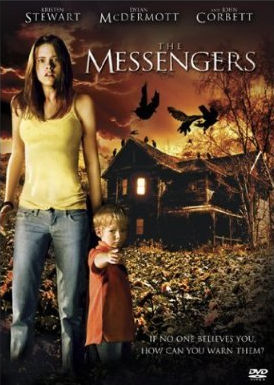 “The Messengers” is the latest film to attempt to capitalize on the popularity of Asian horror and while it isn’t a complete failure it lacks any personality of its own.
 “Over the last decade “X-Men,” “Spider-Man” and “Batman Begins” raised the bar of what could be done in a comic book movie. These films placed as much importance on character and story as lavish special effect set pieces. The same can not be said of “Ghost Rider.”
 “Pan’s Labyrinth” is a fantasy film, but is by no means kid’s stuff. It is a graphic, violent film that is very much for adults.
  “Music and Lyrics” is the sort of lightweight, fluff you expect from a movie starring Hugh Grant and Drew Barrymore. For romantic comedy fans this will go down easy, but it lacks the crossover appeal of some of Grant’s other films, most notably, “About a Boy.”
 Writer/director Nick Cassavettes’ “Alpha Dog” shows a world of privileged suburban teens and twentysomethings playing at thug life. We’ve been shown this world before and told of its dangers, but “Alpha Dog” runs deep by exploring the line between pretending to be a tough guy and really being one.
  On the surface, I enjoyed “The Devil Wears Prada,” a comedic, but not quite satiric take on the cutthroat fashion world. Meryl Streep’s fast-talking, demanding, fashion magazine editor is played to near perfection. It is a sharp characterization that adds substance to what could’ve been broad caricature. Streep even manages to elicit sympathy for her supposed she-devil.