Friday, December 16, 2011

'Chances Are' offers early example of Downey's talent

In honor of the release of “Sherlock Holmes: A Game of Shadows,” Robert Downey Jr.’s second time inhabiting the shoes of the famous detective, I wanted to take a look at a film early in Mr. Jr.’s career.

The high-concept romantic farce,“Chances Are” from 1989 has fallen off of every one’s radar, but it is a fine early example of Downey’s abilities as a comic actor and a film worth seeking out.

In the first scenes of the film, the happily married Louie Jeffries (Christopher McDonald) dies in an accident and is whisked up to a heaven similar to the one that appeared in Warren Beatty’s “Heaven Can Wait,” a film “Chances Are” owes a lot to in terms of tone and theme.

In this case heaven is a way station for souls waiting to be reincarnated. Louie does not take death well and is allowed to skip the line and be reborn. The problem is he didn’t receive an inoculation shot that will erase the memories of his previous life with his wife, Corinne (Sybil Shepherd), and best friend, Philip (Ryan O’Neal).

Louie is born again as Alex, who, 22 years later, takes the form of Downey. Alex winds up meeting and falling for Louie’s daughter (Mary Stuart Masterson) and eventually meeting both Corinne and Philip. Once Alex enter’s Louie’s house all the old memories come flooding back leading to some very confused emotions.

Turns out Corrine has been carrying an unhealthy torch for Louie this whole time. Philip has become a surrogate husband and father, but never officially took over either role despite secretly loving Corrine.

Now that Alex has Louie’s memories he is repulsed by Miranda’s advances, which leads to several great awkward exchanges. Similarly, the scenes in which Alex must convince Corrine he is in fact Louie are played just right. It is even funnier when Corrine not only accepts, but embraces it. This is further complicate by Philip deciding he finally will profess his love to Corrine.

In essence you have a Shakespearean case of mistaken identities except in this case the two identities are housed in one person. I love quadrangle develops between Alex and Miranda, Louie and Corrine, and Corrine and Philip.

As with any comedy of errors, despite the odds, everything neatly works out and everyone winds up with the correct partner. When done poorly this can be groan inducing, but when done correctly it is breezy, feel-good fun. The latter is the case with “Chances Are,” which features a witty script by Perry and Randy Howze. The movie strikes a nice balance to between frothy comedy and low-key romance.

The film certainly has its flaws. The great composer Maurice Jarre, who wrote scores for such films as “Lawrence of Arabia” and “Doctor Zhivago,” provides a similarly epic score to “Chances Are” when it needs something more whimsical. The score is too overwrought and on-the-nose with telling you how to feel that it becomes laughable and distracting. This is a minor shortcoming and in a way has its own charms. I began to predict when the music would swell on the score with a knowing grin.

Through it all you have Downey at the center in a performance that allows him to be charming, goofy and tender. In “Chances Are,” Downey has a light touch and shows his apt timing for physical comedy in several fine set pieces. It is very likely it is this performance that helped get him the title role in “Chaplin,” arguable his break-out role and one that lead to his first Oscar nomination.

In the years since Downey made his comeback from his public downward spiral into drugs, he hasn’t made a blatant romantic comedy like “Chances Are,” but his assured comedic timing and finesse with dialogue are the key to the success of so many of his characterizations. The way he banters with Gwyneth Paltrow in the “Iron Man” movies and Jude Law as Watson in the “Sherlock Holmes” films follows the beats of screwball comedy.

Over the years, Downey has developed impeccable line delivery. He does snarky one-liners better than just about anyone, but underneath even the most barbed dialogue there’s a genuineness that makes even narcissistic jerks like Tony Stark in “Iron Man” likable. Cynical sincerity is what helped make Downey a star.

Friday, December 09, 2011

A good Scrooge carries M&D's 'Carol'

What would the month of December be without a local production or two of “A Christmas Carol?” Now one man can only take so much of the beloved Charles Dickens' tale of a cold-hearted, penny-pinching cynic who finds the spirit of Christmas and carries it all year. So, here I am reviewing M&D Productions’ good, but unremarkable production of “A Christmas Carol.”

M&D Productions went a slightly different route with the classic. The production, which opened at Your Theatre in North Conway, N.H. Thursday, Dec. 8 and is running Thursday through Sunday for the next two, is based on an adaptation by playwright Doris Baizley, which adds a story frame of a bitter stage manager (Bill Knolla) gathering a traveling troupe of actors together to mount a production of “A Christmas Carol.” But the actor playing Ebenezer Scrooge has gone rogue, forcing the stage manager to step up to fill the role.

After that set up, the show begins proper and more or less stays true to the Dickens' story. There is a playful moment in which Knolla, now as Scrooge, flubs his first use of “Bah humbug” and has to be coached by the actor playing Scrooge's nephew Fred (Robbie Distasio) on how to do the line. It is funny bit, and more of that sort of self-aware winking would’ve helped add an extra twist to the material. Alas Baizley’s adaptation drops the theater inside jokes after that exchange.

“A Christmas Carol” is such a timeless tale it is hard to screw it up, but there’s also only so much you can do with it. How successful a production of “A Christmas Carol” lies almost solely on the quality of actor playing Scrooge. In Knolla, M&D Production has found a most excellent Scrooge.

Knolla contorts his face into a believable nasty, grimace. He spits out iconic lines like “If they would rather die they had better do it, and decrease the surplus population” with a venomous vigor. When Scrooge has his change of heart, Knolla makes his childlike jubilation apparent.

As the narrator, Shelly Morin brings seemingly boundless and joyous energy to the proceedings. Her bright smile is full of good cheer that easily transfers over to the audience. She also doubles as Jacob Marley, Scrooge’s former partner who warns of the three spirits, who will come to visit Scrooge. She makes a fittingly frightening Marley.

Elsewhere the cast is hit and miss, but other highlights include Steve Hoyt as an effectively earnst Bob Cratchit, Oliver Clay Storm as a charming Tiny Tim and Elaine Kondrat makes a pretty good Ghost of Christmas Past.

The show is punctuated by moments of the cast breaking into carols making the show a semi-musical. The songs are brief, but well sung.

People often forget how dark “A Christmas Carol” is, and in one scene in particular M&D’s Productions stages a truly creepy moment. The Ghost of Christmas Yet to Come scene concludes with the entire cast donning Scrooge masks and tormenting the real Scrooge. It is an unsettling moment that is enhanced by moody lighting.

The set is sparse, with Scrooge’s bed as the centerpiece. Other furniture and chairs are brought in as necessary, but this is a simplistic staging and it works at achieving its modest goals. At around 80 minutes it is a quick and efficient production that gets the audience in and out and ends brightly.

For more information or tickets, call the box office at 662-7591.

Offbeat, quirky songs for the holidays

Over the years I've written quite a few lists of off-beat, dark, subversive Christmas songs. These songs are the alternatives to the familiar ones saturating the airwaves. I have now compiled them all in one piece and added five more. Enjoy.

“Cool Yule” — Tony Rodelle Larson (1962)

I discovered this a few years back mis-labeled as being performed by William Shatner. It is easy to understand the confusion as Larson's broken speech patterns do indeed bring to mind Shatner's riffs on such songs as “Rocket Man.” This beatnik take on “Twas Night the Night Before Christmas” is most definitely way out.

“Monster’s Holiday” — Bobby "Boris" Pickett (1962)

After the “Monster Mash” became a hit this quickie sequel was churned out. There are some amusing riffs on holiday classics, but it is mostly a shameless rewrite of the original. It was a minor hit, but didn’t remain a holiday classic.

"Silver Bells" — Paul Simon and Steve Martin (Sometime in the late 1970s)

This rare show rehearsal starts out simple enough with Simon doing a lovely version of this classic song, but soon Simon's singing becomes mere backdrop for Martin deadpanning through a cynical monologue on the true meaning of Christmas that ranges from goofy to racy.

"Father Christmas" — The Kinks (1977)

Leave it to The Kinks, the same band that sang about an encounter with the transvestite "Lola," to write a song about mugging Santa. Ray Davies' sunny delivery masks the nastiness in lyrics such as "Father Christmas, give us some money/Don't mess around with those silly toys/Well beat you up if you don't hand it over."

"Christmas in the Stars" (from the "Star Wars" Christmas album of the same name) (1980)

Strange and frightening things began to happen after the tremendous success of the original "Star Wars" including an astounding awful 1978 Christmas special. Lessons weren't learned, though, and two years later came a Christmas album. "Christmas in the Stars" is so bad as to become campy fun.

“There Ain't No Sanity Clause” — The Damned (1980)

English punk band The Damned released this song just in time for the holiday season, but it failed to chart perhaps because no one wanted to have the Santa Claus bubble popped for the youngest yuletide revelers. The lyrics are barely intelligible, but, it is the sing-a-long anthem-like chorus that brings this one home.

"Christmas in Heaven" — Monty Python (1983)

Monty Python was always known for loopy songs that often pointed out the hypocrisies or the idiosyncrasies of society. In the film "The Meaning of Life," Graham Chapman sings a caustic song about the consumerism and commercialism that runs rampant during the holiday season that includes lyrics like: "There's great films on TV/"The Sound of Music" twice an hour/And ‘Jaws’ one, two, and three."

"Christmas In Hollis" — Run DMC (1987)

This is a happy hip hop holiday song about Christmas in Queens, N.Y. The song includes such endearingly goofy lyrics as "It was December 24th on Hollis Avenue in the dark/When I seen a man chilling with his dog in the park/I approached very slowly with my heart full of fear/Looked at his dog, oh my God, an ill reindeer."

"Merry Christmas (I Don't Want to Fight Tonight)" — The Ramones (1989)

The Ramones were still kicking around in the late 1980s cranking out three-cord ditties. Surprisingly, one of the best songs from this era is a Christmas song that manages to capture the tension of the season.

“Santa Song” — Adam Sandler (1993)

Everyone is familiar with Sandler’s "Chanukah Song," but he actually did a Christmas themed song that pre-dates its by a year. In this one Sandler sings about all the reasons he won’t be getting a visit from Santa. Best line: “Santa don't like bad boys — especially Jewish ones.”

“12 Days of Yaksmas” — Ren and Stimpy (1993)

There have been numerous parodies of the “12 Days of Christmas." Which is your favorite really comes down to personal preference. As a youth in the 1990s, I’ll always have a special place in my heart for the warped antics of this dog and cat team.

"Little Drum Machine Boy" — Beck (1996)

"The Little Drummer Boy" gets morphed into an odd dance and rap flavored Chanukah anthem featuring "the holiday Chanukah robot of funk." Beck is a chameleon-like musician who blends different genres with amazing skill. It is hardly traditional, but certainly original and memorable.

"The Night Santa Went Crazy" — Weird Al Yankovic (1996)

Don't be fooled by the sweet guitar strumming of the opening. This Christmas carol turns humorously sour fast. Yankovic turns his twisted mind on Christmas in the story of the night Santa finally snapped and became a "big, fat, disgruntled yuletide Rambo."

"I Won't Be Home for Christmas" — Blink 182 (1997)

Goofball pop/punk rockers wrote this anthem for all those who are driven up the wall by the holiday season. The song features bitter, but funny lyrics like: "It's time to be nice to the people you can't stand all year/I'm growing tired of all this Christmas cheer"

"O Holy Night" — Eric Cartman (1999)

"South Park" dedicated a whole episode to satirizing holiday music back in 1999. This is one of the tamer songs from the episode with the spoiled Cartman butchering the holiday classic to hilarious effect.

"Bizarre Christmas Incident" — Ben Folds (2002)

This aptly named song from the tongue-in-cheek piano man unfolds a dark tale of a man encountering Santa in the night. The song answer the question of what would happen if Santa got stuck in the chimney. Needless to say, it doesn't end pretty. Best in enjoyed by those who like their humor black.

“Elf’s Lament” — Barenaked Ladies (2004)

On “Barenaked for the Holidays” the Ladies presented a collection of Christmas favorites as well as original songs featuring their quirky sense of humor. On this song an elf complains “I make toys, but I've got aspirations.” Bonus: this song features vocals from Michael Bublé.

"Mr. Heat Miser" — Big Bad Voodoo Daddy (2004)

The song first appeared in the 1974 stop-motion animation special "The Year Without Santa." Thirty years later the swing revival group Big Bad Voodoo Daddy recorded the definitive version of the song for their holiday album "Everything You Want for Christmas."

“I'm Getting Nuttin' for Christmas” — Relient K (2007)

Christian punk/pop band Relient K's does a fast, rocking cover of the novelty song “I'm Getting Nuttin' for Christmas.” The snarling punk attitude and crunching guitars suit lyrics like “I broke my bat on Johnny's head/Somebody snitched on me” quite well.

“Another Christmas Song” — Stephen Colbert (2008)

Satirical pundit Stephen Colbert did a hilarious parody of holiday specials. The special's songs either subverted pre-existing songs or, in this case, are something completely new. Lyrics like “The tree is frozen, the winter’s bright/Who’d have thought the wise men look so white” are made all the funnier by Colbert's authentic crooning.

“Present Face” — Garfunkel and Oates (2008)

This female comedy-folk duo combines disarming charming and simple hooks with goofy and/or raunchy lyrics. In this case the duo leans toward the silly side as they sing about the all too familiar face people make when the get a present they don’t like.

“Christmas Tree” — Lady Gaga featuring Space Cowboy (2008)

Leave it to Lady Gaga, the reigning pop queen of weirdness, to co-write a Christmas song filled with dance beats and dripping with sexual innuendos. It is most definitely not family friendly, but the audacity is admirable.

“Merry Something to You” — Devo (2009)

Yep, Devo, those quirky new wavers, recorded a song for the holidays. Blending cheery, generic holiday music with the synthesizers and drum beats they are known for, the band creates an infectious little ditty. Devo often used songs to satirize society, and that's most definitely the case here as the band proclaims: “Believe what you want nothing's really true.”

"It's Christmastime!" — Mad Tea Party (2009)

This uke-abilly band vents its frustration for Christmas in this infectious two-minute ditty. The cynical lyrics include sentiments that anyone can relate to, if only fleetingly: "It's Christmas, forgot about the pagans and Jews/It's Christmas and it makes me blue."

"Christmas Night of the Living Dead" — MxPx (2009)

It was perhaps inevitable that there would be a zombie-themed Christmas song. Punk rockers MxPx present this bloody tale of Christmas carnage featuring the chorus: "Christmas night of the living dead/My face is green and the snow is red."

Friday, December 02, 2011

It's the return of the Muppets: Yaaaaaaaaay!

It's time to play the music, it's time to light the lights, it’s time to re-meet the Muppets and it is quite the sight. Yes, after a more than a decade-long hiatus from the big screen the Muppets have returned in all their glory in “The Muppets.”

In “The Muppets,” Kermit the Frog and the rest of the gang have broken up and have been largely forgotten by the world. A trio of fans, Gary (Jason Segel), his girlfriend Mary (Amy Adams) and Gary’s adopted brother Walter, who is a Muppet, but doesn’t seem to be aware of that fact, head to Los Angeles to tour the now decrepit Muppet Studio.

Through chance, Walter discovers an evil tycoon (Chris Cooper, in a gloriously campy performance) wants to tear the studio down to drill for oil. Gary, Mary and Walter seek out Kermit and gather everyone together to put on a telethon in the style of the old “Muppet Show.” That's it in terms of plot and that’s really all you need.

Segel, a huge Muppets fan in real life, co-wrote the script with Nick Stoller and their love of the characters comes through in every moment of the movie. This is a joyful tribute to the characters and a throwback to the original show and the first few films. Much like “The Muppet Movie” there is a self-aware tone to the material that is fun. The script is full of real wit and even some heart-tugging pathos.

Jim Henson’s felt friends became an unlikely sensation in 1976 on “The Muppet Show,” which spawned three films from 1979 to 1984, “The Muppet Movie,” “The Great Muppet Caper” and “Muppets Take Manhattan.”

Following Henson’s death in 1990 it was unclear if the Muppets would go on without him, but his son, Brian, continued the legacy in a new series of films from 1992 to 1999 with “The Muppet Christmas Carol,” “Muppet Treasure Island” and “Muppets from Space.”

In 2000 Jim Henson’s children sold the Jim Henson Company to a German company. Shortly after the purchase that company faced financial difficulties and Henson’s children struggled to buy back their father’s company. They did and, in 2004, sold the all rights to Disney.

All this back and forth with the company may explain why in the new millennium the Muppets were relegated to TV movies, commercials and music videos. In the entertainment world, there was much discussion to whether the Muppets were even cultural relevant anymore, and so it is fitting that the new film uses that as a jumping off point.

It was a series of video on YouTube, including the Muppets’ take of “Bohemian Rhapsody,” that helped prove that the Muppets popularity hadn’t waned and paved the way for the new film.

“The Muppets,” as with the previous films, is a musical, and a rather effective one, too. Familiar songs like “The Muppet Show Theme” and “The Rainbow Connection” are recreated, but there are several new songs written by Bret McKenzie, one half of the New Zealand folk comedy duo Flight of the Conchords. His songs are bright, catchy and funny. Highlights include “Life’s a Happy Song,” “Me Party” and, my personal favorite, “Man or Muppet” in which Gary and Walter each ponder if they’re a “Muppet of a man or a very manly Muppet.”

Directed by James Bobin, who worked with McKenzie on the “Flight of the Conchords” TV series, there is an irreverent, but never vulgar tone to the material. This is gentle family friendly material that will appeal to both kids and adults.

All the favorite Muppets are here including Kermit, Fozzie, Miss Piggy, Gonzo, Scooter, the Swedish Chef, etc. Everyone gets their due, even if only briefly. As was the case with “The Muppet Movie,” this new film is full of celebrity cameos. Some are very funny and some are gratuitous, but everyone seems happy to be on screen with these beloved characters.

Segel and Adams as the human stars of the movie are cheery and energetic. They may have too much screen time, after all this is a Muppets movie, but they are good company and play well off the Muppets.

The film is made in such a way as to appeal to fans, but also reintroduces the characters to a new audience. Above everything else this is a genuine feel-good movie that will have you smiling as you leave the theater. I was grinning like a fool from beginning to end.

Student Artist Profile: Matt Stoker's 'eye opening' journey in theater

Matt Stoker, a senior at Fryeburg Academy in Fryeburg, Maine, has acted throughout the valley in numerous productions for M&D and Arts in Motion including “Dog Sees God,” “Rent,” “Seussical: The Musical” and “The Fantasticks.” Last December, thanks to a contest through Dove Haircare, he performed as part of Alpenglow at Radio City Music Hall in New York City. He will next be seen in Arts in Motions’ production of “It’s a Wonderful Life” at the Leura Hill Eastman Performing Arts Center at Fryeburg Academy Saturday, Dec. 17 at 1, 4 and 7 p.m. and Sunday, Dec. 18 at 1 and 4 p.m.

It has been a year almost since the whole Radio City Music Hall thing. How’s it been?

I was actually just thinking about that earlier. It has been good. Definitely looking back on that, that’s got to be my fondest performing arts memory by far. It is incredible to think that roughly this time last year we were scrambling around trying to get votes from the community and pull everything together. I’m really glad that it happened and I kind of wish I was doing something exciting this Christmas. It is kind of lax around here.

That was crazy. Even just from my perspective.

Yeah, it was a whirlwind all right.

Did you feel any different? Do you think anything changed in the wake of that?

Yeah, I mean now I can put in all my bios for my shows that I performed on Broadway. That’s quite an accomplishment. That always brings up some conversation. But being on such a big stage, I didn’t think it was going to feel different than being around here, I mean I did, but not that different. I got out on stage and looked up and there was just tiers and tiers of people and I was like “Wow, this is what it feels like to be one of the big stars, the big leagues.” That’s incredible. So, yeah it definitely has changed my perspective on where I want to go and what I want to do with my life. It was eye opening.

So, it did solidify that this is what you want to do, that you want to be a performer?

Yeah, yeah, definitely. Hopefully that’s going to be where I am. I'll be there permanently. Hopefully. We’ll see.

When did you first get into performance?

Wow. Well, I’ve been singing since I was very little. Back in England, I used to sing in a choir and at my church. Since then I’ve grown up and didn’t really do anything seriously until high school, until I came to the academy with Brent Lacasce. I really got into music and I heard about auditions around North Conway with M&D Productions and I went out thinking maybe it's something I’ll give a shot. And it turned out to be one of the best experiences in my life. It really did show me that musical theater was for me, so I’m very thankful for that and to M&D for that. Since then I’ve had a lot of opportunities open up for me and it has really steered me in the right direction, so it is good. I’m excited about it.

Coming from this as a singer and then trying acting, how did you take to acting?

It was harder. It was definitely harder. Singing for me always came as a natural thing. My grandfather was an incredible tenor. I’ve always just enjoyed singing. I’ll sing badly to the auto-tuned stuff on the radio now. My mom hates it. It was a lot harder acting. Getting on stage and portraying a character who maybe is suicidal or is mentally disturbed in a way or something that is totally outside of the box, outside of what I am and what I am comfortable with is hard at first, but after awhile you get into the character and it becomes something you are more familiar with and it definitely opens your eyes. I don’t know. It is really hard to describe. It is definitely something you need to fall into. It is something you need to get used to, sitting on stage and having the lights blaring down on you. But it is what I live for: the adrenaline, everything, just when I am on stage and everyone is just enjoying what I am doing and what I am putting out there for them.

Now with “Dog Sees God,” was that your first non-musical?

It was. That was an interesting show. I wasn’t quite sure I was prepared for what the show was going to be. I flipped through the script when M&D told me about it and I said “Yeah, I’d love to audition for this” and I got cast as the very reclusive piano player that was gay and everyone hated him for being gay. I ended up finding out a lot more about myself through that character than I have probably through any of my other characters. It was a fun role to play. It was eye opening. Was that the only straight [non-musical] show I’ve done? I think it is. I’ve definitely stuck more to musicals. I am in a straight show right now, “It’s a Wonderful Life” and that will be going up the middle of December in Fryeburg.

What role are you playing in that?

I am Sam Wainwright. Now I am going to be honest: I’ve never actually seen the movie, so I know people are going to be like: “What? You have not seen that movie?” I just haven’t. I know who that is now reading through the script, but yeah that's who I ended up playing.

Are you looking forward to it?

I am looking forward to it. It is going to be a great show. Mary [Bastoni-Rebmann] is, oh my gosh, by far one of the best directors I’ve ever worked with. Going to New York with Mary, we’ve become very close. It is like working with one of my best friends and it is a lot of fun, so I’m very excited to do this show.

What would say your favorite performance is, outside of Alpenglow?

I’m going to have to go with “Rent.” It was a tough role for me vocally as well as acting wise. It is probably the first role I struggled with the way I was going to sing it, the way I was going portray the character. It was interesting being a character who was on the outside looking in, not as much being a part of the story. That was hard to portray, being more of the narrator role instead of being an actual character in the story. I think the camaraderie that came from the cast, we were together for months on end, day in, day out throughout the summer of 2010. It was definitely one of the best casts I’ve ever worked with and I’ve become like family to them and them to me. We still talk and we hang. That was definitely one of the best experiences in theater for me.

What are you hoping to do after high school?

That’s a million-dollar question. I am going to college definitely. I’ve actually got to go home and send off some college applications. As for what I am doing, I’m going to do computer programming and I’m also going to double major in musical theater. Now those are very different things, but hopefully I’ll find, when I get there, I lean one way or the other and I’ll kind of just fall more into that, but it could be I double major the entire way and I get a major in both. We’ll see how that goes. Let’s be honest, actors don’t make a lot of money. Even in the big leagues, the flow of cash isn’t secure, so that’s the reasoning behind the computer programing.

That’s not a bad idea. On the side you can just do some freelance Web designing, make some money that way.

Exactly. Hopefully I’ll be all set in that regard.

Do you have any final thoughts on why you do what you do?

Not really besides to say thank you to all those who inspired me throughout the years: to M&D for helping me find my love of musical theater; to Arts in Motion for providing me with some of the most incredible casts I’ve worked with and most incredible shows; to Brent Lacasce for helping me become the singer that I am today through his vigorous vocal jazz exercises; and to, of course, my mom, who drives me around to all these crazy places. She is definitely a force to be reckoned with, but she’s probably the most inspiring person in my life.

Wednesday, November 23, 2011

Breaking yawn

Another year brings another “Twilight” movie, this time “Breaking Dawn,” the adaptation of the final book of the vampire/human/werewolf love story. Alas this is not the final film of intense brooding and angst as “Twilight” is going the way of “Harry Potter” and splitting the final novel into two films.

This time next year look for “The Twlight Saga: Breaking Dawn: Part 2.” Fans are already lining up, everyone else is stocking up on garlic and stakes. If only it were that simple, though. Author Stephanie Meyer created a new breed of vampires for her series that can’t be killed by conventional vampire slaying methods. Vampires are supposed to burst into flames in sunlight not sparkle like diamonds.

But “Breaking Dawn” the film can’t even follow the rules established by its creator. There is a extended sequence with vampire Edward (Robert Pattinson) enjoying some Brazilian sun and there’s not a sparkle to be seen.

In this installment, Edward and his human girlfriend Bella (Kristen Stewart) finally get married much to the chagrin of Bella’s best friend the werewolf Jacob (Taylor Lautner). The “Twilight” series has been one long allegory for abstinence with Bella begging to be turned into a vampire and Edward refusing unless they get married first. With marriage out of the way, Bella can finally get her vamp on, but first she wants to get it on with some human-on-vampire action in the bedroom.

Naturally, their sexual adventures end in a pregnancy. The fast-growing fetus is “incompatible” with Bella and is destroying her from the inside. As if that wasn’t enough drama, the news of the pregnancy has the wolves in Jacob’s pack vowing to kill this vampire/human spawn. This leads to a lot of people trying to look intense and distressed, but generally just coming off as constipated.

There’s also a controversial development involving Jacob’s character that has already stirred much debate. Without spoiling anything, this development can best be described as creepy and not in a good way.

During the film’s many pregnant pauses, my mind began to wander and wonder about the logistics of vampire sex and impregnation. If a vampire doesn’t have a heart that beats blood then how can they become aroused? Furthermore how would they produce sperm? And even if they did wouldn’t it be venomous and turn a human into a vampire? The world may never know.

The movie is competently made by Bill Condon the talented filmmaker behind such films as “Gods and Monsters” and “Dreamgirls,” but there’s really only so much that can be done with material this silly and superficial.

There are isolated moments that break up the angst-ridding monotony. An all-too-brief flashback of Edward’s darker past that is shot in the black-and-white style of 1930s horror movie creates more atmosphere in a few minutes than anything in the rest of the movie.

Bella’s father’s (Billy Burke) wedding speech is good for a laugh as he reminds everyone he is a cop with a gun he knows how to use. Anna Kendrick as a catty frenemy also gets some choice one-liners. On the flip side, the film is at its most unintentionally hilarious when we get to hear the thoughts of the snarling wolf pack.

There would be need to be a drastic rewrite of the source material to find anything interesting here, but Melissa Rosenberg’s screenplay is slavishly faithful to the novel. This is great news for the die hard fans of the series, but dire news for those hoping for something more.

In truth, Meyer’s first “Twilight” had some promise, but that got watered down over a series of films that dwelled on shallow characters who mistake obsessive devotion with love. These are the kind of whiny self-absorbed people whose lives would be great if they could just get over themselves. It’s not much fun to be around people like this in real life and it is worse being trapped with them in a movie theater.

Student Artist Profile: Shelby Noble hits the road

Shelby Noble, a senior at Kennett High School, has been acting since the age of 10 and has appeared in numerous productions of Arts in Motion Theater Company. She recently was accepted to tour with Up With People, an international educational and cultural program. Noble, the daughter of Glenn and Jane Noble, will join Cast B 2012 for a world tour that begins in July. Each year hundreds of young men and women between the ages of 17-29 apply to join the international, educational and cultural program for a one- or two-semester experience that visits diverse communities on a multi-continent tour.

Tell me about Up With People.

It is an organization like People to People except the difference is they perform for communities instead of just helping communities.

And what will you be doing with them?

I will be touring with them. I don’t get a final printed schedule until January of all the places I’ll be going to. Basically, I leave July 1 to go to Colorado and I meet with all the other people that have been chosen and then I get to learn the show and we start touring all around the world.

Do you know what sort of things you’ll be performing?

The only general overview that I have are the videos they have on their website, and then on YouTube they have videos of their shows. That’s all that I’ve seen so far.

What sort of things have they done in the past?

In the past, they do everything from like Macy’s Day Parade to the Olympics. They do all sorts of different performances. Usually, they go to a specific community, like last year when Haiti was undergoing all their distress, they went there and built reforms and helped with their community and then at the end of the week they put on a big show. That’s basically what they do.

How did you find out about this or get chosen?

My dad had someone he had in his theater shows back in the day and eventually he went on to do Up with People and that’s how my dad heard about it. We’ve always talked about it and it wasn’t until this year that I was like “Hey, that might be something I’d want to do.”

What was the process like for the selection?

First you need to apply online. There’s a standard $20 fee. Then you just fill out what you’ve done community-service wise, performance-wise. I actually knew a guy because my dad is also trying to get Up with People to come into town and do performances with Arts in Motion. So, this guy named Brad Good was e-mailing me before that and saying he was excited to have an interview with you. Then I had an interview and after the interview they were like, “We’ll let you know in a few weeks at how you placed or whether you got in” and then a few weeks later I got an e-mail saying congratulations and I got a phone call. That’s the general process.

And when did you first become interested in performing in general?

I think it is just in my blood because my dad went to college to be an actor and then he came up with the non-profit organization Arts in Motion, and so ever since I was really outgoing. I just started acting when I think I was 10 or 11 and my first production was “Alice in Wonderland.” That was when I first started.

What was your first role?

The Gryphon. It is not in the movie so your probably have no idea what I am talking about. That was my first role. It wasn’t a very big role.

What would you consider your favorite performance?

Probably Annelle in “Steel Magnolias” because I am named after the movie, so it is special to me and the opportunity to be in it was really cool because I went there to try out and I was like “There all these older people and I’m only 16 years old.” I didn’t even think I was going to place because my mom was going to try out with me. So I was like, “Alright, I’ll go for support” and when I got a role I was really surprised. That was definitely my favorite.

That was a fun performance.

Yeah, I like working with close-knit casts of only a few people because you get to know everyone better.

What was it like doing “Ordinary People” because that’s obviously a fairly dark show?

Yeah, “Ordinary People” was definitely a lot different than all the other shows I have done — well, I don’t know, it was kind of like “Steel Magnolias” with the tight-knit cast thing. It was a dark show because I’m used to doing musicals and happy things, but I prefer when I watch a show or I am in one for it to be more dark. I feel like it challenges people to act a certain way because I am obviously not in this gloomy life, but when I’m asked to be in a show like that I just think that is more of an opportunity.

And how do you get to a darker or gloomier place?

I don’t really know. I don’t know I act a certain way. I guess to try to take on the whole character and be that character when I am on stage. I don’t have things constantly going through my mind like, “Oooh, what am I going to do after this.” I’m thinking of if I was that person how would I be acting, so I guess that’s how I get to any place when I take on a role.

What are you hoping to do after high school?

After high school I leave July 1 for Up With People and when I get back I plan on applying to colleges. I don’t know where yet though. I had some in mind, but I’m not sure. I do want to pursue acting as my major though.

And will you continue to participate in community theater?

Probably, yeah. Community theater is where I started. I feel like obviously I’d have to continue.

Friday, November 18, 2011

Double your displeasure with 'Jack and Jill'

Just in time for Thanksgiving, Adam Sandler has released his biggest turkey yet. “Jack and Jill,” a supposed family comedy in which Sandler gets to play his own twin sister, may not be his worst movie, but it is easily his laziest.

Sandler in drag has been funny before. One of the most popular sketches he did on “Saturday Night Live” was the Gap girls with David Spade and Chris Farley. But what is funny for five minutes isn’t necessarily funny for 90.

Guys dressed as women can be funny, but the idea isn’t intrinsically funny unto itself. Sure, the visual is good for a quick laugh at first, but after that you need to start writing some actual jokes. Movies like “Some Like It Hot,” “Tootsie” and “Mrs. Doubtfire” knew this and created funny and interesting characters and plots.

In all the above examples you also have characters that are guys who decide to dress up as a woman and so there’s the comic tension of how long the charade will last. With “Jack and Jill,” we’re supposed to accept Jill is an actual woman and that’s not believable on any plane of existence.

This could be excusable if the movie was actually funny. There are admittedly some laughs but, few to none of them come from the Jill character. There’s a reoccurring sight gag in which Sandler’s son tapes things to his body that is amusing and an extended appearance by Al Pacino that is, well, we’ll get to that later.

Any time Jill comes on screen with her shrill voice and obnoxious, loud and disgusting behavior you just want her to go away. If fart jokes are your thing, Jill is your gal. Somehow, despite having no redeemable qualities, we’re supposed to believe that Jack’s entire family falls in love with her.

Jill apparently has no job because she just keeps extending her Thanksgiving visit through to the new year. We’re supposed to feel sorry for her because she’s lonely since the passing of her mother who, other than her pet bird, was her only friend. She isn’t a character, but a very ugly caricature. Jack isn’t any better as Sandler plays his latest in a line of rich jerks.

The rich jerk character first appeared in “Funny People,” but that was a film in which Sandler did some real acting. Believe it or not, Sandler is better than movies like “Jack and Jill.” Sandler is just following the money. Anytime he’s tried something more serious like “Punch Drunk Love” or “Reign Over Me,” the films, despite being quite good, are box office duds. His lazy comedies gross $100 million.

In “Grown Ups,” “Just Go With It” and now “Jack and Jill,” he has played wealthy men who are bitter and self-absorbed and then in the final third of the films learn the error of their ways and become better men.

This has been a similar arc to many of Sandler’s films, but in his films from the 1990s such as “Happy Gilmore” there seemed to be some winking at the audience or some genuine sweetness as in “Big Daddy.” In his latter films there’s a sourness. A father now in real life, it's as if he feels obligated to put heartwarming messages in his films even if they feel disingenuous.

“Jack and Jill” is at least partially saved by Pacino. Pacino, playing himself, falls instantly in love with Jill at a basketball game. This leads to some strange scenes in the final third that are so off-the-wall that they actually work. Pacino seems oddly committed to playing himself.

The scenes with Pacino, particularly one in which he takes a call from Jack in the middle of a live stage production are indeed funny, but they feel like they are coming from an entirely different movie.

The Pacino scenes are worth seeing, but it is not worth sitting through all the fart jokes and lame prat falls. So, here’s the recommendation: Walk in an hour late or better yet, save your money and wait for it show up on YouTube or Netflix or in Red Box.

Friday, November 11, 2011

'Time'ly science fiction

Writer/director Andrew Niccol is a dangerous man in Hollywood. He makes movies about ideas and forces his audience to think. His latest film “In Time” is set in a world in which time literally is money and uses this allegory to comment on the current state of the economy.
“In Time” is set in a future, or perhaps parallel universe, in which all people have been genetically altered to not age past 25. The catch is you are given only one more year to live and you must work, steal, beg or borrow more time to continue living. The rich are essentially immortal whereas the poor literally live day to day and often second to second. 
Niccol does a terrific job fully fleshing out and running with this idea. Characters have a glowing green time code on their forearm clicking off the time that remains. People can loan time by holding each other’s wrists. Time has replaced currency. A cup of coffee costs four minutes. It gives a whole new meaning to the expression: What’s it worth to you? The premise also makes things more urgent. When you’re out of money it may not be the end of your life, but in Niccol’s world if you’re out of time, you’re dead.
This is a brilliant concept for a piece of science fiction, but when Niccol set out to make “In Time” I doubt he realized how timely the film would actually be. Niccol’s film directly addresses many of the same issues at the center of the Occupy movement.
The star of the film is Justin Timberlake, who has done the rare feat of transitioning from pop star to a movie star with genuine acting ability. His character, Will Salas, is a laborer who lives with his mother (Olivia Wilde) and they barely can make it to the next day.
Will meets Henry Hamilton (Matt Bomer) who has lived 102 years and has another century to go. Henry no longer wants to live, and, sensing Will is a good man, gives his remaining time to him. He also lets Will in on a little secret that “for a few immortals to live, many people must die.” The system is staked to ensure that enough people die off so there isn’t over population while the rich live forever.
With this new-found time, Will is allowed into a different “time zone” for only the wealthy, but it also gets the attention of the Time Keepers led by Cillian Murphy. These new form of police make sure that time remains in the right hands and believe that Will murdered Henry.
Now on the run, Will kidnaps Sylvia Weis (Amanda Seyfried), an adventure-seeking heiress, and the film essentially becomes “Bonnie and Clyde” meets “Robin Hood” with Will and Sylvia stealing time from her father’s banks and giving it to the poor.
 After establishing the universe and rules, the film settles into a more traditional action movie with car chases and gun fights. These scenes are slick and well produced and flow naturally from the plot rather than just being arbitrary. There are enough quiet moments that allow for tough moral questions to be asked.
Perhaps the best scene in the film is a high-stakes poker match in which being all in means your life is on the line. There is also a similar, but less effective, to-the-death arm-wrestling match.
The premise also allows for a youthful cast. Apparently in this world, in addition to not aging passed 25, you also remain thin and attractive. Timberlake makes a viable thinking-man’s action hero and does continue to prove his acting chops. He does have one unfortunately laughable crying scene, but the guy has real screen presence and that’s something you can’t fake.
Seyfried is a good and appealing actress who is given an underwritten role. She is only here to serve one purpose: fall in love and aid the hero. Her character does have some arc going from a rich girl to a rebel overthrowing the system, but, ironically, there’s not enough time given to show this transition. Even so Seyfried does what she can with the role and Timberlake and Seyfried make an appealing couple.
Murphy is essentially the Tommy Lee Jones character from “The Fugitive” and he does the dogged, hardened-cop role well. He brings a stoic intensity to the character.
Much like “Gattaca,” which Niccol also wrote and directed, and his screenplay for “The Truman Show,” Niccol uses his sci-fi premise to comment on society, culture or human nature, which is in the tradition of the best science fiction.

Thursday, November 10, 2011

Talent springs forth in powerful 'awakening'

For its annual musical, M&D Productions has mounted an ambitious and powerful production of “Spring Awakening,” the eight-time Tony Award-winning musical of sexual discovery set in 19th century Germany.

“Spring Awakening,” which opened Thursday, Nov. 10, at Your Theatre in North Conway, N.H. and is playing Thursday through Sunday for the next two weeks, is a rock musical adaptation of the controversial 1892 German play of the same title by Frank Wedekind. Featuring music by Duncan Sheik and book and lyrics by Steven Sater, the dialogue is more or less to period, but the lyrics are contemporary.

The show is like a greatest hits of misery: child abuse, rape, abortion and suicide. This isn’t a light, happy musical, but it isn’t a total downer either. It explores these issues in a serious and direct way, but also features rousing musical numbers and a sly sense of humor.

There’s a large cast that mixes community actors with three professional actors that M&D brought in specifically for this show. The most notable of the three pros is Jason Cabral in the lead role of Melchior, a bright student who is seen as dangerous for being a free thinker.

Cabral, who also was assistant director, has a strong, commanding voice and an engaging stage presence. He is good in both dramatic and comic moments. Most importantly, you never see him acting. It feels natural. His standout moment, backed by the ensemble, is “Totally “F---ed,” the show's funniest, most dynamic number.

It is a testament to the level of talent that we have in this community and to Ken Martin’s abilities as a director, that the professionals, who also include Christopher Baron and Janet A. McWilliams in supporting roles, don’t stand out like sore thumbs. The cast blends together seamlessly. The pros don’t come down to a lesser level, everyone comes up to their level ability.

Molly Paven is the naive Wendla, who embraces her sexual desires toward Melchior not knowing the consequences thanks to a lovely bit of misinformation about child birth from her mother (Christina Howe). Paven is every bit Cabral’s equal in terms of vocal and acting ability. Paven, seemingly with little effort, brings across Wendla’s innocence, confusion, frustration and excitement.

Paven and Cabral have a palpable chemistry and share numerous powerful scenes together most notably one in which Wendla asks Melchior to beat her with a rod as she wants to be able to relate to her abused friend Martha (Amy Nicole Smullen). The act unleashes their sexual desires.

Chris Madura as Moritz is the third lead. Mortiz is troubled by his developing sexual urges which plague his dreams. As a student, he struggles to make the grade and is often the target of abuse and humiliation from his teachers (Bill Knolla and Karen Gustafson).

Madura beautifully brings across the tremendous pressure Mortiz is under and the depression he is struggling with. When he confronts his father (Kevin O’Neil) about his struggles at school only to be ridiculed we feel his pain. Madura shines brightest sporting a fauxhawk and venting his frustration on the punk-ish “Don't Do Sadness.”

Outside of the three leads, everyone gets at least one moment to shine. Smullen takes lead on the heartbreaking “The Dark I Know Well" which explores her character’s abuse. Jessica Pappalardo as Ilse, who tentatively attempts to be more than a friend to Mortiz, showcases her beautiful voice on the haunting “Blue Wind” and leads the cast in the show’s final number "The Song of Purple Summer" Baron and Ezra T. Alves share a funny and tender scene of budding, forbidden love.

This is complex and big show and so everyone deserves their credit. The actors are backed up by a solid live band that includes Cella Mariani, Eric Hudson, Eric Jordan, Thaddeus Pinkerton and Rafe Matregrano, who also provided musical direction. Once again Deborah Jasien has provided a beautiful set with an amazing tree as the center piece. Johnathan Pina provides the show with its lively choreography. Lighting design by Martin and Mark Delancy and sound design Pinkerton are both effective.

For more information or tickets call the box office at 662-7591.

Friday, November 04, 2011

'Puss' gets by on the charms of Banderas and Hayek

Last year the “Shrek” series petered out with the passably entertaining “Shrek Forever After.” It was clear the series was well passed its expiration date, but Hollywood always perseveres when there is money to be made and thus we have the spin off “Puss in Boots.”

All cynicism aside about the roots of the film, “Puss in Boots” is a charming, funny animated film that recaptures much of the original wit and freshness of the first “Shrek” while having its own flavor and personality.

As with “Shrek,” “Puss in Boots” is set in a world that reworks and satirizes fairy tales, but the film differs from “Shrek” by taking on a tone of a spaghetti western.

Antonio Banderas returns as the adventure seeking cat that is part Zorro and part El Mariachi, his character from “Desperado” and “Once Upon a Time in Mexico.” In this story, he is a bandit who thieves as the means to a noble end. A back story reveals that years ago Puss was betrayed by his friend Humpty Dumpty (Zach Galifianakis) and tricked into robbing his beloved home town. Left an outlaw, Puss desperately hopes to somehow repay his debt.

That chance comes in the form of heist cooked up by Humpty that involves stealing magic beans from Jack and Jill (Billy Bob Thornton and Amy Sedaris), who in this universe are feared criminals, and growing the famed beanstalk that leads to the goose that lays the golden eggs. Despite his qualms about Humpty, Puss agrees to take part in the caper. It helps that the third partner in crime is the lovely Kitty Softpaws (Selma Hayek).

Banderas and Hayek worked together in “Desperado” and “Once Upon a Time in Mexico” and their chemistry, even just in voice performances, is tremendous. Both actors breathe so much robust life into their characters. It is ultimately their performances that make the film so enjoyable even when the films plot begins to feel stretched in spots.

Galifianakis, whose socially awkward idiot schtick in “The Hangover” and “Due Date” is wearing thin, gives a sweet, genuine performance as Humpty Dumpty. There’s some complexities to the character that Galifianakis’ vocal performance brings across naturally.

Thornton and Sedaris have a lot of fun as the bickering bandits and lovers Jack and Jill. In an amusing twist Jack wants to give up the criminal life and have kids and start a family.

The screenplay by Brian Lynch, David H. Steinberg, Tom Wheeler and Jon Zack is full of clever ideas, visuals and lines of dialogue. A particular favorite is the way a wagon transforms into a flying machine. The plot does become needlessly complicated in the end suggesting that there was perhaps one too many writers working on the script.

Director Chris Miller, who wrote and directed “Shrek the Third,” brings a slick visual style that emulates the “Shrek” style, but has a feel all its own. The film movies at a brisk pass and the use of split screens at various points in the film is clever and energetic.

But as previously stated it is Banderas and Hayek that make this work. Without them there really is no movie. Other actors could’ve provided the voices of these characters and done a good job, but it just wouldn’t have been the same. Their personalities are so completely infused in the characters it is hard to imagine it any other way.

Student Artist Profile: Kevin Brown — 'It is really nice to perform'

Kevin Brown, a senior at Fryeburg Academy in Fryeburg, Maine, is in vocal jazz and has an interest in theater.


How did you get interested in vocal jazz?

Originally, I really wanted to go into theater my freshman year, but Mr. Neland was like "No, no, no, you should go to chorus" and I was like "Alright." So, I went to chorus and the first few years I wasn't really interested in eclectic, which is like JV vocal jazz and then junior year I tried out for vocal jazz and Mr. Lacasce said "Yeah, you're definitely in. You're definitely one of the best basses we have." Alright, cool. So, kind of been on the road since.

Have you always had interest in singing?

Yeah, my mother was a choir director for the church we went to in Massachusetts before we lived here, so often times I'd stay after and sing with her, hang around and get some pieces under my belt.

You have done some theater, too?

Yes, I've always been interested in theater. Again, my mother and my brother, Ryan, have both been interested in theater and influenced me most of my life. Ryan right now lives in Baltimore, Md. and he's actually directing plays. For his job, he works at an intern hospital and he walks in and acts like a patient sometimes. He'll walk in, "Oh, I think I have a heart problem and I don't really know why." And they have to wonder what he is going to do. That sort of thing. I get a lot of influence from him.

Have you been in any productions?

Well, I've only been in like three because it has mostly been school productions that I've been able to go to because they are pretty local. Even then I wasn't really interested. A lot of theirs are like these comedy musicals things and I've always been interested in drama and really acting not just: deliver line, punchline, walk off stage.

Have there been any roles you really enjoyed playing or that you really want to play?

Last year when we did the one acts for the May term I got to play this character who wasn't really connected to his parents because he was adopted and they didn't really feel like telling him until pretty much half way through his life. The character really stuck out and I enjoyed it because he started out as this really shelled in boy and then he grew up to be this rough and tough guy, but deep down he was still this boy. I really liked that part. As for a part I've really wanted, I don't know. My father always told me "There's no such thing as big parts, but big actors" and same thing for small. I've always worked with what I got. Granted, guard number three isn't a great role.

What do you hope to do when you get out of high school?

I've been mostly looking into botany and ecology. Oddly enough, I don't really want to go into theater much, but if it comes to be I might do the school plays or that kind of thing, again, what I've actually been doing lately. I've been looking at the College of the Atlantic and mostly coastal ecological kind of places for studies.

In terms of the vocal jazz, has there been any standout performance you really enjoyed participating in?

Yeah, last year we did the Berklee Jazz, which has, I think, over 200 schools. We luckily came out on top against all the other schools across the entire New England performance. At the end, I just remember singing and things weren't really on time and we weren't really singing that great, but it just felt so good to be in front of all these other schools and be like, "Yeah, Fryeburg Academy, we're singing in front of you guys." I just remember looking behind me and seeing our drummer, Jon Dana, jamming out on these 50 Toms and he didn't know what to do like a little boy in a candy shop. It was really great. It was really nice performance. That was last year when we won at Berklee. That was a great performance definitely.

Have you had any interest in participating in community theater with M&D or Arts in Motion?

Nah, there just hasn't been enough time in anything I've done. I don't even have a car, so it is kind of hard for me. If my dad was home a lot more, but often time he has been working a lot, so it would've been middle of the day, right after school, I'd have to find a ride and then a ride back. It is a great idea, I'd really love to be a part of it, but it is just too out of the way.

Do you have any final thoughts on what you want to do or why you like to perform?

I just perform because it is really nice to perform. I like being different from who I am. Can I be this character? Can I be that character? Can I act sane for once or can I act insane. Yeah, that's about it.

Friday, October 28, 2011

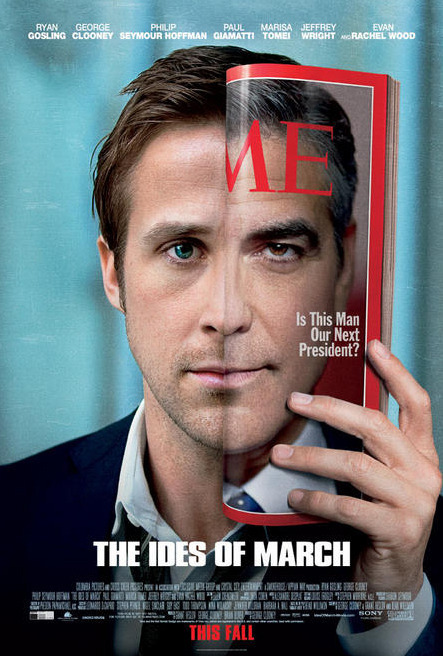
'Ides of March' is a good, but not great political drama

Politics are saturating the atmosphere as potential presidential candidates vie for the Republican nomination. “The Ides of March,” George Clooney’s new film as co-writer, director and star, offers a look behind the scenes of that process. Not surprisingly, it is a dirty world.
“The Ides of March” is based on the 2008 play “Farragut North” by Beau Willimon, which was loosely based on the 2004 Democratic primary campaign of Howard Dean. The retitling of the movie is in reference to the day Julius Caesar was assassinated and would imply that this story will have its own assassination. It doesn’t.
The title is a metaphor for the backstabbing that occurs to get ahead and for the death of ideals of Ryan Gosling’s Stephen Meyers, the second in command for the presidential campaign of Clooney’s Mike Morris.
Trailers and advertisements for the film have made it appear to be a taut, fast-paced political thriller. It isn’t. It is a deliberately paced drama that shows the inside workings of a political campaign much the same way that “Primary Colors” did in 1998. That was a broader and more savagely funny look at the process, but both films follow the same arc: the disillusionment of a campaign staff members who at one point truly believed in their candidates.
“The Ides of March” is a more dramatic, even heavy-handed, approach to the subject matter. There’s a twist involving an intern played by Evan Rachel Wood that isn’t exactly what you expect, and it works. Another twist is then added on top of the first that is a bit of a stretch. Wood’s performance can't be faulted though. Like the rest of the cast, she is excellent. She is charming, intelligent and, when needed, emotionally vulnerable. 
This plot development is the linchpin on which Gosling’s belief in Clooney swings, and in the final third of the film Gosling’s character goes from idealist to hardened cynic. It is a transformation that is well acted by Gosling and, while you’re watching it, is effective and believable, but doesn’t hold up to much scrutiny. The timeline of the film is mere weeks. Gosling’s character seems pretty quick to sell his candidate out at the first sign of imperfection.
Perhaps this is the limitation of the source material showing through. The film does very much feel like a play, which isn’t a bad thing, but perhaps the material could’ve been further expanded for the film. Maybe the changes in Gosling’s character should have developed over the span of several months.
Despite these flaws, this is well crafted and exceptionally well acted film. The performances in this film are what make it work.

Clooney is believable as a presidential candidate, so much so that if his character were to run in real life he’d probably get a nomination.
Philip Seymour Hoffman plays the head of Clooney's campaign staff and he gives a fantastic speech about loyalty. Paul Giamatti is head of the rival candidate's staff and in a few scenes steals the movie. His character tries to court Gosling to his side. When Giamatti reveals his true intentions it is a shocking moment.
Marisa Tomei is solid as a journalist who helps introduce the film’s ongoing theme of friendship. What does that word mean in the political world? It is a good question, and the way it is explored is interesting.
Outside of the acting, the best thing about “The Ides of March” is the feeling that we are getting an inside look. The film opens with a microphone check for a speech and closes with Gosling being prepped for a TV interview. These behind the scene details are fascinating as are the behind-closed-doors conversations that the characters have.
The games, manipulations and tricks that are played to win in politics are not exactly surprising, but are engaging and thought provoking as presented by Clooney and his cast.

Friday, October 21, 2011

The new 'Thing' doesn't quite live up to the old 'Thing'

When talking about seeing the “The Thing,” the semi-remake prequel to John Carpenter’s 1982 “The Thing,” it feels like an Abbott and Costello routine.
“I just saw the new ‘Thing’”
“What thing?”
“The Thing.”
“Listen if you don’t want to tell me what you saw that’s fine.”
“I already told you what I saw. I saw the new ‘Thing.’”
“What thing?”
The 1982 version of “The Thing” was itself a remake of 1951’s “The Thing from Another Planet.” That film was set in the North Pole whereas the 1982 and 2011 installments are set in Antarctica. Each film involves a small, isolated group of scientists and researchers dealing with a hostile alien.
In the 1951 film it was a creature (played by James Arness in alien makeup) that evolved from plants rather than animals. In the 1982 and 2011 version it is a shape shifting creature that can assume the shape, memories and personality of any living thing it comes in contact with. Anyone can be the Thing, which in both the 1982 and 2011 films leads to an atmosphere of paranoia and suspicion.
The 1982 film had the Thing arrive in a United States research center in the form of a dog being chased by a helicopter piloted by the two survivors of a battle with the creature at a Norwegian base. The 2011 film shows what happened at that Norwegian base.
First-time director Matthijs van Heijningen Jr. clearly has a genuine love for Carpenters film and this film does a nice job of recreating the look and feel of the earlier film. Sets were recreated in remarkable detail, which the many fans of the previous film should appreciate greatly.
Some fans of the 1982 film have asked: What’s the point of making this film? The argument being that the mystery of what happened to the Norwegians was part of the allure and appeal of the 1982 “Thing.”
It was a safe assumption that the action that unfolded at the United States base followed a similar arc to that of the Norwegian base. Now we know it was almost exactly the same; in fact, it is so similar it starts falling into the category of remake.
The film’s roster of characters features a mix of Norwegian researchers and American experts flown in to help dig out the creature who has been frozen for 100,000 years. This includes paleontologist Kate Lloyd (Mary Elizabeth Winstead, “Scott Pilgrim Vs. the World”), who becomes the film's main protagonist much in the same way Kurt Russell did in the 1982 film.
Having a female lead character gives the film a different dynamic than the 1982 version and inevitably recalls Sigourney Weaver’s work in the “Alien” films. Winstead gives a solid, believable performance in the film. The film doesn’t transform her into an unrealistic action hero, but rather a smart, strong woman who takes hold of a terrifying situation.
The rest of the cast, which includes Joel Edgerton (“Warrior”) as a pilot, is indistinct and interchangeable. There’s very little character development. Carpenter’s film didn’t exactly have fully developed characters, but there was a sense of camaraderie in that film that is sorely missing here.
The film’s best scene is a new twist on the 1982's film's iconic scene testing to see who is human and who is a Thing. The screenplay by Eric Heisserer comes with a clever variation on that scene that is logically sound and makes sense.
Which brings us to the question of the special effects used to create the creature. The 1982 version was made in a time before CG effects and featured an effectively gooey mixture of puppets, prosthetics and other practical effects.
This new film uses some practical effects, which is welcomed, but leans a bit too heavily on computer effects. A more even blend of the two styles would’ve been more effective. That being said, there’s definitely some good, creepy and gory scenes that, while not nearly as shocking as anything in the 1982 film, do provide some good scares.
Overall, this new “Thing” is decent entertainment. It honors its predecessors, but doesn’t match or surpass them. Of its kind, it is well made with moments of genuine suspense. You can certainly do worse if you’re looking for a horror film this Halloween.

Friday, October 14, 2011

Music for food: Red Gallagher presents benefit concert for food pantry Oct. 15

CONWAY — Musician Red Gallagher, of Center Conway, has been living and performing in the Mount Washington Valley and Lakes Region for three years now. He decided it was about time to give back.
“I decided to do a benefit for the [Vaughn Community Service] Food Pantry because of the good work they do,” Gallagher said. “I've been doing a similar food pantry benefit concert in Minneapolis for 15 years, every Thanksgiving, and I've wanted to get something going here that would benefit the community and help me become a more contributing member of my new community.”
Gallagher will present a concert to benefit the food pantry and honor long-time volunteer Bob Therrien. The event will take place at The Salyards Center for the Arts at 110 Main Street in Conway Village, Saturday, Oct. 15, from 7 to 9:30 p.m.
“I've been wanting to do something at the Salyard Center,” Gallagher said. “It is very intimate, very small. It would hold 150 people, maybe more, but they'd be really crammed. And I thought it would be perfect for a first-time event like this because if we draw a crowd at all it would be great. But of course the dream is to fill the place, have this become a successful and maybe do it every year.”
Gallagher, a long-time entertainer at the The Balsams Grand Resort, will be performing a mix of humor and straightforward blues and boogie. He will play a mixture of dark, funny songs including original compositions and parodies and covers of songs by people like John Prine, Steve Goodman, Shel Silverstein and Pat Donohue.
“I don't do a lot of slow ballad, sad stuff,” Gallagher said. “I leave that to the people that do it better and one of them is my wife, Lorraine, and she will be, as she often is with me, a special vocal guest and she'll do probably four to six songs in the course of the evening.”
In addition to the Gallaghers, Balsams pianist Greg Goodwin will open the show with a half hour of jazz and popular music at the grand piano. Goodwin is a long-time friend of the Gallaghers and was even in the best man at their wedding.
“He's a virtuoso,” Gallagher said. “His repertoire is jazz-pop crossover, due in large part because of where he plays — the dining room up at the Balsams. You have to play songs people are familiar with, but his love is jazz, so he gives it a real special flavor and texture.” 
Suggested donation for attendance will be $10 per person or $5 and items of non-perishable food.
“We're going to keep it short, we're going to keep it early and we're making it cheap,” Gallagher said. “I want it to be a fun thing for people to have an alternative of something to do on a Saturday night.”
For more information call 986-7736.

'Misery' loves company

CONWAY — Stephen King is the modern master of macabre, so with Halloween in the air, it only seems natural to turn to him for some scares on the stage. “Misery's Child,” M&D Production's original adaptation of King's novel “Misery” directed by Ken Martin, brings one of author's most psychological disturbing tales vividly to life.
Of all King's work, “Misery,” with its tale of an author being trapped and tortured by a psychotic self-proclaimed number one fan, seems the most natural fit for a fiendish evening of theater. With only two actors, “Misery's Child” manages to keep the audience captivated.
After a brief prologue in which romance novelist Paul Sheldon (Richard Russo) receives an award, we hear the sounds of a car accident. In the next scene Paul is bedridden and being tended by his savior, the overly cheery Annie Wilkes (Janette Kondrat), his top fan. At first Annie seems like a well-intentioned, if somewhat kooky nurse, but it doesn't take long for Paul or the audience to discover how unstable and deranged Annie is.
Any number of cliches could be used to describe the experience of seeing “Misery's Child,” which opened last night at Your Theatre in North Conway and is running Thursday through Saturday until the end of the month. It'll put you on the edge of your seat. It'll make your skin crawl. These phrases are accurate, but don't do justice to the caliber of the work in this show.
Kondrat's performance is truly and often deeply unsettling much in the same way Kathy Bates was in her Oscar-winning portrayal of the role in the 1990 film. Kondrat, who says she has avoided watching the film, matches Bates iconic performance. They way she turns in a moment from sunny and nearly childlike to angry, spiteful and violent is seamless and disturbing. There's an unrelenting tension as you never know what will set Annie off next.
In playing Annie, Kondrat gives a risky performance. She goes for big emotions with intense highs and lows. In a scene showing Annie in a profoundly depressed mood, Kondrat creates an almost entirely different character and yet it springs naturally from the rest of her performance. It is astounding work.
Russo's role is less showy, but in many, and certainly different, ways just as challenging. His performance is almost entirely based on reaction. Russo gives a restrained and precisely timed performance. It is also a quiet performance. His subtle, controlled facial expressions say everything when the dialogue is scant. We see fear, agony, confusion, dread and even joy in Paul's small victories.
The show also gives Russo some rich monologues where Paul talks to himself when he is left to his own devices trying to figure out if there is any way out of Annie's trap. The most harrowing and brilliantly performed of these is when Paul is left stuck in bed with no food, water or medication for two weeks. It is difficult to watch.
Beyond the psychological games played between Paul and Annie, which are in turns disturbing and darkly comic, “Misery's Child” is also a well-observed look at the craft of writing. Russo does a good job of portraying the process of writer as Paul is forced to write a new book just for Annie.
These performance are housed in a beautiful rural house set designed by the consistently amazing Deborah Jasien. The lighting design by Mark DeLancey aids in creating a mood of dread when necessary. The sound design by Martin and Elaine Kondrat utilizes creepy music and effective use sound effect, particularly during the car crash, to help create an atmosphere of unease.
For those who enjoy the thrill of being scared, “Misery's Child” is a fantastic night out and one that will stick with you long after the final bows.
For more information and reservations call 662-7591.

Friday, October 07, 2011

'Farmageddon' is a well-intentioned, but under developed documentary

“Farmageddon” is a documentary that sheds light on an unseen issue: the government's persecution of small family dairy farms. The problem is writer/producer/director Kristin Canty doesn't really have much to say about the subject other than it is bad.
Canty, whose intentions are clearly noble, decided to make “Farmageddon” after discovering raw milk was able to cure her son's allergies. In talking to local farmers she discovered much of their troubles and wanted to share their stories.
As a first time filmmaker, Canty deserves credit for putting together a film that looks professional. This doesn't look like something slapped together over the weekend. It is clear a lot of time, care and effort was put into the film and it does show.
The first 30 minutes of the film are compelling as Canty shows some disturbing imagery of farms being raided at gun point. Farmers share anecdotes that are shocking. One family had imported sheep to start a dairy farm, but the USDA went after them, eventually killing the sheep out of fear of the spread of mad cow disease, which there is no proof of sheep carrying. Other families had milk and yogurt and supposedly contaminated feed confiscated.
This would be a good subject for a 15 to 30 minute news segment on such programs as “Dateline” or “60 Minutes.” As a film, the material is stretched too thin and is repetitive. We are shown more farms given the same cruel inexplicable treatment and hear more tearful stories that certainly carry emotional weight, but we are never given answers or context.
Canty and the numerous family she interviewed want to know why both national and state governments are picking on the little guys over safety and healthy regulation instead of going after big commercial farms.
The conclusion that Canty comes to is that agribusiness must have the government in its back pocket. It isn't a huge leap to make and it is quite possibly the case, but Canty provides zero evidence to back up this assertion.
Canty only talks to the owners of small farms. There was no apparent attempt to talk to owners of larger farms. She does state that she tried to contact government officials to give the other side of the story, but was only able to get a couple to go on camera. Out of frustration she says, “People from the government don't really want to talk for some reason, which bums me out.” In that moment, despite the slick look of the film, you know you're in the hands of an amateur.
For the 85-minute run time, you mostly only hear one side of the story and sometimes her subjects make dubious statements. Kevin Brown, author of “The Liberation Diet,” states “Real food like butter, like real milk, like eggs have been made the devil in the world of food to the point where people are afraid to eat real food and unfortunately the result of that is 72 percent of the country is obese or overweight. Heart disease, cancer rates and diabetes rates are at all-time highs, and every year it is getting worse.”
That is just faulty logic. Would there be less obesity if people only ate “real” butter, eggs and milk? It is possible, but once again the film is dealing with ideas that are unsupported and Canty never seeks out the facts to support her claims. The inclusion of material like this does a disservice to her primary subject: the owners of these small farms.
Canty does provides interesting information about why milk pasteurization became standard practice and Dr. David Acheson, food policy consultant and former FDA/USDA administrator, offers some insight into why there are strict regulations on milk. No one ever explains or even attempts to justify the extreme behavior against small farms.
By the conclusion of the film in which Canty blatantly states, “I made this film to be a cautionary tale for consumers,” it is apparent that you've watched the visual equivalent of a school report. Is it a report worth seeing? A qualified yes. Seeing the way these farmers are treated is shocking, and the film is worth a look if only for that footage.