Friday, June 04, 2010

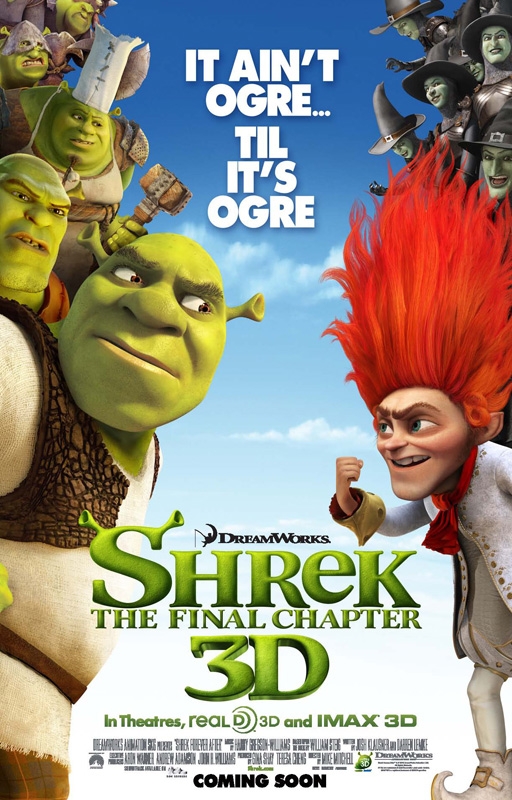
'Shrek Forever After' is thin, but still fun

Nearly a decade has passed since the first “Shrek” came out. It became the first film to win an Academy Award in the newly formed Best Animated Feature category — and for good reason, too. It was sharp, uproariously funny, imaginative and even at times tender. Now we have “Shrek Forever After,” the fourth installment of the series, and franchise fatigue is settling in.

This latest “Shrek” isn't bad, but at this point it is no longer fresh. The first film was a sly satire on fairy tale characters and of Disney's often sanitized versions of these dark tales. But now, four films into the series, the satirical world is accepted as its own universe and the lampooning is substantially duller. The first two films were consistently laugh-out-loud funny. Those moments of laughter are far fewer.

As the film opens, Shrek (Mike Myers), now a father of three, has become bored with family life and is yearning for the days when he was feared ogre. Enter Rumpelstiltskin (Walk Dohrn) who offers Shrek one day in his old life. Naturally, there is a tricky catch that thrusts Shrek into an alternate universe where he never existed and Rumpelstiltskin is tyrannical dictator. Shrek has
24 hours to figure out how to fix it or he'll cease to exist.

Yes, it is the old “It's a Wonderful Life” routine and while it is hardly an original twist, it does offer some unexpected moments. The opening scenes with Shrek and his family show how stale this franchise had become, so at least the alternate world offers some variation.

In this world Fiona (Cameron Diaz) is the hardened leader of the ogre resistance against Rumpelstiltskin. She wants nothing to do with Shrek and he must court her all over again. Some things never change, though, and Donkey (Eddie Murphy) almost instantly becomes Shrek's best friend again.

The funniest thing about this alternate world, and the film overall, is that Puss in Boots (Antonio Banderas), now Fiona's pet, has become pampered and fat. This leads to several great visual and verbal gags. Banderas' Puss in Boots is easily the best thing in the franchise at this point. This is supposedly the last in the series, but a Puss in Boots spin-off seems like a viable and worthy way to keep this money train moving forward.

Overall, the voice work remains solid. Myers is actually giving a genuine performance that makes the tired you-don't-know-what-you-have-until-you-lose-it theme work far better than it should. Murphy is still funny as Donkey, although he is let down by writers Josh Klausner and Darren Lemke who play the card that Donkey likes to sing far too much.

Diaz gets to have some fun being the tough leader type who is slowly softened by Shrek. Craig Robinson is nice new addition as the resistance's chef. He scores a few very big laughs.

The animation remains as impressive as ever, but on one occasion it is almost too good. There's a moment early in the film in which horses pulling a carriage look completely real. That level of realism is distracting, but it is an isolated moment. Mostly the film remains a bright, colorful universe.

Although this installment is not nearly as funny as its predecessors, a sincerity and tenderness that were always in the background have moved to the fore. Over time we have garnered a lot of affection toward Shrek, Donkey, Fiona and Puss in Boots, and that goodwill goes along way to keeping “Forever After” watchable.

Thursday, June 03, 2010

A 'streetcar' worth riding

M&D Productions is taking on a cultural icon with its production of Tennessee Williams' “A Streetcar Named Desire,” which open tonight, June 3, at Your Theatre in North Conway, NH at 8 p.m. with additional dates June 4, 5, June 10-12 and June 17-19.

This is quite possibly M&D's biggest show to date, not in terms of scale, but in the expectations and pre-conceived notions that come along with the show, which remains one of the most famous in both American theater and cinema.

For a community theater to take on a show carrying such cultural weight is no small undertaking, but this cast under the assured direction of Richard Russo has pulled it off and managed to retain all of the complexities and power of Williams' masterpiece.
“Streetcar” is the tragic story of Blanche DuBois (Christine Thompson), who seeks sanctuary and solace with her sister Stella (Heather Elise Hamilton) in New Orleans.

Blanche, a fallen Southern Belle desperately trying to cling to an image of herself that may no longer exist, comes into direct conflict with Stella's blue collar husband Stanley Kowalski (Ryan Sturgis).

In talking about “Streetcar,” it is impossible to ignore the specter of the 1951 film version or, more specifically, Marlon Brando. Stanley Kowalski was one of Brando's first film roles and the one that made him a star. It still remains one of his signature performances and it is difficult to separate Stanley from Brando.

Sturgis tackles the difficult task of playing Stanley and captures all of the character's raw magnetism and explosive rage. He doesn't do Brando, but like Brando, he has a brooding, frightening intensity that is paired with the emotional maturity of a child. Stanley is smarter than he looks, though, and Sturgis silently finds those moments where Stanley's wheels are turning.

But this is really Blanche's story and her show. Thompson manages to get all the complex shading of her character, which director Russo refers to as the female Hamlet in terms of the emotional journey the character goes through.

Blanche has been wearing so many masks and facades that even she isn't really sure who she is and where the line between reality and fantasy is anymore. As the show progresses, that line becomes increasingly blurred. She is a character that is fragile and vulnerable, but also has tremendous strength. Thompson gets all of that and does so in a way that isn't false or shrill. She makes Blanche sympathetic and believable.

The structure of the show is one that offers Blanche hope in the form of one of
Stanley's poker buddies, Mitch (Adam Kee). Mitch is a sweet and awkward momma's boy who falls easily under Blanche's charms. Kee is very likable, and in his scenes of courtship with Thompson the show nearly enters the realm of lighthearted romantic comedy. Throughout it all, though, there is always a sense of danger from Stanley and from the secrets in Blanche's past.

In the middle of all this is Hamilton's Stella, who is forced to be a buffer between the clashing personalities of Stanley and Blanche. She is constantly jumping through hoops to keep both happy. Most of Hamilton's performance is reaction. Watch her face in the final scene to see how good she really is. She doesn't say a word and you know exactly what she feels.

In addition to the fine acting, the production's set and tech are equally top notch. The set designed by Deborah Jasien effectively recreates the cramped two-room apartment as well as the iconic stairs that Stanley stands below as he so famously screams “Stella!” Lighting design by Mark DeLancey captures the perfect mood for the sultry New Orleans settling, and jazz musical interludes reflect the atmosphere of the city.

For more information and tickets call 662-7591.

Thursday, May 27, 2010

Surprise! 'MacGruber' isn't terrible

“MacGruber” is the latest film to spin off from a “Saturday Night Live” character. Given that the sketches feature an inept version of “MacGuyver” who always ends up blowing himself up, it is amazing that a reasonably funny 90-minute film was able to be fashioned around the character at all.

With the exception of “The Blues Brothers” and “Wayne's World,” movies inspired by
“Saturday Night Live” haven't exactly been the pinnacle of film comedy. I have a guilty-pleasure soft spot for many of these films, but even I'll admit that calling them good would be a very liberal use of the word. These low expectations work to the advantage of “MacGruber.”

Following Kevin Smith's “Cop Out,” “MacGruber” is the second film of the year to pay homage to the 1980s action movies. But where “Cop Out” is a affectionate tribute to the buddy cop sub-genre, “MacGruber” is a gloriously over-the-top lampooning of bloated action movies.

The movie has a hard R rating, meaning that there's plenty of vulgar language, cringe inducing sight gags and one of the most awkward sex scenes ever put to film. “MacGruber” is infantile, crude and shameless. The film's gags are hit and miss, but some of those hits are riotously funny bull's eyes.

As the film opens, MacGruber (Will Forte) is retired in South America, but is coaxed back into active duty by a former superior (Powers Boothe) when it is revealed that the man who blew up his wife Dieter Von Cunth (Val Kilmer) has stolen a nuclear warhead. MacGruber teams up with a young lieutenant (Ryan Phillippe) and a former colleague (Kristen Wiig).

Most of the film's humor is mined from MacGruber's complete and utter incompetence. He is referred to as being “the best” and the recipient of an amusingly long lists of accolades, but either years of retirement have dulled his abilities or, like Maxwell Smart and Inspector Clouseau, he just gets very, very lucky.

Some of the best jokes are actually the smaller ones. Take for example a bit about parking a surveillance van 20 blocks away to avoid parking by a meter or providing a subtitle for “You're loco, man.” For those who don't speak Spanish the translation is "You're crazy, man."

First-time feature director Jorma Taccone is one-third of the comedy group The Lonely Island, which provides digital shorts for “Saturday Night Live." Taccone perfectly captures the look and feel of a slick 1980s action flick. The authenticity helps create a nice juxtaposition with the absurd verbal play and sight gags.

A lot of humor is drawn from gay jokes. Some of this works, some of it is painful. Action movies from the 1980s often had an odd homo-erotic tension (think “Top Gun”), and “MacGruber” is funny when it subtly mocks that tension. It is less funny when MacGruber openly offers to have sex with men as a bribe.

Forte, much like Will Ferrell, is completely without shame and is quite willing to do anything for a laugh including running around nude. Wiig, a fellow “Saturday Night Live” cast member, has stolen several movies with minor supporting roles, and she does much the same here. She is a master of deadpan delivery. Phillippe deserves credit for managing to keep a straight face throughout. Kilmer is clearly having fun hamming it up as the baddie.

“MacGruber” is most definitely not for all tastes, but fans of the character or of '80s action films who have taste for extremely lowbrow humor should get at least a few laughs.  

Dramatica presents new original play at Barnstormers

Rae McCarey's excitement about being part of the new original play “Bikers” can barely be contained. With the reliability of Old Faithful, she gushes every few minutes about how “jazzed” she is to be in the show.

“I keep telling people, you know I ask you to come see my shows, but you don't understand, you can't miss this one because you will miss something. You will miss an experience,” McCarey, one of the leads in “Bikers,” said.

“Bikers,” which opens tonight at the Barnstormers Theatre in Tamworth, N.H. at 7:30 p.m. with additional performance May 29 and 30, June 4- 6 and June 11-13, is the second show from the theater company Dramatica. It has been a long time in the making. The company's first production, Harold Pinter's “Lovers,” was back in 2006.

“I didn't intend for it to be four years between productions, but it has been,” Tom O'Reilly, the creative force behind Dramatica, said. “Also, I wrote this play and it has taken my a couple years to talk myself into doing it. It is always easier to put a show up, with the amount of money it costs, to pick something that you know is great. This is sort of a chance.”

The play's name “Bikers” is somewhat of a misnomer. The title conjures up images of “Easy Rider” or “The Wild One,” but, while motorcycles are a key component of the story, it doesn't fall into the traditional biker stereotype.

“It is actually completely different than what the title alludes to,” O'Reilly said. “However, it does focus on motorcycling and cycling. There's a lot of reference there. There's a lot of draw there.”

The play is a comedy that focuses on a disgraced bicycle racer's (Dan Tetreault) journey back home to New Jersey and the rekindled friendship with a childhood buddy (Scott Katrycz) who is now a Harley fan. The impetus behind the show was when O'Reilly became aware of the number of people over the age of 30 who ride bicycles and motorcycles in the valley.

“I think the most important thing was knowing some Harley bikers and just watching conversation they've had with someone that takes something serious like cycling and have them like argue with each other,” O'Reilly, who is also producing and directing the show, said. “The idea just sort of popped in.”

For O'Reilly, “Biker” is a perfect example of what Dramatica is all about: a focus on scene work, characters, dialogue and the dynamics between characters.

“The Dramatica theory is scenes,” O'Reilly said. “Are the scenes working? It is like when you watch 'Saturday Night Live.' That one didn't, that one didn't work, wait, that one was going. I think a good play is an assembly of stuff that works.”

In the case of “Biker,” the stuff that works just happens to be of the may-not-be-suitable-for-younger-audiences variety. There's language, smoking, drugs and a bit of flesh, but it is always played for laughs.

“You know I've done a lot of comedy shows,” McCarey said. “This is different. This is something entirely special. He's got the right mixture. The word fleshy is perfect, but we don't got over the line to vulgarity and the comedy makes up for it, shades it a little bit so it isn't inappropriately shocking.”

In trying to explain the vibe of the show, O'Reilly compares it to a Steve Buscemi film or the work of playwright and filmmaker David Mamet, at least in terms of the level of vulgarity and the interaction of the dialogue. McCarey compares it to Quentin Tarantino “minus the violence and the guns, but it is the humor, the banter back and forth.”

“Bikers” captures another aspect of the theory behind Dramatica, which is that O'Reilly likes to handpick his cast from the best of local talent. He doesn't hold auditions, but rather seeks out specific people.

“It is like if you could form an ideal little jazz combo or rock band,” O'Reilly said. “You'd be like, 'Well I want this guy on drums, I'd like this guy.' And that's what I try to do and see if they can all get along and work together and, boy, there's some real magic when that happens.”

This was how McCarey got involved. She was shown a monologue and was instantly hooked. She told O'Reilly that he had her whenever he needed her for the show. She was in.

“The monologue was just too good to be true,” McCarey said. “I can take this monologue, which I plan on, and use it as an audition piece. It is that good. I already did. I was complimented on it, 'Wow, that was a really good monologue — where did you get that?' And I said, 'Thank you very much, a friend of mine wrote that.'”

In addition to Tetreault and McCarey, O'Reilly recruited several familiar faces from the local theater scene including Kevin O’Neil, Dan Phelps and Natasha Repass. For one of his leads, though, O'Reilly did reach outside of the valley. Katrycz, from Manchester, has been commuting four hours round trip to be a part of “Bikers" as the character Dean.

“I don't know if another actor would've been able to do it the justice and then take it beyond it,” McCarey said. “And Scott did that. He IS this Dean. He's really lovable and he's very funny, and I could see myself, as Rae, falling for him in a second.”

The modest O'Reilly isn't one to toot his own horn, and he qualifies things with phrasings like “I hope it is funny.” But with McCarey not only does he have his female lead, but an excellent cheerleader.

“It is hot, sexy, but funny, I can't stop laughing during rehearsals,” McCarey said. “I'm having a blast. Everyone is perfect. The casting is perfect. And the timing, I think we're on our game. I think we're doing great.”

Tickets for “Bikers” are $20. For reservations call 447-2537. For more information about Dramatica visit www.dramaticartstage.com.

Tuesday, May 25, 2010

Soundtrack of the season: 20 songs for the summer

Summer has arrived in the valley, so below is a 20-song soundtrack to enhance your enjoyment of the season. The guiding factor in the compiling of this list is that every song features the word summer in its title.

“Summertime” — Billie Holiday (1936)
This oft-covered jazz standard was composed by George Gershwin for the 1935 opera “Porgy and Bess.” Holiday's version is one of the earliest and most iconic.

“Summertime Blues” — Eddie Cochrane (1958)
A classic example of 1950s rock and roll teen angst. Years later The Who would crank the volume up on the song on the “Live at Leeds” album.

“Summertime, Summertime” — The Jamies (1958)
A one-hit wonder about putting your books away for, you guessed it, summertime. If you missed it the first time though it is repeated several times.

“Those Lazy-Hazy-Crazy Days of Summer”— Nat King Cole (1963)
The title track of an album full of cheery, lighthearted songs about summer. The song's somewhat silly lyrics harken back to a more innocent time.

“All Summer Long” — The Beach Boys (1964)
What is the summer without The Beach Boys? Enough said.

“Summer In The City” — The Lovin' Spoonful (1966)
This number-one hit remains one of the quintessential songs of the 1960s and with its use of car horns and jackhammers does indeed capture the vibe of summer in the city.

“Long Hot Summer Night” —The Jimi Hendrix Experience (1968)
Most people associate Hendrix with wailing guitar anthems, but if you dig deeper you can find album cuts like this one that have a chiller jibe, but rock just as hard.

“Hot Fun In The Summertime” — Sly and the Family Stone (1969)
Released shortly after the band's appearance at Woodstock, this became a big hit that, thanks to powerhouse vocals and catchy horns, remains a classic of the era.

“One Summer Dream” — Electric Light Orchestra (1975)
A beautiful ballad that like many Electric Light Orchestra songs recalls John Lennon. Jeff Lynn has a tendency to over-produce, but when he let's the music breathe he can soar as high as Lennon.

“Lonely Summer Nights” — Stray Cats (1981)
Amongst the New Wave movement the Stray Cats helped to lead a rockabilly revival. This melancholy lament would sit perfectly next to many similar ballads from the 1950s.

“Summer Of Love” — The B-52's (1986)
One of the more idiosyncratic and enduring bands to emerge from the New Wave scene. This is a fine example of their colorful lyrics and fresh blending of sounds.

“Summertime” — DJ Jazzy Jeff & the Fresh Prince (1991)
Will Smith's goofy good-spirited rapping was an oasis when gangsta rap surfaced in the late 1980s. His brand of fun hip hop would ultimately sling shot him to mega wattage movie star status.

“A Summer Wasting” — Belle & Sebastian (1998)
This folky-pop band from Scotland is known for writing low-key wistful songs and this is a prime example of the cheery love songs that are their trademark.

“Summer Days” — Phoenix (2000)
A country-tinged song from the English-singing alternative French band that is as upbeat as a warm summer day.

“Feels Like Summer Again” — The Wallflowers (2002)
Jakob Dylan, the driving force behind The Wallflowers, will never be his father Bob Dylan, but he's a talented writer of crisp, clever pop songs. Plus he can sing better too.

“Summertime in Wintertime” — Badly Drawn Boy (2004)
An eclectic performer who throws different genres at will into a Brit-pop formula. This particular track jams along with Jethro Tull-esque flute wailing in the background.

“Summer In The City” — Regina Spektor (2006)
This is not a cover of the Lovin' Spoonful song, but a simple piano-based ballad that is full of yearning and Spektor's quirky singing style.

“Summer's End” — Foo Fighters (2007)
Foo Fighters remain one of the most reliable sources of pure, unpretentious pop-rock. Here frontman Dave Grohl adds a country flavor to a driving 70s rock formula to excellent effect.

“The Summer” — Coconut Records (2009)
This is actor Jason Schwartzman's one-man band. What sounds like a vanity fueled side project is actually quite the opposite. This is just one of many catchy, well-written songs from Schwartzman.

“Summertime” — Barenaked Ladies (2010)
Steven Page, one of the primary songwriters and co-frontman of the band, recently went solo, but as evidenced by their new album, it looks like the rest of the Ladies are doing just fine without him.

Saturday, May 22, 2010

Arts in Motion delivers laughters and tears with 'Steel Magnolias'

Barbershops and beauty salons have long been the place for lively conversation and uninhabited wisecracking. Robert Harling's “Steel Magnolias,” which Arts in Motion brings to the Eastern Slope Inn Playhouse in North Conway, N.H. May 22, 27, 28, 29, 30 at 8 p.m., runs with that idea and is a fine portrait of female camaraderie.

The tagline for the 1989 film version of “Steel Magnolias” was “The funniest movie ever to make you cry” and, while funniest is perhaps a slight overstatement, that is a fair description of both the play and film. Simply saying things turn tragic is a spoiler in itself. Once the wheels of the plot get moving it is clear exactly where it is going and yet it still proves to be quite emotionally affecting.

All the play's action takes place at Truvy's Beauty Parlor, a salon in Louisiana where everyone has a quick witted, sassy one-liner in the ready. It is as if a team of comedy writer is in the backroom feeding them material. To be sure there's some sharp jokes here and the cast delivers them well.

The parlor is populated by a motley crew of women. Truvy (Alex Bradford) is the larger-than-life owner of the parlor; Annelle (Shelby Noble) is Truvy's new socially awkward assistant; Clairee (Paula Sullivan Jones) is the wealthy widow of the former mayor; Ouiser (Pamela MacDonald) is the local curmudgeon; Shelby (Hanna Paven) is the bubbly pretty girl in town; and M'Lynn (Holly Reville) is Shelby's doting, over-protective mother.

The plot centers around Shelby's marriage and the complications of her becoming pregnant. There is also a subplot involving Annelle's transformation for a shy withdrawn girl to a wild child to a born-again Christian. Noble plays this metamorphosis well and is strong in the early scenes in which Annelle is painfully awkward.

Director Barbara Spofford has pulled good work out of all her actresses and there is a good sense of the bond between these women. They have good chemistry and comic rapport together. It helps that they have a believable environment in which to perform. Set designer Deborah Jasien has created an impressive recreation of a beauty parlor.

Bradford is very funny as Turvy who has a big, boisterous personality and an even bigger heart. MacDonald is suitably bitter and sarcastic, but still manages to make Ouiser likeable. Jones is consistent throughout, but has a bit with MacDonald late in the second act that is particularly amusing and that breaks some heavy emotionally tension.

At the core of the show is the mother/daughter relationship between Paven and Reville. Paven is perky and sweet and plays Shelby with a bright, resilient optimism. She butts heads with Reville throughout the play. Reville plays M'Lynn as a reserved, concerned, but loving mother. She has a monologue late in the show that should get the tear ducts going.

“Steel Magnolias” is a fine showcase for the women in the cast. The plot is manipulative, but effective. It is a “I laughed, I cried” kind of show, and Arts and Motion has done an admirable job mounting it.

For more information visit www.artsinmotiontheater.com or call 356-5776.

Friday, May 21, 2010

Crowe and Scott get serious with 'Robin Hood'

“Robin Hood” is an evergreen story as sturdy as the trees that fill the forests of Nottingham. Going back to the silent era, the swashbuckling philanthropist has been played by the likes of Douglas Fairbanks, Errol Flynn, Sean Connery and Kevin Costner. Now, under the direction of frequent collaborator Ridley Scott, it is Russell Crowe's turn.
Those expecting to see new versions of familiar scenes such as the archery contest and Robin's bridge battle with foe-turned-friend Little John will be disappointed. This is what in the comic book world would be called an origin story. The film is very much Ridley Scott presents “Robin Hood” in terms of the more brooding, somber tone of the film. Many audience members and critics are comparing this “Robin Hood” to Scott's “Gladiator.”

While Crowe seems to be playing Robin more or less the same way he played Maximus in "Gladiator," this new “Robin Hood” is closer in spirit to Scott's lesser seen “Kingdom of Heaven.” In fact, given that film was set during the Crusades, this could be seen almost as a sequel of sorts.

Those expecting the lighthearted antics of the merry men and swaggering heroics of Robin may be turned off by the switch in tone. There is action to be sure, but it is mostly contained to the beginning and end of the film and is on the scale of the epic battle scenes Scott has become known for in these sorts of films.

There is only one example of Robin and his men robbing from the rich to give to the poor and it is a welcome bit of familiarity. It would be nice if the film were looser and more rambunctious, but it is clear that Scott wanted to show an origin that was more serious. This is not to say this take on the early years of Robin doesn't work given the right expectations.

Scott's film, in terms of its revisionist tact, is similar to 2004's “King Arthur” which also attempted to give a mythic character a more realistic historical context. The difference being that Arthur had at least same basis on a real person, where Robin Hood truly is a man of legend.

In a way, this frees screenwriter Brian Helgeland to shape Robin anyway he wants as long as we have the backdrop of the Crusades that is associated with the character. Typical, Robin remains in England fighting for the poor and defending the good name of King Richard the Lionheart (played here by Danny Huston), but as this film opens Robin is a soldier returning from the Crusades and he is none too fond of Richard's choices as a leader.

Maid Marion, or in this case widow Marion, comes into the picture through a series of circumstances that has Robin posing as her late husband, Sir Robert Loxley, to prevent her lands from being seized by the government should the ailing Sir Walter Loxley (a delightful and warm Max Von Sydow) die.

In an ideal bit of casting, Marion is played by Cate Blanchett who brings the same sort of fiery independence and spunk that she did to her version of Queen Elizabeth in the two “Elizabeth” films. The device of having Robin and Marion posing as a married couple is a clever variation on their barbed courtship. The banter between Robin and Marion provide some of the film's few moments of levity.

Although never referred to as such, several of the merry men are present and also provide some of the few lighter moments of the film. Kevin Durand, Scott Grimes and Mark Addy as Little John, Will Scarlet and Friar Tuck fill the iconic rolls well and with good cheer. They help hint to the Robin legend we all know so well.

Although Prince John (Oscar Isaac) and the Sheriff of Nottingham (Matthew Macfadyen) are featured, the real villain of the piece is Godfrey (Mark Strong), a traitor who is working with the French in planning an invasion. Strong, who has appeared most recently in “Sherlock Holmes” and “Kick Ass” has become the go-to guy for this sort of villainy. It is typecasting to be sure, but the man gets the job done.

The film ends with a title card proclaiming the legend begins. If this is a teasing a new series of “Robin Hood” movies then I am in. Scott has done a good job establishing the characters and Crowe and Blanchett are perfectly suited for the role. A lighter touch would be nice next time around though.

Friday, May 14, 2010

Downey mixes it up with game cast in 'Iron Man 2'

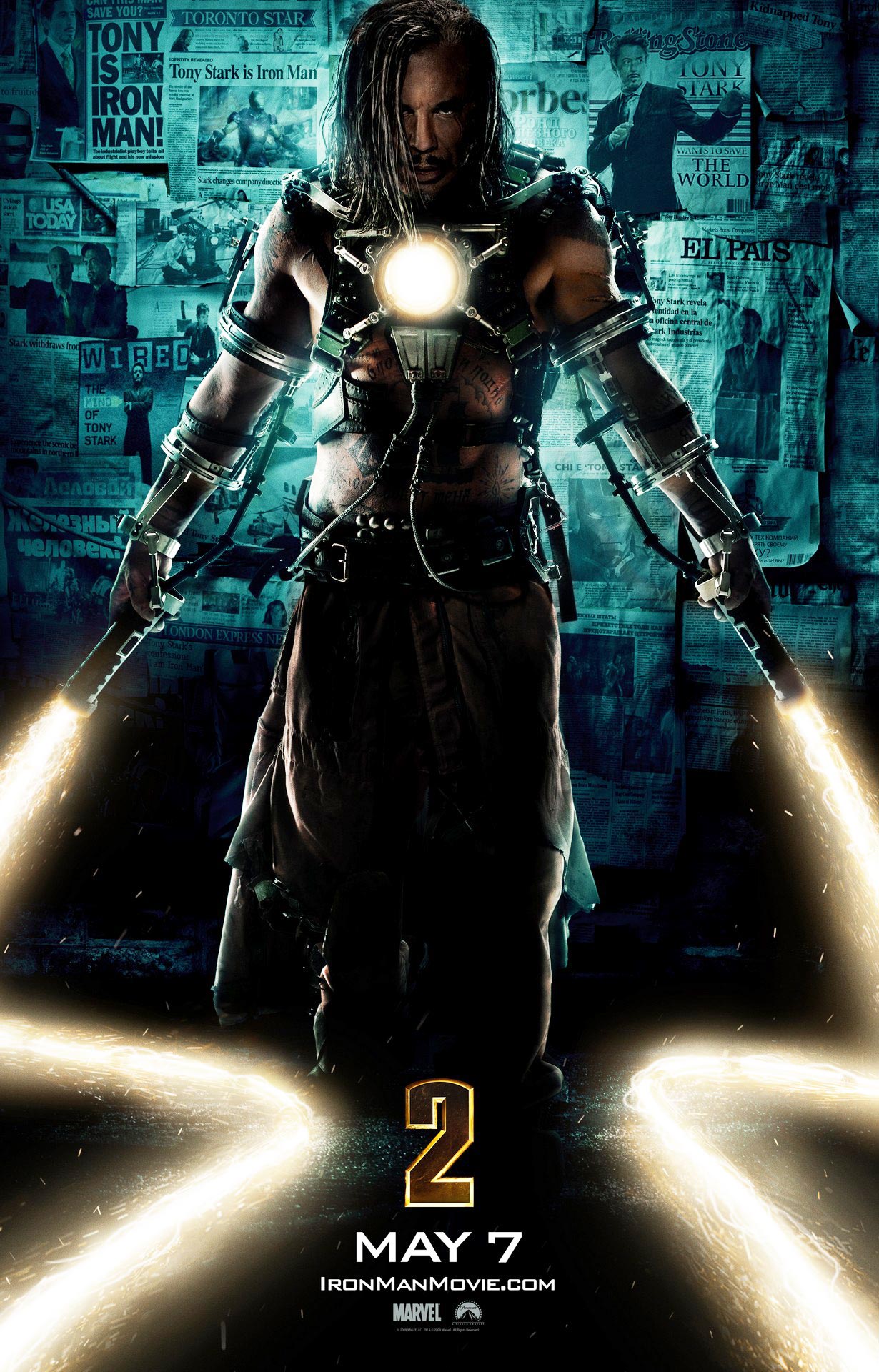
It would be an overstatement to say that the first “Iron Man” was a revelation, but for the purposes of this review let's just go with it. The film had style, energy, surprising substance and, at its center, a star-making performance by Robert Downey Jr. It is a tough act to follow and while “Iron Man 2” doesn't quite match it, it is still a vastly entertaining film.

There's a lot going on in this sequel. Tony Stark (Downey), the billionaire playboy turned hero, revealed that he was Iron Man at the end of the first film and in the six months that have passed since he has more or less brought about world peace. All is not right for Stark, though.

The film opens with Mickey Rourke's Ivan Vanko working on creating his own suit. Vanko believes that Stark stole his father's work and he is out for revenge, that great motivating factor for so many villains. In the comic book the character's alias was Whiplash, but he is never addressed as such in the film.

In addition, the government, led by a smarmy senator played by Garry Shandling, wants Stark's suit, and Justin Hammer (Sam Rockwell), a competitor in the weapons industry, is desperately trying to make his own Iron Man suit. Hammer is so desperate in fact he enlists Vanko after watching him bang up Iron Man pretty badly in a fantastic action set piece set at the Monaco Grand Prix.

Oh, but there's more. The device that is keeping Stark alive is also slowly killing him. Stark has promoted his former assistant Pepper Potts (Gwyneth Paltrow) to CEO and his new assistant (Scarlett Johansson) has her own agenda. Best bud Lt. Col. James Rhodes (Don Cheadle) may be turning against his friend.

Samuel L. Jackson pops in for a couple scenes. These scenes are worked into the plot in a way that helps point Stark in the direction of a cure to his ailing health, but are really only here to help set up an Avengers movie, which will unite several Marvel comic book heroes in one film. Screenwriter Justin Theroux deserves credit though for finding a way to work what could've been perfunctory scenes into the film in a way that drives the movie forward.

The density of the plot probably seems overwhelming on the page, but it all makes sense on the screen and, as with the first film, that's largely due to the strong central performance by Downey. In the first film Downey struggled with Stark's growing pains of a sprouting conscience, here he struggles with mortality. It is just enough substance to give the film a little weight and Downey plays it for real.

This isn't to say the Downey isn't also very funny. Theroux's script is full of many great one-liners, and I'm sure Downey came up with a few of us own. Downey can delivery a fast paced, sarcastic quip like no one else. His idiosyncratic edge gives life to the whole movie.

Rourke, who has that same sort of quirky intensity, is fantastic as the villain because he underplays so well. Comic book villains are often played broad and cartoonish, but Rourke keeps the character brooding and quiet. He doesn't have much dialogue, but he says more with a slightly arched eyebrow than he ever could with a lengthy monologue.

Rockwell has been playing variations on his persona here since his big break as the baddie in 2000's “Charlie's Angels” and he does snarky villainy better than just about anyone. Rourke and Rockwell have an excellent dynamic together. Rockwell thinks he's the guy in control, but Rourke knows better.

Paltrow gets to once again banter feistily with Downey, although it gets somewhat lost in the mix this time. Johansson and Cheadle get to join in the action in the finale where director Jon Faverau, who has a fun supporting role as Stark's driver, delivers the sort of spectacle you expect in a big summer movie.

But for a blockbuster film, “Iron Man 2” is actually light on the big action set pieces and instead focuses on character interaction and that's a good thing. Downey is given plenty of new people interact with and watching him mix it up with a group of actors this good is a whole lot of fun.

Friday, May 07, 2010

Comic book movies without superheroes?

In honor of the release of “Iron Man 2,” let's take a deeper look at movies based on comics. Comic books typically bring to mind images of heroic feats by the likes of Superman, Batman, Spiderman, the X-Men, the Fantastic Four and a seemingly never-ending list of superheros, but not all comics deal in super-powered heroics.

In the last three decades or so, the comic book, or graphic novel, has become, at least in some hands, a much more serious and respected medium with the potential to cover diverse and varied subject matters. With that in mind, here are five films that you'd probably never guess have their origins as a comic book.

“American Splendor” (2003)
OK, so given the subject matter is a comic book artist, it shouldn't come as surprise that this film had its origins as a comic book, but the film's protagonist, Harvey Pekar, didn't pen books of high-flying heroics, but rather about his own bitter, cynical, sarcastic view of the world. The film starring, Paul Giamatti as Pekar, is a completely original and unexpected blending of animation, bio-pic and documentary.

“From Hell” (2001)
Jack the Ripper is perhaps an unlikely subject for a graphic novel — but then, famed writer Alan Moore isn't your run-of-the-mill comic book writer. Moore, who also wrote “Watchmen,” “V for Vendetta” and “The League of Extraordinary Gentlemen,” has been notoriously displeased with the handling of his titles by Hollywood. Despite his protests, The Hughes Brothers' “From Hell” is a violent but compelling entertainment powered by a charismatic performance by Johnny Depp and fine support by Robbie Coltrane as the duo on the trail of the ripper.

“Ghost World” (2001)
Despite the implications of the title, this is not about a world full of ghoulish apparitions, but rather the tale of two snarky recent high school graduates (Thora Birch and Scarlett Johansson) who play a mean spirited prank on a nerdy record collector (Steve Buscemi). Unexpectedly, an awkward, but oddly sweet romance develops. Based on the series by Daniel Clowes, this is an idiosyncratic look at adolescence that captures all the bittersweetness of those early formative years.

“A History of Violence” (2005)
Based on a graphic novel by John Wagner and Vince Locke, the film starts out like a Norman Rockwell painting come to life. In a small town diner, Viggio Mortenson seems like just another average guy behind the counter, but when a robbery turns violent he reveals shocking skills from a hidden past, a past that comes to town in the form of a scarred Ed Harris. Director David Cronenberg and screenwriter Josh Olson take the material into dark, psychological territory that attempts to address whether humans are violent by nature.

“Road to Perdition” (2002)
From a graphic novel by Max Allan Collins and Richard Piers Rayner, “Road to Perdition” is a depression-era story of a gangster on the run with his teenage son. The film is noteworthy as the first time Tom Hanks sort of played a bad guy and also features a brilliant performance by Paul Newman and a slimy, creepy one from Jude Law. Beautiful directed by Sam Mendes (“American Beauty”), the film explores the gray area of what is right and wrong and reminds that sometimes it isn't clear who the heroes and the villains really are.

Tuesday, May 04, 2010

Ben Hammond returns to Stone Mountain May 6

Musician Ben Hammond, a 2001 graduate of Fryeburg Academy, realizes as a performer it is important to give the audience what they want, and that's exactly what he intends to do with his second appearance at the Stone Mountain Arts Center in Brownfield, Maine Thursday, March 6, at 8 p.m.|

“A common response from those who see my live show and then buy the CD is 'Hey, I love the record, but it isn't the same as what I saw you do live, I miss the vocal trumpet and looped vocal percussion and solo singer-songwriter vibe,'” Hammond said.
“Basically they missed my solo imitative versions of what I had real instruments do in the studio.”

Hammond intends to change all that with his Stone Mountain performance Thursday, which will be filmed and recorded for a live DVD and CD package.

“I have been eagerly awaiting a return to Stone Mountain Arts Center since our sell-out CD Release show in 2008,” Hammond said. “And realized I could get the best of both worlds: a high-energy live solo acoustic show and a recording of that show which showcases the one-man band element of what I do for my solo gigs.”

The man behind the camera will be Michael Dana, the film and photo instructor at Fryeburg Academy, who has worked on such high-profile films as “Once Upon a Time in America” and “Requiem for a Dream.”

“The idea to film and release the video on DVD was almost a no-brainer in this YouTube-driven world,” Hammond said. “That site is definitely the first place most people now look to check out new bands and it'll be helpful to have some high-quality, well produced video to help make my first impression.”

The show will consist of new original material, acoustic versions of songs from his first album, "[Reasonably] Honest," and songs he has gathered during the past few years of world travels, including tunes from Canada and New Zealand.

“The original material will explore some new areas, both in mood and in genre, while maintaining the overall acoustic soul-pop vibe that I tend to gravitate towards,” Hammond said. “Stylistically I have certainly been influenced by my extended stays in Florida and New Zealand. There are tinges of reggae and swampgrass poking their respective musical heads up throughout, quite often simultaneously.”

Hammond is also planning a tour of the United States that will include stops throughout the Midwest, Mid-Atlantic and New England. He is also putting plans together for his second studio album.

“As a composer and producer I can't wait for the next kid-in-the-candy-shop experience of sitting in a high-end studio with a roomful of talented musicians and instruments,” Hammond said.

That isn't to downplay his excitement about his upcoming live album. He is just as eager to show the solo performer aspect of his personality and to have that documented.

“Ever since that first cave-man wooed his special cave-lady with a stick and a bit of taut rope, the singer-songwriter vibe has been popular and I can't wait to present my 21st century version of this ancient art-form.”

Tickets for the show are $15 plus $1 handling fee. For more information visit www.stonemountainartscenter.com.

Friday, April 30, 2010

'North Face' is gripping

“North Face” is an extraordinary recreation of a 1936 attempt to climb the North Face of Eiger, a peak in the Alps that is so steep and dangerous that it is nicknamed the death wall.

For those with an aversion to foreign language films, yes, this is a German film and is subtitled, but the film is worth the effort. The hiking footage in the film is amazingly authentic and is an absolute must-see for hiking enthusiasts.

The film centers on Toni Kurz (Benno Fürmann) and Andi Hinterstoisser (Florian Lukas), hiking partners who are prodded along by Luise (Johanna Wokalek), a childhood friend, turned struggling photojournalist, to attempt the deadly hike. The first team to make the ascent is promised fame and the title of Olympic hero.

Toni, the more practical of the pair wants nothing to do with the death wall, but Andi is hungry for the notoriety. Out of loyalty to his friend and to keep him safe, Toni agrees to the ascension.

A competing Austrian hiking team (Georg Friedrich and Simon Schwarz) follows Toni and Andy's newly created route. When things become increasingly perilous the two teams join forces. It is the Austrian team that the screenplay by Christoph Silber and director Philipp Stölzl blames for events turning tragic.

Down below Luise he is staying in a posh hotel with a reporter (Ulrich Tukur) who has taken the young photographer under his wing. The presence of this older man is upsetting to Toni, who loves Luise. This material is delicately played. The reporter keeps the relationship largely professional and it is relief that the film doesn't attempt to force a love triangle subplot. Instead, Luise's struggle is where her loyalty lies: with her friends or her job.

The film doesn't ignore the presence of the Nazi party, which want to use the conquering of Eiger as a metaphor for their strength and to turn Toni and Andi into heroes. It is good that film addresses this, but once on the mountain that's where the film's focus stays.

Director Stölzl uses an impressive mix of real footage with special effects. The illusion is completely seamless. It is very clear they are on that mountain in several scenes, but upon research I discovered other scenes were done in a studio setting. Spotting which scenes are on location and which aren't is just about impossible.

The hiking scenes, especially as the elements begin to turn on our heroes, are taut, suspenseful and gripping. The footage of Eiger is beautiful to behold, but also ominous. Eiger means ogre and the mountain, often filmed surrounded by foreboding clouds, does indeed look monstrous.

As with all films that claim to be based on a true story, some liberties are taken with the facts and, as one character notes, it is impossible to know entirely what happened up there. But, based upon what information is available, the film seems to be mostly accurate.

The acting throughout is strong, with Fürmann as Toni making the strongest impression. He has moments of tenderness with Wokalek, who doesn't play a typical passive love interest. Fürmann and Lukas portray a clear sense of friendship between Toni and Andi. We care about all the players when things start to go south.

“North Face” is not a feel good film, but it is an enthralling one. This is the kind of film you watch and wonder: how did they do that?

Thursday, April 29, 2010

More than just a mime

Silent actor Rajmund Klechot comes to Your Theatre


For a silent actor, Rajmund Klechot sure has a lot to say.
The 70-year-old polish born performer with a thick accent will eagerly discusses his craft with great passion and enthusiasm. Even while just sitting and talking he is performing, often acting out the words as he is saying them. But sometimes his seat is too confining.

“After one and a half hour being on the stage I am exhausted,” Klechot said leaping from his stool. “I cannot even speak because I am in my vision. I have to have a break then I can come back and speak logically with someone. Because when I perform you are sitting here, I am looking through you, not looking at you.”

M&D Production is bringing Klechot to their Your Theatre stage in North Conway, N.H. to perform his “Journey of Life” May 1, 2, 8 and 9. The performance is a silent one-man show in four vignettes. Whatever expectations that description may create, the actual experience is likely to be quite unexpected, according to Klechot's manager Ben Mayerson.

“Every age, you just scan the audience, whether you're talking 80 years old or 4 years old, they are all sitting there with their mouths hanging open,” said Mayerson, who came out of retirement to manage Klechot. “The comments afterward are, 'I didn't see that coming. I had no idea that that's what this is about. This is not mime.' And of course immediately he's, it is not mime, it is silent acting. Don't you dare call this mime because it is such a different art form.”

So, then what is the difference between mime and silent acting? To understand the distinction, Klechot first goes to the word that mime is shortened from: pantomime.
“Generally, they [people] think pantomime is silent acting, it is not,” Klechot said. “It is a combination of two different words: pan and mimus. Pan is everything and mimus is to imitate, so in other words I imitate everything.”

Klechot furthers the distinction by noting that pantomime, unlike mime, is not necessarily silent.

“Mime is even more narrow,” Klechot said. “Mime is more clownish. I'll say their vocabulary is very limited. Pantomime, you can speak, you can make gesture, you can use symbolic things, metaphoric things, you can even use music and Et cetera.”

Kletchot has a similar skill set to that of a mime, but his performance goes deeper and has more substance. In discussing his craft, he often uses the late mime Marcel Marceau, his good friend of 40 years, as a point of reference and to further clarify the difference between mime and silent acting.

“Marcel Marceau is a completely different technique, a completely different philosophy, completely different acting,” Kletchot said. “He is more in clouds. I am more in Earth inserting my roots here. When I imitate things it is almost like naturalistic things, but of course it is not. But it is more appealing I would say and more understood.”

Kletchot is also quick to note that his performances are not just one persona, but a series of different characters.

“Marcel Marceau is Bip [the Clown], the same as Charlie Chaplin was The Tramp in different situations,” Kletchot said. “I create different personalities. Every time I come on stage it is a different person, a different characterization, different philosophy of life, different acting, even the movement doesn't repeat, if repeated [it is] in a different form.”

Kletchot learned his craft at a conservatory in Poland. After 10 hard years of work he earned his diploma in silent acting and joined the award-winning Theatre Pantomima. After working with this large group for 15 years he co-founded the five-person ensemble Warsaw Mime Theatre. With the change in size of the company, so changed the size of the stage.

“You have big stages, big theaters as well as chamber stages and chamber theaters and some how silent acting appeals more with limited audiences instead of huge audiences
because you can't amplify your voice,” Kletchot said.

Once again to emphasize his point he uses Marcel Marceau.

“I saw him [Marcel Marceau], on a huge stage,” Kletchot said. “It was probably 3,500 seats and the stage was big. Instead of putting the light on him, limited and simple and the rest black, they completely put light on the whole stage. He was tiny. He lost so many expressions. Therefore you need to be very careful where you are performing, but of course this is money.”

While touring with Warsaw Mime Theater in the United States in the 1970s he met his future wife. This would bring him to America where in addition to performance and direction he began teaching at several universities including the Yale School of Drama.

Perhaps his most successful achievement as a teacher was at Sinclair Community College where he put together a show with his students that made it all the way to the Kennedy Center in Washington, D.C.

“He brought them up to the level of being professional and yet none of them had background or training in theater,” Mayerson said. “These were teenagers who came to a community college and yet he was able to mold this production into the highest level of polished performance in a matter of months.”

Although Mayerson never got to see this performance live, he did see a tape of the show.

“I'll never forget we were sitting in his den or something and he turned off the VCR and said, 'Well what do you think?' and I said 'Ah crap, you are really good' and he said, 'Of course I am.'”

Following his wife's death, Kletchot took a break from performance because he could no longer “put everything together,” but you cannot keep a good artist down for too long. Soon the stage was calling to him again.

“Life has limitations and I still have a lot of things to do and to express a lot of things, to create a lot of things,” Kletchot said. “And this is the thing, maybe 10 or 15 years from now I can teach, I can talk, I can write a book.”

But that time has not yet come. As long as he is physically able, Kletchot will continue to perform because it is his primary means of expression and there are still things to be said. Even when a single word is never spoken.

Friday, April 23, 2010

Fey and Carell are an enjoyable 'date'

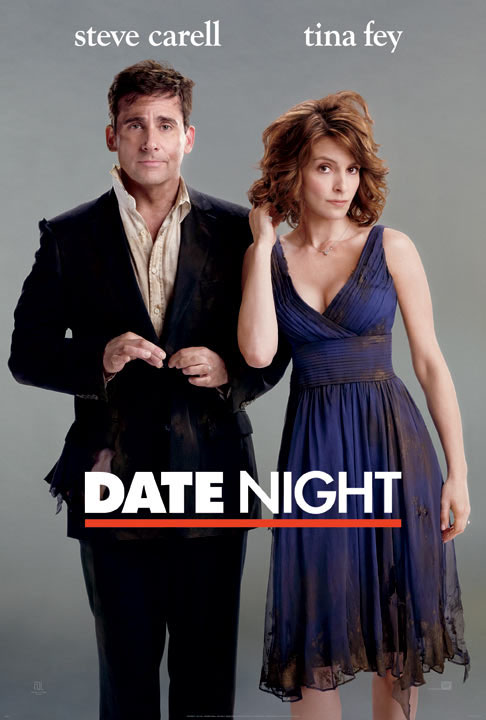
Between “The Office” and “30 Rock,” Steve Carell and Tina Fey have perhaps the funniest and smartest hour of comedy on TV. When you can get these two in the comfort of your own home, is it worth going to a movie theater to see their new film “Date Night?” While you could probably wait for DVD, this is a worthy night out. Unless there is an “Office” and “30 Rock” crossover episode, this may be only time to see these comedy titans together.
"Date Night” is an action comedy about the Fosters, a married couple whose life is stagnating in suburbia. In an attempt to add some excitement into their lives they go on a date in New York City, but get more than they bargained for when they steal a reservation at a expensive restaurant. Before you can say “Check please” they are being chased by crooked cops (Jimmi Simpson and Common), a mobster (Ray Liotta) and a corrupt district attorney (William Fichtner).

This is familiar territory. The plot, which revolves around the Fosters trying to find a stolen flash drive, is negligible. All the parts fit together and make sense, but ultimately the why behind everything that is happening doesn't really matter. It is merely an excuse to have Carell and Fey banter and wisecrack through car chases and gun fights.

Car chases, especially in action comedies, have become routine and rarely thrill simply because it has all been done before. Deja vu is deadly for a film. So, “Date Night” deserves immense credit for coming up with a gimmick for its big chase center piece that is unique and funny. You haven't quite seen anything like it.

The stars, though, are what make this film work. Their comic timing and line delivery is impeccable. A gag reel at the end of the film shows that much of their dialogue was improvised. They are so good at this sort of fast-paced repartee that even when they are riffing it feels natural and unforced.

Carell and Fey are given several people to play off of. Mark Walhberg is very funny as a perpetually shirtless high-tech security agent that takes pity on the Fosters. Likewise, James Franco and Mila Kunis get big laughs as the trashy second-rate criminals whose reservation the Fosters stole.

Kunis is a fine comic actress who has a tendency of popping up in action movies like “Book of Eli” that don't utilize her talents. Her one five-minute scene with Franco is a highlight of the film. The four actors bounce off each other with such ease. You want more screen time with them, but maybe director Shawn Levy has it right to not have too much of a good thing.

Surprisingly enough, the film does actually have some dramatic tension and tender moments. These moments aren't sustained for long, but they don't need to be in an action comedy like this. The opening scenes do a nice job of establishing how Carell and Fey's marriage has fallen into a grind, but at the same time we are given glimpses of their chemistry. This is key to giving their adventure some weight.

Naturally, by the end of the night they find that missing spark and learn to trust each other. Beyond being funny, Carell and Fey actually make the relationship credible and make the audience care.

It is safe to say that without its stars this film would be just an average genre film. Carell and Fey make a great team, and, thanks to the supporting work of Wahlberg, Franco and Kunis, make “Date Night” a quite enjoyable date movie.

Friday, April 16, 2010

Head back to the 1980s with John Cusack

John Cusack is currently starring in “Hot Tub Time Machine,” which, as you may have guessed, is a political thriller that takes the Bush administration to task. No wait, that was “Green Zone.” “Hot Tub Time Machine” sends three 40-something guys back to their youthful heydays.

I saw the film last weekend and it is a lot of fun, but, as of today, it is no longer playing in the Mount Washington Valley. Instead of gushing about a film you can no longer see, let me direct you to some of Cusack's back catalog.

“Hot Tub Time Machine,” which was produced by Cusack's production company and directed by his friend and frequent collaborator Steve Pink, is basically a throwback to the teen romantic comedies that helped make Cusack a star in the 1980s.

The early 1980s began with a few small roles for Cusack, most memorably in “Sixteen Candles,” before he graduated to lead roles. By 1986, the year that “Hot Tub Time Machine” sends him back to, Cusack starred in three teen comedies, co-starred in the Disney adventure film “The Journey of Natty Gann” and had a cameo as the dead brother in “Stand By Me.”

His first starring role was in 1985's “The Sure Thing,” a title that makes it seem like just another of the many “Porky's” knock-offs that were prevalent in the early 1980s. The film, director Rob Reiner's follow up to his smashing directorial debut, “This is Spinal Tap,” is better than its title.

While the film has the requisite T and A, it isn't about them. It is essentially a reworking of 1934's “It Happened One Night,” generally regarded as the template for all romantic comedies to follow. Two college students (Cusack and Daphne Zuniga) who hate each other reluctantly hit the road together for California. He has been promised a sure thing. She has a fiance waiting for her. Naturally, their hatred melts away to love. It is low-key, sweet and a good early showcase of Cusack easygoing charm.

Later in 1985, Cusack starred in “Better Off Dead,” the first of two collaborations with writer/director Savage Steve Holland. Cusack's Lane Meyers goes suicidal after he's dumped by his girlfriend in perhaps the goofiest, most surreal of all the 1980s teen comedies. There's even a sequence with claymation hamburgers rocking out to Van Halen's “Everybody Wants Some.”

“Better Off Dead,” like “The Sure Thing,” isn't original in its plotting. It is the weirdness that permeates throughout the film that makes it special. The same quirky sensibility couldn't quite be replicated when Cusack and Holland worked together again for 1986's “One Crazy Summer.”

This time Cusack played an aspiring cartoonist who is trying to find love in Nantucket. The best thing about “One Crazy Summer” is that there are several animated sequences that are very funny. In a few scenes, much to Cusack's frustration, his cartoons begin talking back to him and they aren't particularly kind. The film is also noteworthy for being one of Demi Moore's first big roles.

By the end of the decade, Cusack was the go-to guy for this kind of teen/20-something romance. He would finish out the 1980s with the best of the bunch, “Say Anything,” a film about a nice, but average guy who against the odds wins the heart of the valedictorian. It is an honest, smart and funny look at love.

All of these films helped established what would become Cusack's career persona. He's almost always a good guy looking for love. He usually has a cynical, smart-alecky edge that only barely masks his sincerity.

Cusack isn't a chameleon-like actor who is different in every movie. Many people assume that those are the only truly great actors, but that isn't necessarily true. Cusack hits similar notes in all his films, but watching him find new riffs and variations is the appeal. Cusack is an actor in the same mold as a Cary Grant or Jimmy Stewart in that he has a certain act that he repeats time and time again, but that's why you go to his films.

So, I say hop into your own time machine and have yourself a Cusack marathon. It'll make the world a better place.

Friday, April 09, 2010

A rather mild 'clash'

“Clash of the Titans,” at this point a somewhat obscure fantasy adventure from 1981, is the latest film to get the remake treatment. The excuse for the existence of this version seems to be that now the film can be bigger, louder and have flashier special effects. As far as these things go, it is passable entertainment.
Like the original “Clash of the Titans,” this plays loose with Greek mythology with man declaring war against the Gods and recruiting the demigod Perseus (Sam Worthington) to aid in their battle. A bitter Zeus (Liam Neeson) prodded by his brother Hades (Ralph Fiennes) threatens to release the terrible beast the kraken unless a human princess is sacrificed. Perseus has a week to discover a way to beat the kraken and save the girl.

While the first “Clash of the Titans” was hardly a masterpiece it had a degree of charm and the stop-motion animation from effects master Ray Harryhausen contained a certain magic. The computer-generated effects in the new version create very little awe or wonder. This stands out particularly in the Medusa sequence, in which the creature seems more fake and cartoonish than the completely animated version from nearly 20 years earlier.

Other times though the effects are quite good. A battle with a group of giant Scorpions does generate some excitement and in this case the visuals seem complete. The kraken's appearance at the end of film is also impressive.

The original also had a better sense of the Gods interacting, but in the new version the only Gods that appear to matter are Zeus and Hades. Neeson and Fiennes could play these roles in their sleep and you get the distinct impression that their work is simply for the paycheck. Fiennes essentially plays Hades exactly the same way he plays Voldemort from the “Harry Potter” series. Even not on their A-game, Neeson and Fiennes bring a bit of credibility to a pretty silly enterprise.

Worthington, who this time last year was a no-name, became a star last year based on his work in “Terminator Salvation” and “Avatar.” He seems to be the go to guy for sci-fi or fantasy adventure right now. His performance goes a long way toward keeping the audience's interest. He has an earnestness that transcends the material.

Other actors help to keep things interesting as well. Mads Mikkelsen (the villain in “Casino Royale”) brings an interesting intensity as one of Perseus' fellow adventurers. Gemma Arterton as the immortal Lo makes for a nice love interest for Perseus. Arterton and Worthington have a training sequence that is fun and sexy.

Overall, it is mildly entertaining. It offers a few chuckles and some decent thrills, but it doesn't capture that elusive “it” factor that makes it something special and memorable. You definitely won't be shouting its praises from Mount Olympus.

Thursday, April 08, 2010

M&D’s new show is un’doubt’edly good

M&D Productions takes on John Patrick Shanley's Pulitzer Prize-winning play “Doubt: A Parable” in their latest production, which opens tonight at Your Theatre at Willow Common in North Conway, N.H.

Although the script never directly mentions the words pedophile or sexual abuse, “Doubt” addresses those issues in regards to a priest working at Catholic school in New York City in the 1960s. It would be easy to dismiss the subject matter as obvious given the headlines that have been plaguing newspapers in recent years, but Shanley's treatment of the material is not salacious or exploitive.

The play sets up a battle of wills between Sister Aloysius (Julianna Brosnan) and
Father Flynn (Bill Knolla). Flynn has a protective relationship with Donald, the first and only black student at the school. When Sister James (Natasha Repass) sees something that could be construed as suspicious behavior it sets Sister Aloysius on a mission to remove Father Flynn. Although she has no evidence, she is absolutely certain of his guilt.

Father Flynn's guilt or innocence is part of a larger ideological struggle. Sister Aloysius is a firm believer in strict authority and emotional distance from the students and the parish. Father Flynn believes in compassion and love and that the church should he seen as part of people's families. There is an implication that this difference in opinion is Sister Aloysius' true motivation.

Thanks to the 2008 film adaptation starring Meryl Streep, Philip Seymour Hoffman, Amy Adams and Viola Davis, “Doubt” should be familiar to a lot of people in the audience, but while the film is an excellent and well-acted point of reference, it isn't so iconic as to be distracting. The cast of M&D's production, under the direction of Ken
Martin, more than hold their own against the formidable cast of the film.

What struck me more in M&D's production than in the film is how Sister James is torn apart by being caught in the middle of a struggle between Sister Aloysius' coldness and Father Flynn's warmth. This secondary philosophical battle is in a way just as important as the primary conflict.

Sister James is innocent and sweet with a passion for teaching. Sister Aloysius wants to crush all those aspects of Sister James’ personality and shape the young nun to be more like her. It leaves Sister James disturbed and literally restless. Repass plays the role on a perpetual verge of tears and her angst and internal conflict is palpable. You just want to give her a hug and tell her everything is going to be OK.

Brosnan as Sister Aloysius perfectly captures the steely rigidness of the character and doesn't make her a particularly likable or sympathetic character. Shanley's script lives in a gray area, there is no villain. It may seem as if Sister Aloysius is a bullying antagonist, but if she's right doesn't the villain become Father Flynn? The doubt that shrouds the whole show makes everything less cut and dry and more realistic.

We want to believe Father Flynn because of his compassion and genuineness. As portrayed by Knolla he is amicable and the kind of priest who could be your friend. Knolla is believable and effective when giving his sermons. The scenes of conflict between Knolla and Brosnan are exceptionally acted.

The only other cast member is Pa'Mela Ramsay as the mother of the boy in question. She only has one scene, but it is profoundly powerful. Sister Aloysius attempts to manipulate the mother for her own cause, but is surprised by the reaction she receives.

This is a potent and compelling show that raises issues and explores them in a way that doesn't offer clear answers. It is the kind of theater that creates lively discussion after the show, which is always a good sign.

For more information visit www.yourtheatre.com For reservations call 662-7591.

Friday, April 02, 2010

Rebmann does 'Patsy'

CONWAY/FRYEBURG — Arts In Motion is presenting “Always…Patsy Cline” as this year's annual scholarship fund-raiser for students at Kennett High School and Fryeburg Academy.

The show, a unique musical that is more of a concert with scenes scattered throughout than a traditional musical, is being performed at Loynd Auditorium at Kennett High School on April 9-10 and at the Leura Hill Eastman Performing Arts Center at Fryeburg Academy on Friday, April 16, at 7:30 p.m.

“Playing music in a musical is different than in a regular club band but this show has a good mix of both,” Mary Bastoni-Rebmann, the show's director and star, said. “The musicians have done a great job of easing into this process and bringing a genuine live club band sound to the show.”

Bastoni-Rebmann as Patsy Cline and is backed by a six-piece band of some of the valley's most familiar and best musicians including Chuck O’Connor on pedal steel guitar, John Whitney on keyboard, Seth Austin on fiddle, Tom Rebmann on electric guitar, Moe Baillergeon on bass and Jill Ohlson on drums.

“Mary has assembled an outstanding group of musicians for this project who are as familial and collegial as they are talented,” O'Connor said. “Mary is an outstanding vocalist and has provided the kind of leadership and direction that allows for this diverse group of artists to coalesce as if having worked together for years.”

Cline's story is told from the perspective of her friend and manager Louise played by Carrie Engfer. The plotting is relatively loose and is a showcase for the music, which brings together 30 songs including “Sweet Dreams,” Walkin’After Midnight,” “I Fall To Pieces” and “Crazy.”

“We're trying to project that this is more about the music than it is about Patsy's life,” Ohlson said. “Patsy's life kind of makes the music come about. The emphasis is mostly on the music.”
Even with the focus on the music, unlike a lot of shows that attempt to string together hits from one particular artist, the dramatic material actually works and has humor and substance.

“A little bit of it tries to key in on her personal life and what it was like to be her and her relationship to Louise,” Whitney said.
The band has been listening to original Cline recordings as well as the cast recording of “Always... Patsy Cline.” Band members are attempting to get as close as possible to the way the songs were originally performed.

“The production is pretty close to how Patsy was singing the material,” Whitney said. “Some of the instrumentation has changed. In some instances someone is playing a lap steel guitar and we're playing a pedal steel guitar, so it sounds a little bit different, but the intent is still the same.”

Bastoni-Rebmann has been working hard on capturing the essence of Cline's distinct vocal style.

“As a vocalist and voice teacher I understand the vocal mechanics of many styles of singing,” Bastoni-Rebmann said. “I have studied Patsy’s vocal style closely and have learned to incorporate her country nuances. Her pure and rich alto sound mixed with vocal power is what made her voice a country legend.”

Tickets are $10 and can be purchased online at www.artsinmotiontheater.com or at the door.

Friday, March 26, 2010

Catch some 'disco' fever with Arts in Motion

Kennett Drama and Arts in Motion travel back in time for “Disco Inferno,” a bright, light and altogether goofy stringing together of hits from the 1970s.

Like “Mamma Mia” and “We Will Rock You,” “Disco Inferno,” which continues at the Loynd Auditorium at Kennett High School in North Conway March 26 and 27 at 7 p.m., is a show that brings together a collection of unrelated songs. The plot is secondary to the music.

Set in 1976, the shows chronicles the rise and fall of Jack (Rafe Matregrano), a would-be singer who works at a disco. He makes a pact with Lady Marmalade (Hanna Paven), an associate of the devil, and soon becomes famous and rich, but, naturally, at the cost of his personal life.

Quick side note about the script. Writer Justin Sepple includes songs that were written after 1976, which in nearly all cases could've been fixed by setting the show in 1978. I know it is silly to expect historical accuracies in a show called “Disco Inferno,” but the laziness of Sepple still irks me. A joke about Ringo Starr with a reference to something from the 1980s was particularly irksome.

Clearly, not every audience member is going to notice or care about such details. I'm a geek and these sort of things bother me, but not enough to ruin the enjoyability of director Glenn Noble's production, which while overlong is a lot of fun.

"Disco Inferno" is essentially 1970s karaoke, but, for the most part, it is good karaoke. This isn't embarrassing, laughable drunken karaoke, but rather the kind where you pull the person aside afterward and say: "Wow, that was really great. Have you ever thought about going on 'American Idol?'"

And Simon would've been proud of Shannon Reville who absolutely nails "I Will Survive." Reville, who also did the show's choreography, plays Jack's girlfriend. Matregrano and Reville have a sweet chemistry together that shines on songs like “Don't Give Up on Me Baby.”

Paven is another stand out belting out a sultry version of “Hot Stuff” and later joining Hayley Szekely for a lively rendition of “Pop Muzick.”

Jamie McDonough gives an entertaining performance as Kathy, a girl with a tough shell, but a soft inside. She only has one song, “Streetlife,” but she makes it memorable.

Kevin Ahearn as Jack's awkward best friend provides solid comic relief, particularly in a scene that flashes back to the day The Beatles broke up. Ahearn's attempts to woo the girl that will later become his girlfriend (Shelby Noble) fail miserably as he keeps accidentally referencing Beatles songs.

At the center, holding the show together, is Matregrano, a charismatic performer with vocal abilities that match or even surpass his acting abilities. “Instant Replay” is particularly memorable as is “Disco Inferno,” “Play That Funky Music White Boy” and “Starman,” in which Matregrano accompanies himself on acoustic guitar.

This is undemanding, light entertainment that doesn't pretend to be anything more. It also proves to be an impressive showcase for young local talent.

For more information or to purchase tickets visit www.artsinmotiontheater.com.

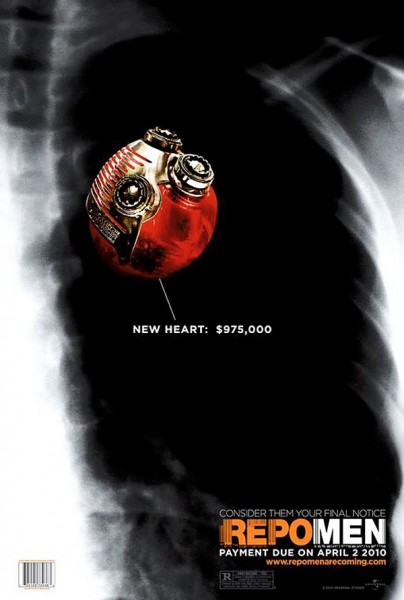
'Repo Men' wastes promising premise

With the passing of the health care reform bill, the futuristic thriller “Repo Men” is a film that has become a film of the moment. In its own gory, action-filled way, the film makes a very valid case for health care reform.

Set in a future where health care for profit has run wild, “Repo Men” starts out as a sharply observed satire, and, like the best satire, it takes a seemingly innocent idea and plays it out to its logical extreme. If a repo man can repossess your home or your car for being overdue on payments, couldn't he also repossess prosthetic organs too? That's premise at the core of “Repo Men.”

Jude Law stars as Remy, who along with his long-time pal Jake (Forest Whitaker), works for a company that sells expensive artificial organs to costumers who can't afford them. If a costumer fails to make a payment after 90 days, Remy, Jake or one of the company's other repo men will break into their home and quite literally rip the organ out of their body.

It is grim, grisly stuff and it is presented with a cold, cynical detachment that is both darkly comic and disturbing. Liev Schreiber as Remy and Jake's boss is a perfectly slimy salesman who helps to sell the film's artificial organs as well as the satire of Eric Garcia and Garrett Lerner's script.

Law has a great scene with RZA of The Wu-Tang Clan as a musician with an artificial heart that Law must repossess. Law is a fan and is asked to help RZA finish what will be his final song. There is a poignancy to the scene as RZA accepts his death as if Law is the Grim Reaper.

Things go awry with the repossession and results in Law getting his own expensive artificial heart. Not only has he lost his heart, but the stomach for his work. When he gets behind on his payments he decides to take down the whole system.
This is a turning point for the film. Everything that follows is in step with a more formulaic sci-fi action film. The film still entertains, but it feels less fresh and more familiar. The arc of Law's character is a sci-fi standard, which was most recently seen in “Minority Report.”

Using a well-worn plot is not the death of a film. It isn't the destination, but how you get there that counts. Luckily, there are just enough quirky pit stops to keep this journey interesting. One such offbeat touch involves a 9 year old performing knee surgery. It is such a gloriously unexpected moment that you wish there were more like it instead of tired scenes involving Law's wife (Carice van Houten) and his new lover (Alice Braga).

Miguel Sapochnik's direction is competent and he handles the “Matrix”-style action scenes late in the film well. There is a nice mood, but too often the film feels like a car commercial for Volkswagen.

When things go slack, you still have Law and Whitaker, both top actors, making the material work even when it is losing some strength. Their camaraderie feels authentic and you sense they are genuinely friends. When Law goes rogue, the conflict that strains their friendships adds some real dramatic tension.

"Repo Men" is a movie that is good enough entertainment. It isn't a bad time, but it is a film that started out with potential it didn't quite live up to. Certainly worth a look if you're a fan of the genre or the leads, but it won't win over non-fans.

Friday, March 19, 2010

'Green Zone' delivers politically-minded action

Movies about the Iraq War haven't exactly been the path to box office gold. “Green Zone” is a big budget Iraq War film and the subject matter still remains a tough sell. Even “The Hurt Locker,” the recent Best Picture winner, only made
$15.7 million during its theatrical run, which in actuality is a modest success considering its small budget and limited release.

With a budget of $100 million, “Green Zone” has only made $16.8 million in its first week. At least the film is on its way to making its money back, but, as with previous films tackling the subject, “Green Zone” is more about making a statement than making a buck. Kudos to Universal for backing it.

This marks the third collaboration between Matt Damon and Paul Greengrass, the director of the last two films in the “Bourne” series. The marketing of the film would lead you to believe this is essentially Jason Bourne in Iraq, but that is really a misnomer. Greengrass' kinetic, visceral, raw style of action is still present, but while it was front and center in the “Bourne” films, it takes a back seat to politics in “Green Zone.”

Oh, there's plenty of action: foot chases, gun fights, explosions, etc., but there also questions raised about the very reasons of the war. Some will be quick to dismiss the film as a heavy-handed liberal propaganda piece, but the film deals with some well documented truths. It is how those truths are presented that may rub some people the wrong way.

Set in 2003, the film focuses on the search for weapons of mass destruction, the reason for the United States' military presence in Iraq. Damon stars as Chief Warrant Officer Roy Miller, who is seemingly the only soldier frustrated by the fact that every site they raid in search of WMDs turns up empty and with zero evidence of weapons ever being there.

Miller begins his own search for the truth to who is providing the dodgy intel and uncovers a web of lies, deceit and cover-up. During his personal mission, he find allies in CIA man Martin Brown (Brendan Gleeson) and journalist Lawrie Dayne (Amy Ryan) and an enemy in Pentagon intelligence officer Clark Poundstone (Greg Kinnear), who will do anything to protect the truth.

The screenplay by Brian Helgeland, based on the book "Imperial Life in the Emerald City: Inside Iraq's Green Zone," simplifies everything by making each character represent a larger group of people in reality.

Damon's Miller stands for anyone who questioned the search WMDs, but it is extremely unlikely one soldier did the things he does. Ryan's journalist represents all journalists who unquestioningly reported what they were given. Kinnear's Poundstone is basically a stand-in for the entire Bush administration. Streamlining this big issue down to a a few players makes it easier to present as a palatable action film.

The film doesn't dumb down, though. There are good and bad guys within the U.S. Army, and good and guys in Iraq. The film strives not to make the idea of hero and villain black and white. Miller is given a tip by an Iraqi named Freddy (Khalid Abdalla) who becomes an important part of the plot.

Freddy's frustration is that he is automatically assumed to be the enemy and constantly must prove his loyalty. He is a man who loves his country and just wants what's best for it. In many ways he is the most interesting character in the film and helps to put a very human face to the story.

The acting throughout is strong. The ever-versatile Damon has mastered this sort of stoic minimalism. He face is hardened into the expressionless mask of a soldier, but it isn't a hollow performance if only because Damon has developed such a powerful command of the screen that makes it easy to almost instantly identify with him.

“Green Zone” works as both an action film and as a film that questions the reasons behind the Iraq War. Could a film have been made that chronicled the shadiness involving WMDs in a more intricate and complex way? Yes, and there are documentaries that have those details, but by squeezing these ideas into an action film, the issues may find a wider audience. It isn't a perfect melding of pop entertainment with loftier ideals, but it is a worthy attempt at something more than just a mindless action film.

Friday, March 12, 2010

Burton in 'Wonderland'

The twisted mind of Tim Burton has taken on the equally warped mind of Lewis Carroll in the latest Disney version of “Alice in Wonderland.” The pairing is a good fit, and this is a visually impressive take on the familiar story.

Burton was an animator for Disney in the early 1980s, but they didn't see eye to eye. After movies like “Beetlejuice” and “Batman” made him a superstar, Disney lured him back by allowing him to make his dream project: “A Nightmare Before Christmas.” After he made the critically-acclaimed, but box office dud “Ed Wood,” Disney moved on again.

So, now Burton and Disney are together again and Disney must be very pleased indeed. The movie made $116 million its opening weekend, which is an unheard-of number for a spring release. Some will claim this was a sell-out move on Burton's part, but I say more power to him for getting Disney to front the $200 million bill for this loopy adaptation of Carroll's beloved books.

Burton and screenwriter Linda Woolverton (“The Lion King”) freely blend elements of “Alice's Adventures in Wonderland” with “Through the Looking Glass and What Alice Found There” with a new framing device and central story.

Alice (Mia Wasikowska) is now nearly 20 and only recalls her last visit to Wonderland (or Underland) as a nightmarish dream.
Her mother wants to marry her off to a wealthy fop who wants to repress Alice's whimsical mind that is full of strange, seemingly mad thoughts. When Alice gets a glimpse of the White Rabbit, it is down the rabbit hole once again.

Underland is now ruled by the tyrannical Red Queen (Helena Bonham Carter) and a prophecy says it is Alice who will slay the queen's dragon-like Jabberwocky and restore the throne to the goofy, but good White Queen (Anne Hathaway). Alice has lost her “muchness,” as the Mad Hatter (Johnny Depp) tells her, and the movie is about her becoming much more mucher.

Burton is well aware of how iconic all these characters are and dispenses with lengthy introductions. It may be confusing for little children or for those who have managed to have zero exposure to the story, but that isn't necessarily a bad thing. Carroll's world is supposed to be slightly off-kilter.

This is very much a straightforward Disney fantasy adventure in terms of its plotting, but it is the vivid art direction and odd flavorings that Burton adds that give the film a personality that is distinctly his own.
Working with Depp for the seventh time, the duo have created a fittingly bizarre characterization of the Mad Hatter. Under

Burton, Depp goes out on huge acting limbs that sometimes don't always work, but his Mad Hatter is a wonderful creation. At times a lisping fool, his madness sometimes materializes into genuine anger towards the Red Queen. There is also a come- and-go Scottish bourque that is quite amusing.

Bonham Carter is appropriately menacing as the Red Queen and adds lots of idiosyncratic touches in her line deliver, but those familiar with her work in the TV movie “Merlin” will recognize that she's doing a riff on the villainy that she portrayed in that film.

Wasikowska is quite effective as Alice and an engaging lead. She has a way of being completely sincere and believable when surrounded by all these special effects. She makes you care about Alice's struggle to be who she really is.

There is also excellent voice work from Stephen Fry as the Cheshire Cat, Alan Rickman as the Caterpillar, Timothy Spall as the dog Bayard and Michael Sheen as the White Rabbit. Matt Lucas (“Little Britain”) is transformed into both Tweedledum and Tweedledee and has some of the movie's best laughs.

This “Alice in Wonderland” isn't a mind-blowing experince, but it is dark, weird and comic in unexpected ways. It is visually stimulating throughout and, thanks to the performances, always engaging.

Thursday, March 11, 2010

Actors 'Bare' all in pop opera

Growing up is never easy. Adding the judging eyes and ears of a Catholic school only makes it worse. “Bare: The Pop Opera,” which opens Thursday, March 11, at Your Theatre in North Conway, N.H. knows this all too well.

Following on the heels of M&D Productions' youth musical productions like “Godspell” and “Footloose,” “Bare” is perhaps the most ambitious show the company has attempted with a largely high-school-age cast. The students in the cast reach the higher bar that director Ken Martin has set for them.

“Bare” revolves around the story of Jason (Billy Cavanaugh) and Peter (Kyle Mulcahy), two gay teenagers struggling with understanding and accepting their feelings. Peter doesn't want to keep it a secret anymore, but Jason fears the repercussions of letting the world know. When Ivy (Courtney Phelps) falls in love with Jason it becomes a chance for so-called normalcy.

Although the show has the ongoing debate of sexuality and the Christian faith at its center, the emotions this struggle creates are universal to the experience of growing up. The show's book by John Hartmere and Damon Intabartolo knowingly remembers and re-creates the teen angst of not knowing one's place and the desire to belong and be understood. The characters in “Bare” battle with being true to themselves even as they try to find out who that self is.

Yes, this is an opera in the sense that nearly every line is sung, but the music is not that of a traditional opera. This is very much based in the traditions of pop music with influences from Motown. The show features 36 songs. This would be a daunting task for trained professionals, let alone young performers who are still learning. Musical director Tracy Gardner worked extensively with the cast and has got them to an impressively high level of performance.

The leads are very strong. Mulcahy so badly wanted to play this role that he has been commuting three hours one-way from Franklin Pierce University to play Peter. His passion and commitment to the role absolutely comes across in every moment he is on stage. He isn't afraid to be open and vulnerable especially on songs like “Role of a Lifetime” and “Ever After.”

Cavanaugh, who, as the program notes, had only ever sung in his bathroom, very nearly matches Mulcahy. He makes Jason's struggle with his identity feel authentic. The perfect straight act that Jason presents begins to crumble and Cavanaugh plays that conflict well.

Phelps, who last year was the female lead in “Footloose,” has taken a massive step forward as a singer and has several powerhouse moments. She is particularly strong on “All Grown Up," where she taps into painful, raw emotions.

Jessica Pappalardo as Jason's sarcastic loner sister gets some of the best lines in a show that is full of funny lyrics that range from clever to crass. In songs like “Plain Jane Fat Ass," she gets the snarky self-deprecation just right.

Rae McCarey get the juicy role of Sister Chantelle and plays her to the hilt as a tough soul sister. In a dream sequence she comes out as a Mother Mary who is more likely to be on her way to Vegas than Bethlehem. McCarey, flanked by a couple of angel backup singers (Amy-Nicole Smullen and Janette Kondrat), belts out the showstopping “911! Emergency.” She also shines on “God Don't Make No Trash.”

Other highlights include Kelly Karuzis, as Peter's mother, delivering the heartbreaking “Warning,” and Ged Owen, as the student drug connection, performing an amusing rap.

This is a show that will have you laughing heartily one moment and dabbing away tears the next. This is a Kleenex show, for sure, but it is also one that earns every single tear.

Tickets are $15. For reservations call 662-7591.

Friday, March 05, 2010

The Oscars just got bigger

Sunday night the 82nd annual Academy Awards are airing at 8 p.m. on ABC, but this year the notoriously long award ceremony is going to be a little different. This year the Best Picture category has been expanded from five to 10.

It is a curious decision, especially when paired with the choice to have two hosts, Alec Baldwin and Steve Martin. There have been two hosts in the past, but it just seems like the Academy of Motion Picture Arts and Sciences decided since they were doubling things they should also double the hosting duties.

Many reasons have been batted around as to why the category was expanded. The change could be an attempt to return the show to its roots. Up until 1943 the best picture category featured 10 films. It could be possible that the academy is attempting to honor that tradition.

The more cynical interpretation of this move is that it is motivated by ratings. The academy has been struggling for years to keep a balance between nominating quality commercial films that mainstream audiences will be familiar with alongside art house and independent cinema that the general moviegoer may not be familiar with. By expanding the category by five, there can be an even split between the two groups. In theory more people will watch with more familiar titles nominated.

This struggle between commercial films and art films goes back for decades. If we dig further back in Academy Award history we will discover that not one, but two Best Picture awards were given out at the first ceremony in 1929. “Wings” won Most Outstanding Production and “Sunrise” won Most Artistic Quality of Production. Essentially, this comes down to best film as a spectacle and best film as art.

If we are bringing back old ideas, this seems like one that should have been dusted off as well. Both big-budget commercial films and art films when done well are equally valid and both should be honored. It certainly would be helpful this year.

Easily the most spectacular, visually stimulating film of 2009 was “Avatar,” a film that is an extraordinary technical achievement. I'm not sure it is the best film of the year, but it certainly would be a lock for a Most Outstanding Production award. This would then make way for a movie like “Precious,” “Up in the Air” or “A Serious Man” to take the Most Artistic Quality of Production.

The reason the two separate Best Pictures categories were probably tossed out in the first place is that you inevitably encounter gray areas. Just look at this year's nominees for evidence. “The Hurt Locker” and “District 9” can be viewed on a purely surface level as rousing spectacles, but there's a second level to these films that raises them to artistic achievements.

Of course, we only have the one category, which means that we will mostly likely get a repeat of “Titanic,” the last film “Avatar” director James Cameron directed. Everything else reeks of deja vu. “Avatar,” just like “Titanic” before it, is the most expensive film made to date and has gone on to become the highest grossing film of all time at $2.5 billion worldwide.

When Cameron won Best Picture for “Titanic” in 1998 he proclaimed himself the king of the world. Chances are come Sunday he'll still reign supreme. But I'm hoping for an upset. I'm on team “Hurt Locker.”

Friday, February 26, 2010

Scorsese's 'Shutter Island' disappoints

“Shutter Island,” a film that is both fascinating and frustrating, represents a rare misfire from legendary director Martin Scorsese.

Based on a novel by Dennis Lahane, the author of such books-turned-films as “Mystic River” and “Gone Baby Gone,” “Shutter Island” focuses on two U.S. Marshals (Leonardo DiCaprio and Mark Ruffalo) who are sent to a hospital for the criminally insane in hopes of being able to find an escaped patient (Emily Mortimer).

DiCaprio's Teddy Daniels believes he has stumbled upon a conspiracy but he may never be able to leave the island to tell the world what he has discovered. From the get-go, the head doctors of the island, played by acting greats Ben Kingsley and Max von Sydow, seem up to something.

Teddy is haunted by memories of his late wife and the atrocities he saw at a concentration camp during World War II. As the film progresses his sense of reality becomes increasingly warped. Is he going insane or are the employees of the island simply attempting to ruin his credibility?

The film recalls Alfred Hitchcock's “Vertigo” as well as “The Wicker Man” and Stanley Kubrick's “The Shining.” All these films deal in a reality that is becoming increasingly unstable and on forces working to undermine the protagonist.

There's are also moments that bring to mind the kitschy horror films of William Castle, who made such films as “House on Haunted Hill” and “13 Ghosts.” The idea of Scorsese making a campy horror film does have appeal, but “Shutter Island” is attempting to be somber, paranoid-filled thriller, so these isolated flashes of camp work against that objective.

The film's biggest problem is that it is such an amalgamation of conflicting tones that it is hard to get a read on the film. This is meant to be a psychological thriller, so having the audience off balance is a good thing, but somewhere along the way there is a break and the film becomes less engaging. You still watch and admire the craftsmanship, but there's no emotional connection.

Part of what feeds this disconnect is that early on it is clear that the film is building towards some big final reveal and so eventually you just sit there waiting for the big twist to occur. It is a long wait with the film clocking in at over two hours. When it finally does arrive, it is rather anti-climatic and requires Kingsley to do a lot of explaining.

This is a departure for Scorsese in terms of genre and he feels out of his element. Scorsese almost always seems in complete control of his films; here at times he seems slightly lost at sea. The perfect example of this is the comically overwrought score that is employed heavily in the early scenes. It distracts instead of helping to create a mood.

Is the film still worth a look? When your as prolific a filmmaker as Scorsese, it is inevitable that your work will be looked at with a more critical eye. And while this doesn't hold up against his best work, there are still things to admire about it.

There is a suspenseful sequence in the corridor of the ward where the worst of the criminally insane are held that has an effectively chilling atmosphere. Some of the dream sequence are startling and create an unsettlingly surreal mood.
Unfortunately, in both cases, Scorsese is unable to sustain these moods.

The acting throughout is solid. DiCaprio plays the film on an unremitting level of intensity as he interacts with a cast of reliable character actors including Jackie Earle Haley, Patricia Clarkson, Elias Koteas, Michelle Williams, Ted Levine and John Carroll Lynch.

So, yes, this is not Scorsese at the top of his game, but even a lesser Scorsese film is still better than most films released on a weekly basis.

Saturday, February 20, 2010

'From Paris with Love' is formula fromage with a bite

“From Paris with Love” is the latest action film from Luc Besson, the French filmmaker who does American-style action films better than most Americans. As with many, but not all, of the works associated with his name, this is a movie with little substance, but a lot of pure, visceral fun.

Besson as either writer, producer or director has made such films as "The Professional," “The Fifth Element,” “The Transporter” series, the underrated “Unleashed” and last year's “Taken.” Although his films are typically set in Paris, his films are usually in English.

Here Besson takes on the role of producer and story handing over the directing to “Taken” director Pierre Morel and the screenwriting to Adi Hasak. Although different in tone from “Taken,” it follows the same structure: A brief prologue sets up an excuse for nearly non-stop action and then said action commences.

The set-up is that Jonathan Rhys Meyers is the assistant to the U.S. ambassador, who lives a double life as a lowly CIA operative. This uptight would-be spy gets his chance to prove his mettle when he's hooked up with an unorthodox wild-man of a super agent (John Travolta). Together this mismatched duo will banter back and forth and prevent a terrorist attack.

This is a formula genre film through and through, but there's nothing wrong with that if the film engages within the confines of its formula. “From Paris with Love” is essentially “Lethal Weapon” in Paris.

The film works thanks to some cracking dialogue and a clever script by Hasak, whose only other credit is a film from 1997 called “Shadow Conspiracy.” Don't worry, there's a reason you haven't heard of it. Clearly, the 13-year gap between scripts did him well.

At the center of the film is a bald Travolta giving his best, most entertaining performance in years. He has a maniac energy that powers the film. He spits out quips as fast as the many rounds of bullets that he fires at the never-ending stream of faceless enemies.

Travolta is an actor whose career has some Everest-like peaks and some Death Valley-like lows. For the last decade, he's been trying to climb out of the valley that “Battlefield Earth” sent him to. The last few years he has been making progress getting back to the top of his game most notably with his cross-dressing turn in “Hairspray” and in last year's “The Taking of Pelham 123.”

“From Paris with Love” is a reminder of just how good he can truly be and how much fun and magnet of a screen presence he can be when he lets loose all of amble charms.

Rhys Meyers, perhaps best known as King Henry VIII on HBO's “Tudors,” is a good balance for Travolta and they play off each other nicely, but unfortunately the Irish-born actor struggles with an American accent. Still, although not necessarily a perfect fit, he gets the job done.

As with “Taken,” Morel proves to be a competent director of a fast-paced action. There are no stunning set pieces, but the action is well executed and exciting while watching it. This is video game style action where the bad guys pop up and the good guys shoot them. It can get old very quickly, but to Morel's credit he keeps things moving and interesting.

This is a popcorn movie and it is proud of it. It doesn't pretend to be anything else. It is a fun, undemanding 90 minutes. Check your brain and enjoy.