Friday, April 16, 2010

Head back to the 1980s with John Cusack

John Cusack is currently starring in “Hot Tub Time Machine,” which, as you may have guessed, is a political thriller that takes the Bush administration to task. No wait, that was “Green Zone.” “Hot Tub Time Machine” sends three 40-something guys back to their youthful heydays.

I saw the film last weekend and it is a lot of fun, but, as of today, it is no longer playing in the Mount Washington Valley. Instead of gushing about a film you can no longer see, let me direct you to some of Cusack's back catalog.

“Hot Tub Time Machine,” which was produced by Cusack's production company and directed by his friend and frequent collaborator Steve Pink, is basically a throwback to the teen romantic comedies that helped make Cusack a star in the 1980s.

The early 1980s began with a few small roles for Cusack, most memorably in “Sixteen Candles,” before he graduated to lead roles. By 1986, the year that “Hot Tub Time Machine” sends him back to, Cusack starred in three teen comedies, co-starred in the Disney adventure film “The Journey of Natty Gann” and had a cameo as the dead brother in “Stand By Me.”

His first starring role was in 1985's “The Sure Thing,” a title that makes it seem like just another of the many “Porky's” knock-offs that were prevalent in the early 1980s. The film, director Rob Reiner's follow up to his smashing directorial debut, “This is Spinal Tap,” is better than its title.

While the film has the requisite T and A, it isn't about them. It is essentially a reworking of 1934's “It Happened One Night,” generally regarded as the template for all romantic comedies to follow. Two college students (Cusack and Daphne Zuniga) who hate each other reluctantly hit the road together for California. He has been promised a sure thing. She has a fiance waiting for her. Naturally, their hatred melts away to love. It is low-key, sweet and a good early showcase of Cusack easygoing charm.

Later in 1985, Cusack starred in “Better Off Dead,” the first of two collaborations with writer/director Savage Steve Holland. Cusack's Lane Meyers goes suicidal after he's dumped by his girlfriend in perhaps the goofiest, most surreal of all the 1980s teen comedies. There's even a sequence with claymation hamburgers rocking out to Van Halen's “Everybody Wants Some.”

“Better Off Dead,” like “The Sure Thing,” isn't original in its plotting. It is the weirdness that permeates throughout the film that makes it special. The same quirky sensibility couldn't quite be replicated when Cusack and Holland worked together again for 1986's “One Crazy Summer.”

This time Cusack played an aspiring cartoonist who is trying to find love in Nantucket. The best thing about “One Crazy Summer” is that there are several animated sequences that are very funny. In a few scenes, much to Cusack's frustration, his cartoons begin talking back to him and they aren't particularly kind. The film is also noteworthy for being one of Demi Moore's first big roles.

By the end of the decade, Cusack was the go-to guy for this kind of teen/20-something romance. He would finish out the 1980s with the best of the bunch, “Say Anything,” a film about a nice, but average guy who against the odds wins the heart of the valedictorian. It is an honest, smart and funny look at love.

All of these films helped established what would become Cusack's career persona. He's almost always a good guy looking for love. He usually has a cynical, smart-alecky edge that only barely masks his sincerity.

Cusack isn't a chameleon-like actor who is different in every movie. Many people assume that those are the only truly great actors, but that isn't necessarily true. Cusack hits similar notes in all his films, but watching him find new riffs and variations is the appeal. Cusack is an actor in the same mold as a Cary Grant or Jimmy Stewart in that he has a certain act that he repeats time and time again, but that's why you go to his films.

So, I say hop into your own time machine and have yourself a Cusack marathon. It'll make the world a better place.

Friday, April 09, 2010

A rather mild 'clash'

“Clash of the Titans,” at this point a somewhat obscure fantasy adventure from 1981, is the latest film to get the remake treatment. The excuse for the existence of this version seems to be that now the film can be bigger, louder and have flashier special effects. As far as these things go, it is passable entertainment.

Like the original “Clash of the Titans,” this plays loose with Greek mythology with man declaring war against the Gods and recruiting the demigod Perseus (Sam Worthington) to aid in their battle. A bitter Zeus (Liam Neeson) prodded by his brother Hades (Ralph Fiennes) threatens to release the terrible beast the kraken unless a human princess is sacrificed. Perseus has a week to discover a way to beat the kraken and save the girl.

While the first “Clash of the Titans” was hardly a masterpiece it had a degree of charm and the stop-motion animation from effects master Ray Harryhausen contained a certain magic. The computer-generated effects in the new version create very little awe or wonder. This stands out particularly in the Medusa sequence, in which the creature seems more fake and cartoonish than the completely animated version from nearly 20 years earlier.

Other times though the effects are quite good. A battle with a group of giant Scorpions does generate some excitement and in this case the visuals seem complete. The kraken's appearance at the end of film is also impressive.

The original also had a better sense of the Gods interacting, but in the new version the only Gods that appear to matter are Zeus and Hades. Neeson and Fiennes could play these roles in their sleep and you get the distinct impression that their work is simply for the paycheck. Fiennes essentially plays Hades exactly the same way he plays Voldemort from the “Harry Potter” series. Even not on their A-game, Neeson and Fiennes bring a bit of credibility to a pretty silly enterprise.

Worthington, who this time last year was a no-name, became a star last year based on his work in “Terminator Salvation” and “Avatar.” He seems to be the go to guy for sci-fi or fantasy adventure right now. His performance goes a long way toward keeping the audience's interest. He has an earnestness that transcends the material.

Other actors help to keep things interesting as well. Mads Mikkelsen (the villain in “Casino Royale”) brings an interesting intensity as one of Perseus' fellow adventurers. Gemma Arterton as the immortal Lo makes for a nice love interest for Perseus. Arterton and Worthington have a training sequence that is fun and sexy.

Overall, it is mildly entertaining. It offers a few chuckles and some decent thrills, but it doesn't capture that elusive “it” factor that makes it something special and memorable. You definitely won't be shouting its praises from Mount Olympus.

Thursday, April 08, 2010

M&D’s new show is un’doubt’edly good

M&D Productions takes on John Patrick Shanley's Pulitzer Prize-winning play “Doubt: A Parable” in their latest production, which opens tonight at Your Theatre at Willow Common in North Conway, N.H.

Although the script never directly mentions the words pedophile or sexual abuse, “Doubt” addresses those issues in regards to a priest working at Catholic school in New York City in the 1960s. It would be easy to dismiss the subject matter as obvious given the headlines that have been plaguing newspapers in recent years, but Shanley's treatment of the material is not salacious or exploitive.

The play sets up a battle of wills between Sister Aloysius (Julianna Brosnan) and
Father Flynn (Bill Knolla). Flynn has a protective relationship with Donald, the first and only black student at the school. When Sister James (Natasha Repass) sees something that could be construed as suspicious behavior it sets Sister Aloysius on a mission to remove Father Flynn. Although she has no evidence, she is absolutely certain of his guilt.

Father Flynn's guilt or innocence is part of a larger ideological struggle. Sister Aloysius is a firm believer in strict authority and emotional distance from the students and the parish. Father Flynn believes in compassion and love and that the church should he seen as part of people's families. There is an implication that this difference in opinion is Sister Aloysius' true motivation.

Thanks to the 2008 film adaptation starring Meryl Streep, Philip Seymour Hoffman, Amy Adams and Viola Davis, “Doubt” should be familiar to a lot of people in the audience, but while the film is an excellent and well-acted point of reference, it isn't so iconic as to be distracting. The cast of M&D's production, under the direction of Ken
Martin, more than hold their own against the formidable cast of the film.

What struck me more in M&D's production than in the film is how Sister James is torn apart by being caught in the middle of a struggle between Sister Aloysius' coldness and Father Flynn's warmth. This secondary philosophical battle is in a way just as important as the primary conflict.

Sister James is innocent and sweet with a passion for teaching. Sister Aloysius wants to crush all those aspects of Sister James’ personality and shape the young nun to be more like her. It leaves Sister James disturbed and literally restless. Repass plays the role on a perpetual verge of tears and her angst and internal conflict is palpable. You just want to give her a hug and tell her everything is going to be OK.

Brosnan as Sister Aloysius perfectly captures the steely rigidness of the character and doesn't make her a particularly likable or sympathetic character. Shanley's script lives in a gray area, there is no villain. It may seem as if Sister Aloysius is a bullying antagonist, but if she's right doesn't the villain become Father Flynn? The doubt that shrouds the whole show makes everything less cut and dry and more realistic.

We want to believe Father Flynn because of his compassion and genuineness. As portrayed by Knolla he is amicable and the kind of priest who could be your friend. Knolla is believable and effective when giving his sermons. The scenes of conflict between Knolla and Brosnan are exceptionally acted.

The only other cast member is Pa'Mela Ramsay as the mother of the boy in question. She only has one scene, but it is profoundly powerful. Sister Aloysius attempts to manipulate the mother for her own cause, but is surprised by the reaction she receives.

This is a potent and compelling show that raises issues and explores them in a way that doesn't offer clear answers. It is the kind of theater that creates lively discussion after the show, which is always a good sign.

For more information visit www.yourtheatre.com For reservations call 662-7591.

Friday, April 02, 2010

Rebmann does 'Patsy'

CONWAY/FRYEBURG — Arts In Motion is presenting “Always…Patsy Cline” as this year's annual scholarship fund-raiser for students at Kennett High School and Fryeburg Academy.

The show, a unique musical that is more of a concert with scenes scattered throughout than a traditional musical, is being performed at Loynd Auditorium at Kennett High School on April 9-10 and at the Leura Hill Eastman Performing Arts Center at Fryeburg Academy on Friday, April 16, at 7:30 p.m.

“Playing music in a musical is different than in a regular club band but this show has a good mix of both,” Mary Bastoni-Rebmann, the show's director and star, said. “The musicians have done a great job of easing into this process and bringing a genuine live club band sound to the show.”

Bastoni-Rebmann as Patsy Cline and is backed by a six-piece band of some of the valley's most familiar and best musicians including Chuck O’Connor on pedal steel guitar, John Whitney on keyboard, Seth Austin on fiddle, Tom Rebmann on electric guitar, Moe Baillergeon on bass and Jill Ohlson on drums.

“Mary has assembled an outstanding group of musicians for this project who are as familial and collegial as they are talented,” O'Connor said. “Mary is an outstanding vocalist and has provided the kind of leadership and direction that allows for this diverse group of artists to coalesce as if having worked together for years.”

Cline's story is told from the perspective of her friend and manager Louise played by Carrie Engfer. The plotting is relatively loose and is a showcase for the music, which brings together 30 songs including “Sweet Dreams,” Walkin’After Midnight,” “I Fall To Pieces” and “Crazy.”

“We're trying to project that this is more about the music than it is about Patsy's life,” Ohlson said. “Patsy's life kind of makes the music come about. The emphasis is mostly on the music.”
Even with the focus on the music, unlike a lot of shows that attempt to string together hits from one particular artist, the dramatic material actually works and has humor and substance.

“A little bit of it tries to key in on her personal life and what it was like to be her and her relationship to Louise,” Whitney said.
The band has been listening to original Cline recordings as well as the cast recording of “Always... Patsy Cline.” Band members are attempting to get as close as possible to the way the songs were originally performed.

“The production is pretty close to how Patsy was singing the material,” Whitney said. “Some of the instrumentation has changed. In some instances someone is playing a lap steel guitar and we're playing a pedal steel guitar, so it sounds a little bit different, but the intent is still the same.”

Bastoni-Rebmann has been working hard on capturing the essence of Cline's distinct vocal style.

“As a vocalist and voice teacher I understand the vocal mechanics of many styles of singing,” Bastoni-Rebmann said. “I have studied Patsy’s vocal style closely and have learned to incorporate her country nuances. Her pure and rich alto sound mixed with vocal power is what made her voice a country legend.”

Tickets are $10 and can be purchased online at www.artsinmotiontheater.com or at the door.

Friday, March 26, 2010

Catch some 'disco' fever with Arts in Motion

Kennett Drama and Arts in Motion travel back in time for “Disco Inferno,” a bright, light and altogether goofy stringing together of hits from the 1970s.

Like “Mamma Mia” and “We Will Rock You,” “Disco Inferno,” which continues at the Loynd Auditorium at Kennett High School in North Conway March 26 and 27 at 7 p.m., is a show that brings together a collection of unrelated songs. The plot is secondary to the music.

Set in 1976, the shows chronicles the rise and fall of Jack (Rafe Matregrano), a would-be singer who works at a disco. He makes a pact with Lady Marmalade (Hanna Paven), an associate of the devil, and soon becomes famous and rich, but, naturally, at the cost of his personal life.

Quick side note about the script. Writer Justin Sepple includes songs that were written after 1976, which in nearly all cases could've been fixed by setting the show in 1978. I know it is silly to expect historical accuracies in a show called “Disco Inferno,” but the laziness of Sepple still irks me. A joke about Ringo Starr with a reference to something from the 1980s was particularly irksome.

Clearly, not every audience member is going to notice or care about such details. I'm a geek and these sort of things bother me, but not enough to ruin the enjoyability of director Glenn Noble's production, which while overlong is a lot of fun.

"Disco Inferno" is essentially 1970s karaoke, but, for the most part, it is good karaoke. This isn't embarrassing, laughable drunken karaoke, but rather the kind where you pull the person aside afterward and say: "Wow, that was really great. Have you ever thought about going on 'American Idol?'"

And Simon would've been proud of Shannon Reville who absolutely nails "I Will Survive." Reville, who also did the show's choreography, plays Jack's girlfriend. Matregrano and Reville have a sweet chemistry together that shines on songs like “Don't Give Up on Me Baby.”

Paven is another stand out belting out a sultry version of “Hot Stuff” and later joining Hayley Szekely for a lively rendition of “Pop Muzick.”

Jamie McDonough gives an entertaining performance as Kathy, a girl with a tough shell, but a soft inside. She only has one song, “Streetlife,” but she makes it memorable.

Kevin Ahearn as Jack's awkward best friend provides solid comic relief, particularly in a scene that flashes back to the day The Beatles broke up. Ahearn's attempts to woo the girl that will later become his girlfriend (Shelby Noble) fail miserably as he keeps accidentally referencing Beatles songs.

At the center, holding the show together, is Matregrano, a charismatic performer with vocal abilities that match or even surpass his acting abilities. “Instant Replay” is particularly memorable as is “Disco Inferno,” “Play That Funky Music White Boy” and “Starman,” in which Matregrano accompanies himself on acoustic guitar.

This is undemanding, light entertainment that doesn't pretend to be anything more. It also proves to be an impressive showcase for young local talent.

For more information or to purchase tickets visit www.artsinmotiontheater.com.

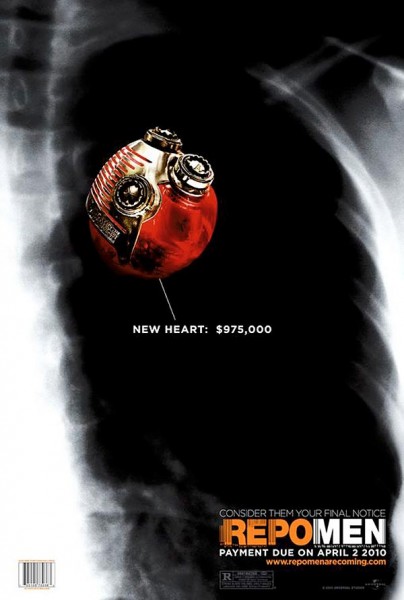
'Repo Men' wastes promising premise

With the passing of the health care reform bill, the futuristic thriller “Repo Men” is a film that has become a film of the moment. In its own gory, action-filled way, the film makes a very valid case for health care reform.

Set in a future where health care for profit has run wild, “Repo Men” starts out as a sharply observed satire, and, like the best satire, it takes a seemingly innocent idea and plays it out to its logical extreme. If a repo man can repossess your home or your car for being overdue on payments, couldn't he also repossess prosthetic organs too? That's premise at the core of “Repo Men.”

Jude Law stars as Remy, who along with his long-time pal Jake (Forest Whitaker), works for a company that sells expensive artificial organs to costumers who can't afford them. If a costumer fails to make a payment after 90 days, Remy, Jake or one of the company's other repo men will break into their home and quite literally rip the organ out of their body.

It is grim, grisly stuff and it is presented with a cold, cynical detachment that is both darkly comic and disturbing. Liev Schreiber as Remy and Jake's boss is a perfectly slimy salesman who helps to sell the film's artificial organs as well as the satire of Eric Garcia and Garrett Lerner's script.

Law has a great scene with RZA of The Wu-Tang Clan as a musician with an artificial heart that Law must repossess. Law is a fan and is asked to help RZA finish what will be his final song. There is a poignancy to the scene as RZA accepts his death as if Law is the Grim Reaper.

Things go awry with the repossession and results in Law getting his own expensive artificial heart. Not only has he lost his heart, but the stomach for his work. When he gets behind on his payments he decides to take down the whole system.
This is a turning point for the film. Everything that follows is in step with a more formulaic sci-fi action film. The film still entertains, but it feels less fresh and more familiar. The arc of Law's character is a sci-fi standard, which was most recently seen in “Minority Report.”

Using a well-worn plot is not the death of a film. It isn't the destination, but how you get there that counts. Luckily, there are just enough quirky pit stops to keep this journey interesting. One such offbeat touch involves a 9 year old performing knee surgery. It is such a gloriously unexpected moment that you wish there were more like it instead of tired scenes involving Law's wife (Carice van Houten) and his new lover (Alice Braga).

Miguel Sapochnik's direction is competent and he handles the “Matrix”-style action scenes late in the film well. There is a nice mood, but too often the film feels like a car commercial for Volkswagen.

When things go slack, you still have Law and Whitaker, both top actors, making the material work even when it is losing some strength. Their camaraderie feels authentic and you sense they are genuinely friends. When Law goes rogue, the conflict that strains their friendships adds some real dramatic tension.

"Repo Men" is a movie that is good enough entertainment. It isn't a bad time, but it is a film that started out with potential it didn't quite live up to. Certainly worth a look if you're a fan of the genre or the leads, but it won't win over non-fans.

Friday, March 19, 2010

'Green Zone' delivers politically-minded action

Movies about the Iraq War haven't exactly been the path to box office gold. “Green Zone” is a big budget Iraq War film and the subject matter still remains a tough sell. Even “The Hurt Locker,” the recent Best Picture winner, only made
$15.7 million during its theatrical run, which in actuality is a modest success considering its small budget and limited release.

With a budget of $100 million, “Green Zone” has only made $16.8 million in its first week. At least the film is on its way to making its money back, but, as with previous films tackling the subject, “Green Zone” is more about making a statement than making a buck. Kudos to Universal for backing it.

This marks the third collaboration between Matt Damon and Paul Greengrass, the director of the last two films in the “Bourne” series. The marketing of the film would lead you to believe this is essentially Jason Bourne in Iraq, but that is really a misnomer. Greengrass' kinetic, visceral, raw style of action is still present, but while it was front and center in the “Bourne” films, it takes a back seat to politics in “Green Zone.”

Oh, there's plenty of action: foot chases, gun fights, explosions, etc., but there also questions raised about the very reasons of the war. Some will be quick to dismiss the film as a heavy-handed liberal propaganda piece, but the film deals with some well documented truths. It is how those truths are presented that may rub some people the wrong way.

Set in 2003, the film focuses on the search for weapons of mass destruction, the reason for the United States' military presence in Iraq. Damon stars as Chief Warrant Officer Roy Miller, who is seemingly the only soldier frustrated by the fact that every site they raid in search of WMDs turns up empty and with zero evidence of weapons ever being there.

Miller begins his own search for the truth to who is providing the dodgy intel and uncovers a web of lies, deceit and cover-up. During his personal mission, he find allies in CIA man Martin Brown (Brendan Gleeson) and journalist Lawrie Dayne (Amy Ryan) and an enemy in Pentagon intelligence officer Clark Poundstone (Greg Kinnear), who will do anything to protect the truth.

The screenplay by Brian Helgeland, based on the book "Imperial Life in the Emerald City: Inside Iraq's Green Zone," simplifies everything by making each character represent a larger group of people in reality.

Damon's Miller stands for anyone who questioned the search WMDs, but it is extremely unlikely one soldier did the things he does. Ryan's journalist represents all journalists who unquestioningly reported what they were given. Kinnear's Poundstone is basically a stand-in for the entire Bush administration. Streamlining this big issue down to a a few players makes it easier to present as a palatable action film.

The film doesn't dumb down, though. There are good and bad guys within the U.S. Army, and good and guys in Iraq. The film strives not to make the idea of hero and villain black and white. Miller is given a tip by an Iraqi named Freddy (Khalid Abdalla) who becomes an important part of the plot.

Freddy's frustration is that he is automatically assumed to be the enemy and constantly must prove his loyalty. He is a man who loves his country and just wants what's best for it. In many ways he is the most interesting character in the film and helps to put a very human face to the story.

The acting throughout is strong. The ever-versatile Damon has mastered this sort of stoic minimalism. He face is hardened into the expressionless mask of a soldier, but it isn't a hollow performance if only because Damon has developed such a powerful command of the screen that makes it easy to almost instantly identify with him.

“Green Zone” works as both an action film and as a film that questions the reasons behind the Iraq War. Could a film have been made that chronicled the shadiness involving WMDs in a more intricate and complex way? Yes, and there are documentaries that have those details, but by squeezing these ideas into an action film, the issues may find a wider audience. It isn't a perfect melding of pop entertainment with loftier ideals, but it is a worthy attempt at something more than just a mindless action film.

Friday, March 12, 2010

Burton in 'Wonderland'

The twisted mind of Tim Burton has taken on the equally warped mind of Lewis Carroll in the latest Disney version of “Alice in Wonderland.” The pairing is a good fit, and this is a visually impressive take on the familiar story.

Burton was an animator for Disney in the early 1980s, but they didn't see eye to eye. After movies like “Beetlejuice” and “Batman” made him a superstar, Disney lured him back by allowing him to make his dream project: “A Nightmare Before Christmas.” After he made the critically-acclaimed, but box office dud “Ed Wood,” Disney moved on again.

So, now Burton and Disney are together again and Disney must be very pleased indeed. The movie made $116 million its opening weekend, which is an unheard-of number for a spring release. Some will claim this was a sell-out move on Burton's part, but I say more power to him for getting Disney to front the $200 million bill for this loopy adaptation of Carroll's beloved books.

Burton and screenwriter Linda Woolverton (“The Lion King”) freely blend elements of “Alice's Adventures in Wonderland” with “Through the Looking Glass and What Alice Found There” with a new framing device and central story.

Alice (Mia Wasikowska) is now nearly 20 and only recalls her last visit to Wonderland (or Underland) as a nightmarish dream.
Her mother wants to marry her off to a wealthy fop who wants to repress Alice's whimsical mind that is full of strange, seemingly mad thoughts. When Alice gets a glimpse of the White Rabbit, it is down the rabbit hole once again.

Underland is now ruled by the tyrannical Red Queen (Helena Bonham Carter) and a prophecy says it is Alice who will slay the queen's dragon-like Jabberwocky and restore the throne to the goofy, but good White Queen (Anne Hathaway). Alice has lost her “muchness,” as the Mad Hatter (Johnny Depp) tells her, and the movie is about her becoming much more mucher.

Burton is well aware of how iconic all these characters are and dispenses with lengthy introductions. It may be confusing for little children or for those who have managed to have zero exposure to the story, but that isn't necessarily a bad thing. Carroll's world is supposed to be slightly off-kilter.

This is very much a straightforward Disney fantasy adventure in terms of its plotting, but it is the vivid art direction and odd flavorings that Burton adds that give the film a personality that is distinctly his own.
Working with Depp for the seventh time, the duo have created a fittingly bizarre characterization of the Mad Hatter. Under

Burton, Depp goes out on huge acting limbs that sometimes don't always work, but his Mad Hatter is a wonderful creation. At times a lisping fool, his madness sometimes materializes into genuine anger towards the Red Queen. There is also a come- and-go Scottish bourque that is quite amusing.

Bonham Carter is appropriately menacing as the Red Queen and adds lots of idiosyncratic touches in her line deliver, but those familiar with her work in the TV movie “Merlin” will recognize that she's doing a riff on the villainy that she portrayed in that film.

Wasikowska is quite effective as Alice and an engaging lead. She has a way of being completely sincere and believable when surrounded by all these special effects. She makes you care about Alice's struggle to be who she really is.

There is also excellent voice work from Stephen Fry as the Cheshire Cat, Alan Rickman as the Caterpillar, Timothy Spall as the dog Bayard and Michael Sheen as the White Rabbit. Matt Lucas (“Little Britain”) is transformed into both Tweedledum and Tweedledee and has some of the movie's best laughs.

This “Alice in Wonderland” isn't a mind-blowing experince, but it is dark, weird and comic in unexpected ways. It is visually stimulating throughout and, thanks to the performances, always engaging.

Thursday, March 11, 2010

Actors 'Bare' all in pop opera

Growing up is never easy. Adding the judging eyes and ears of a Catholic school only makes it worse. “Bare: The Pop Opera,” which opens Thursday, March 11, at Your Theatre in North Conway, N.H. knows this all too well.

Following on the heels of M&D Productions' youth musical productions like “Godspell” and “Footloose,” “Bare” is perhaps the most ambitious show the company has attempted with a largely high-school-age cast. The students in the cast reach the higher bar that director Ken Martin has set for them.

“Bare” revolves around the story of Jason (Billy Cavanaugh) and Peter (Kyle Mulcahy), two gay teenagers struggling with understanding and accepting their feelings. Peter doesn't want to keep it a secret anymore, but Jason fears the repercussions of letting the world know. When Ivy (Courtney Phelps) falls in love with Jason it becomes a chance for so-called normalcy.

Although the show has the ongoing debate of sexuality and the Christian faith at its center, the emotions this struggle creates are universal to the experience of growing up. The show's book by John Hartmere and Damon Intabartolo knowingly remembers and re-creates the teen angst of not knowing one's place and the desire to belong and be understood. The characters in “Bare” battle with being true to themselves even as they try to find out who that self is.

Yes, this is an opera in the sense that nearly every line is sung, but the music is not that of a traditional opera. This is very much based in the traditions of pop music with influences from Motown. The show features 36 songs. This would be a daunting task for trained professionals, let alone young performers who are still learning. Musical director Tracy Gardner worked extensively with the cast and has got them to an impressively high level of performance.

The leads are very strong. Mulcahy so badly wanted to play this role that he has been commuting three hours one-way from Franklin Pierce University to play Peter. His passion and commitment to the role absolutely comes across in every moment he is on stage. He isn't afraid to be open and vulnerable especially on songs like “Role of a Lifetime” and “Ever After.”

Cavanaugh, who, as the program notes, had only ever sung in his bathroom, very nearly matches Mulcahy. He makes Jason's struggle with his identity feel authentic. The perfect straight act that Jason presents begins to crumble and Cavanaugh plays that conflict well.

Phelps, who last year was the female lead in “Footloose,” has taken a massive step forward as a singer and has several powerhouse moments. She is particularly strong on “All Grown Up," where she taps into painful, raw emotions.

Jessica Pappalardo as Jason's sarcastic loner sister gets some of the best lines in a show that is full of funny lyrics that range from clever to crass. In songs like “Plain Jane Fat Ass," she gets the snarky self-deprecation just right.

Rae McCarey get the juicy role of Sister Chantelle and plays her to the hilt as a tough soul sister. In a dream sequence she comes out as a Mother Mary who is more likely to be on her way to Vegas than Bethlehem. McCarey, flanked by a couple of angel backup singers (Amy-Nicole Smullen and Janette Kondrat), belts out the showstopping “911! Emergency.” She also shines on “God Don't Make No Trash.”

Other highlights include Kelly Karuzis, as Peter's mother, delivering the heartbreaking “Warning,” and Ged Owen, as the student drug connection, performing an amusing rap.

This is a show that will have you laughing heartily one moment and dabbing away tears the next. This is a Kleenex show, for sure, but it is also one that earns every single tear.

Tickets are $15. For reservations call 662-7591.

Friday, March 05, 2010

The Oscars just got bigger

Sunday night the 82nd annual Academy Awards are airing at 8 p.m. on ABC, but this year the notoriously long award ceremony is going to be a little different. This year the Best Picture category has been expanded from five to 10.

It is a curious decision, especially when paired with the choice to have two hosts, Alec Baldwin and Steve Martin. There have been two hosts in the past, but it just seems like the Academy of Motion Picture Arts and Sciences decided since they were doubling things they should also double the hosting duties.

Many reasons have been batted around as to why the category was expanded. The change could be an attempt to return the show to its roots. Up until 1943 the best picture category featured 10 films. It could be possible that the academy is attempting to honor that tradition.

The more cynical interpretation of this move is that it is motivated by ratings. The academy has been struggling for years to keep a balance between nominating quality commercial films that mainstream audiences will be familiar with alongside art house and independent cinema that the general moviegoer may not be familiar with. By expanding the category by five, there can be an even split between the two groups. In theory more people will watch with more familiar titles nominated.

This struggle between commercial films and art films goes back for decades. If we dig further back in Academy Award history we will discover that not one, but two Best Picture awards were given out at the first ceremony in 1929. “Wings” won Most Outstanding Production and “Sunrise” won Most Artistic Quality of Production. Essentially, this comes down to best film as a spectacle and best film as art.

If we are bringing back old ideas, this seems like one that should have been dusted off as well. Both big-budget commercial films and art films when done well are equally valid and both should be honored. It certainly would be helpful this year.

Easily the most spectacular, visually stimulating film of 2009 was “Avatar,” a film that is an extraordinary technical achievement. I'm not sure it is the best film of the year, but it certainly would be a lock for a Most Outstanding Production award. This would then make way for a movie like “Precious,” “Up in the Air” or “A Serious Man” to take the Most Artistic Quality of Production.

The reason the two separate Best Pictures categories were probably tossed out in the first place is that you inevitably encounter gray areas. Just look at this year's nominees for evidence. “The Hurt Locker” and “District 9” can be viewed on a purely surface level as rousing spectacles, but there's a second level to these films that raises them to artistic achievements.

Of course, we only have the one category, which means that we will mostly likely get a repeat of “Titanic,” the last film “Avatar” director James Cameron directed. Everything else reeks of deja vu. “Avatar,” just like “Titanic” before it, is the most expensive film made to date and has gone on to become the highest grossing film of all time at $2.5 billion worldwide.

When Cameron won Best Picture for “Titanic” in 1998 he proclaimed himself the king of the world. Chances are come Sunday he'll still reign supreme. But I'm hoping for an upset. I'm on team “Hurt Locker.”

Friday, February 26, 2010

Scorsese's 'Shutter Island' disappoints

“Shutter Island,” a film that is both fascinating and frustrating, represents a rare misfire from legendary director Martin Scorsese.

Based on a novel by Dennis Lahane, the author of such books-turned-films as “Mystic River” and “Gone Baby Gone,” “Shutter Island” focuses on two U.S. Marshals (Leonardo DiCaprio and Mark Ruffalo) who are sent to a hospital for the criminally insane in hopes of being able to find an escaped patient (Emily Mortimer).

DiCaprio's Teddy Daniels believes he has stumbled upon a conspiracy but he may never be able to leave the island to tell the world what he has discovered. From the get-go, the head doctors of the island, played by acting greats Ben Kingsley and Max von Sydow, seem up to something.

Teddy is haunted by memories of his late wife and the atrocities he saw at a concentration camp during World War II. As the film progresses his sense of reality becomes increasingly warped. Is he going insane or are the employees of the island simply attempting to ruin his credibility?

The film recalls Alfred Hitchcock's “Vertigo” as well as “The Wicker Man” and Stanley Kubrick's “The Shining.” All these films deal in a reality that is becoming increasingly unstable and on forces working to undermine the protagonist.

There's are also moments that bring to mind the kitschy horror films of William Castle, who made such films as “House on Haunted Hill” and “13 Ghosts.” The idea of Scorsese making a campy horror film does have appeal, but “Shutter Island” is attempting to be somber, paranoid-filled thriller, so these isolated flashes of camp work against that objective.

The film's biggest problem is that it is such an amalgamation of conflicting tones that it is hard to get a read on the film. This is meant to be a psychological thriller, so having the audience off balance is a good thing, but somewhere along the way there is a break and the film becomes less engaging. You still watch and admire the craftsmanship, but there's no emotional connection.

Part of what feeds this disconnect is that early on it is clear that the film is building towards some big final reveal and so eventually you just sit there waiting for the big twist to occur. It is a long wait with the film clocking in at over two hours. When it finally does arrive, it is rather anti-climatic and requires Kingsley to do a lot of explaining.

This is a departure for Scorsese in terms of genre and he feels out of his element. Scorsese almost always seems in complete control of his films; here at times he seems slightly lost at sea. The perfect example of this is the comically overwrought score that is employed heavily in the early scenes. It distracts instead of helping to create a mood.

Is the film still worth a look? When your as prolific a filmmaker as Scorsese, it is inevitable that your work will be looked at with a more critical eye. And while this doesn't hold up against his best work, there are still things to admire about it.

There is a suspenseful sequence in the corridor of the ward where the worst of the criminally insane are held that has an effectively chilling atmosphere. Some of the dream sequence are startling and create an unsettlingly surreal mood.
Unfortunately, in both cases, Scorsese is unable to sustain these moods.

The acting throughout is solid. DiCaprio plays the film on an unremitting level of intensity as he interacts with a cast of reliable character actors including Jackie Earle Haley, Patricia Clarkson, Elias Koteas, Michelle Williams, Ted Levine and John Carroll Lynch.

So, yes, this is not Scorsese at the top of his game, but even a lesser Scorsese film is still better than most films released on a weekly basis.

Saturday, February 20, 2010

'From Paris with Love' is formula fromage with a bite

“From Paris with Love” is the latest action film from Luc Besson, the French filmmaker who does American-style action films better than most Americans. As with many, but not all, of the works associated with his name, this is a movie with little substance, but a lot of pure, visceral fun.

Besson as either writer, producer or director has made such films as "The Professional," “The Fifth Element,” “The Transporter” series, the underrated “Unleashed” and last year's “Taken.” Although his films are typically set in Paris, his films are usually in English.

Here Besson takes on the role of producer and story handing over the directing to “Taken” director Pierre Morel and the screenwriting to Adi Hasak. Although different in tone from “Taken,” it follows the same structure: A brief prologue sets up an excuse for nearly non-stop action and then said action commences.

The set-up is that Jonathan Rhys Meyers is the assistant to the U.S. ambassador, who lives a double life as a lowly CIA operative. This uptight would-be spy gets his chance to prove his mettle when he's hooked up with an unorthodox wild-man of a super agent (John Travolta). Together this mismatched duo will banter back and forth and prevent a terrorist attack.

This is a formula genre film through and through, but there's nothing wrong with that if the film engages within the confines of its formula. “From Paris with Love” is essentially “Lethal Weapon” in Paris.

The film works thanks to some cracking dialogue and a clever script by Hasak, whose only other credit is a film from 1997 called “Shadow Conspiracy.” Don't worry, there's a reason you haven't heard of it. Clearly, the 13-year gap between scripts did him well.

At the center of the film is a bald Travolta giving his best, most entertaining performance in years. He has a maniac energy that powers the film. He spits out quips as fast as the many rounds of bullets that he fires at the never-ending stream of faceless enemies.

Travolta is an actor whose career has some Everest-like peaks and some Death Valley-like lows. For the last decade, he's been trying to climb out of the valley that “Battlefield Earth” sent him to. The last few years he has been making progress getting back to the top of his game most notably with his cross-dressing turn in “Hairspray” and in last year's “The Taking of Pelham 123.”

“From Paris with Love” is a reminder of just how good he can truly be and how much fun and magnet of a screen presence he can be when he lets loose all of amble charms.

Rhys Meyers, perhaps best known as King Henry VIII on HBO's “Tudors,” is a good balance for Travolta and they play off each other nicely, but unfortunately the Irish-born actor struggles with an American accent. Still, although not necessarily a perfect fit, he gets the job done.

As with “Taken,” Morel proves to be a competent director of a fast-paced action. There are no stunning set pieces, but the action is well executed and exciting while watching it. This is video game style action where the bad guys pop up and the good guys shoot them. It can get old very quickly, but to Morel's credit he keeps things moving and interesting.

This is a popcorn movie and it is proud of it. It doesn't pretend to be anything else. It is a fun, undemanding 90 minutes. Check your brain and enjoy.

Saturday, February 13, 2010

The music or the misery: An exploration of why we listen to pop music

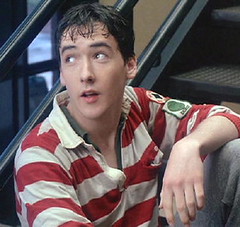
Every Valentine's Day I have a tradition of watching “High Fidelity,” the 2000 John Cusack vehicle based on Nick Hornby's novel about a music-obsessed record store owner's attempt to understand why all his relationships ultimately seem doomed.
The solace I find in this film is not the subject of this article, but rather a question the film presents that, if dwelled upon, forces us to look at the very reason we listen to music and how it affects us.

“What came first: the music or the misery?” asked Cusack's Rob Gordon in the opening scene of the film. “People worry about kids playing with guns, or watching violent videos, that some sort of culture of violence will take them over. Nobody worries about kids listening to thousands, literally thousands of songs about heartbreak, rejection, pain, misery and loss. Did I listen to pop music because I was miserable? Or was I miserable because I listened to pop music?”

Ten years after the film's release, the question remains unanswered. Sure, it is a chicken or the egg question that has no correct answer, but that doesn't mean the question doesn't warrant exploration. With both love and potential heartbreak in the air on the eve of Valentine's Day, the time has come to explore this mystery.

At first blush, the answer seems obvious: the misery has to come first because it is emotion that drives the creation of the music.

“If we look historically … we were emoting these things long before we were able to articulate them,” said Rick Hensley-
Buzzell, a music therapist at Mount Washington Valley Psychological Services. “The emotion had to come first because the ability to create that emotion in some sort of standardized language — the language of music — didn't come until much later.”

So, there's the answer. Case closed. But there's really more to it because, as Hensley-Buzzell notes, once music was created we now “have a common language to be able to convey those emotional ideas and recreate those emotional ideas.”

Essentially, music has become such an ingrained part of culture that it is no longer a one-way street. There's a give and take between the emotion and the music.

“In terms of love songs, this feedback loop reinforces itself, as people then attempt to attain a level of perfection in their own relationships which they have heard so much about via songs and movies, and which has been strummed lovingly into their ear since day one,” said Ben Hammond, a 2001 graduate of Fryeburg Academy who studied music technology at McGill University in Montreal. “We all hope one day to love as strongly as Peter Gabriel does while singing 'In Your Eyes,' though perhaps seeing the doorway to a thousand churches in just one girl's eyes is a bit unrealistic.”

If our query can't be answered with the simple black or white answer of which comes first, then perhaps the question becomes: How do we choose to interact with music?

“I dive deep into lost-love songs when I’ve lost a love,” said Brian Charles, the owner of The Music Shop in North Conway and a Julliard-trained professional musician and composer. “Bonnie Raitt’s 'You Can’t Make Me Love You” is now a deeply set permanent marker in my brain from a divorce 15 years ago. I just don’t have the heart to listen to 'love' love songs when I’m down.”

Nikki Martinez, the former morning show host on Magic 104, also sees music as a way of marking our lives, but sees how we allow music to affect us as a choice.

“Whether it be a song full of cherries and chocolate fountains or pain that you didn't think existed, I think you can choose to either have control of your own feelings, or you can let music control the attitude you're in,” Martinez said. “I personally decide to control my feelings and let music be a type of soundtrack for life.”

This idea of the "soundtrack of our lives" is key to understanding how we interface with music and how it does affect our mood. Music acts as memory trigger to a certain time, place and feeling.

“If I hear the song 'Heaven' by Bryan Adams, I'm back in high school feeling the heartache of a lost girlfriend," Hensley-Buzzell said. "So I can be in a great mood, hear that, and even 25 years later go, 'Man, that really crushed me back then.' So it is relational; it is all about what we project on to [it] … There is a difference between what it is and what it represents.”

Hensley-Buzzell stresses the distinction that, yes, music has the ability to change a mood by recalling a previous emotional state, but that it doesn't create a new mood. The emotion is already within us — it is the music that activates it. It is a distinction that local music teacher, actor, singer, choir director and theater director Mary Bastoni-Rebmann is also quick to make.

“The music we choose to listen to is a direct result of how we feel,” said Bastoni-Rebmann, who has a bachelor’s degree in vocal performance from the University of Southern Maine and is currently working on her master's. “Songs of love will serve as a vehicle to allow the reaction to happen. The feelings and experience, either positive or negative, are already inside, and music gives one permission to let it out.”

Charles believes the ability for music to allow people to let it out is at the core of what pop music is all about. It is pop music's pure, straightforward messages that allows it to speak to us so clearly when we are feeling down.

“[Pop music] doesn't require too much looking under the surface,” Charles said. “The song is identified as pop because it is a song that doesn't require more than one meaning at a time — maybe there's a double entendre thrown in here or there, but once it goes beyond that it stops being pop. So, boy do I want a simple message when I'm feeling bad. I don't want to look into the deep, dark depths of my soul as much as I'd like to get over this period.”

Furthermore, Charles sees music as connecting to a community that allows us to not feel alone.

“What better than to find someone to commiserate with who won't ask you any questions and who won't put you on the spot, doesn't have any needs of their own — they are just there to provide solace,” Charles said.

Hensley-Buzzell agrees with this concept of music as something to connect with, but takes it one step further, suggesting that music helps us to sort out who we are in relation to the world.

“A lot of the pop music will go away because it talks about people on people,” Hensley-Buzzell said. “But when you get to something that allows us to experience the world, the universe, spirituality larger than ourselves, I think that's what music allows us to do, to tap into and give us some perspective.”

So, now we're starting to get into the very reason we listen to music. Music is a universal experience. We all seem drawn to it on some level. Genre preferences may differ from person to person, but the impulse is the same.

“We listen to music because it is a thoroughly human trait,” said Therese Davison, of the Kennett High School music department. “It resonates with our human bio-grammar, meaning that the human body responds to music in a primal capacity related to an innate musical intelligence. Music is a means of communication that exists in a realm other than the tangible or the verbal and goes beyond the cultural conditioning of one’s environment.”

What Davison is talking about is based in science and how our brains actually work. On a certain base level, music speaks to us.

“Music and profanity have a very similar tie in that they are able to speak to lower functions in the brain,” Hensley-Buzzell said. “They are able to speak to the emotional centers of the brain, which are much more protected, almost like first brain, survival, like our reptilian brain that is inside of us.”

But maybe we are getting too cerebral in the what, why and how we listen to music. Music undoubtedly affects us and perhaps it doesn't truly matter what comes first, the emotion or the music. Maybe the key to it is to be aware of the relationship we all share with music.

“Whether it's the chicken or the egg, everyone knows that love songs are exaggerated,” said Hammond. “But maybe that's the way they should be to give us cynics hope that maybe, just maybe, it really can happen. And if nothing else, it gives us acoustic guitar players a cheap way to score points with our wives/girlfriends/potential Valentines.”

That's a good final thought as we either embrace or brace ourselves for the day of love. And if you don't have anyone to hold this year, there's always that reliable, unquestioning friend known as music.
Friday, February 12, 2010

M&D's 'Cuckoo's Nest' flies high

The first thing you notice about M&D Productions' staging of “One Flew Over the Cuckoo's Nest” is its astounding set designed by Deborah Jasien. It authentically recreates a psych ward and gives a believable setting for the actors to play in. The set is indicative of the quality and care that went into the entire production.

“One Flew Over the Cuckoo's Nest,” which opened Thursday, Feb. 12, at Your Theatre in Willow Common in North Conway and is playing Thursday through Saturday for the next three weeks, is about how Randal P. McMurphy (Kevin O'Neil), a convict who has been deemed potentially insane, shakes up the mental institution he is sent to.

This is not an easy show to produce. Not only because of its complex struggles between sanity and insanity, free-thinkers versus the establishment and how institutionalization affects someone, but simply because it is such a well-known show.

The play, based on the novel by Ken Kensey, was first staged in 1963. Twelve years later the famous film version was released and earned Jack Nicholson his first Academy Award as well as wins for best picture, best director, best adapted screenplay and best actress for Louise Fletcher. It is an iconic film with performances from Nicholson and Fletcher that became benchmarks.

M&D's version, directed by Dennis O'Neil, holds its own against such a formidable predecessor. I've seen one other stage production of “Cuckoo's Nest” in London's West End starring Christian Slater in the lead role. Slater was phenomenal in the role, but the production was flawed and in many ways M&D's production outshines it.

One of the innate problems with the show is the monologues delivered by the character Chief Bromden (Dan Tetreault). When delivered directly to the audience they can be confusing, since the character is believed to be mute, and pull you out of the show. Dennis O'Neil corrects this potential problem by having these speeches pre-recorded and allowing them to become internal monologues.

Kevin O'Neil, who recently won best actor at the New Hampshire Theater Awards for his work in M&D's “Facing East,” gives another stellar performance. Those familiar with his previous work may be skeptical about his casting, but he makes the role his own. He has the right level of off-kilter high energy and a gleefully mischievous laugh. But his performance isn't just a looney taking over the looney bin; he hints at the real anger that lies within McMurphy.

Sarah Charles has perhaps the most difficult role in the show as Nurse Ratched, the head nurse that McMurphy butts heads with in a power struggle for control of the ward.

Ratched truly believes her methods are helping her patients even though to many she may seem like a sadist who enjoys tormenting these men. To go too far in that direction, though, is wrong. To go in the other direction and play her too soft is also the wrong approach. Getting that balance somewhere in the middle is what is so tricky about the character.

Charles does a nice job of finding that balance although she may be a bit too soft at times. It is believable, though, that she'd have power over these broken men. Charles even garners some sympathy for Ratched. Ratched loses herself in the conflict for control with McMurphy and ultimately does something that leads to tragedy.

The cast of inmates is stellar, and what this version gets absolutely right is how McMurphy changes these men. It isn't in a heavy-handed way, but by the end the changes are obvious. The friendship that develops between the chief and McMurphy is the heart of the show, and Kevin O'Neil and Tetreault play it beautifully.

Other noteworthy inmates include Tom O'Reilly as Dale Harding, who starts out as mousy and insecure, but as the show progresses slowly picks up more of McMurphy's traits. Eric Jordan as the stuttering Billy Bibbitt as also quite good. It would be easy to overdo a role with a stutter, but Jordan admirable underplays the role and makes it believable.

This is show with both big laughs and big emotions, and this production captures just the right tone in delivering both. If you are a fan of “Cuckoo's Nest” you won't be let down. If you haven't seen or read any of its previous versions, then this is a very good introduction.

Friday, February 05, 2010

What happened to the romantic comedy?

This week I reviewed Arts in Motion's production of the romantic comedy “Almost, Maine,” which got me thinking about the current state of the genre within the world of film. As an avid fan of the romantic comedy, I can tell you it is pretty bleak out there.

It has always irked me that most of the time examples of the romantic comedy are dismissed as much maligned chick flicks. The pleasures of a good romantic comedy transcend gender, but unfortunately most of what is now passed off as representatives of the genre do target a primarily female audience.

The romantic comedy as we know it today has roots in the screwball comedies of the 1930s and 1940s. These films were marked by slapstick antics, misunderstandings, double entendres, innuendos, rapid-fire dialogue and a sense of anarchy.

The conclusion of these films, in which the two people the audience has been rooting to get together finally get together, were often tagged on, seemingly arbitrarily. Here in lies the key to the screwball comedy: The ending doesn't matter. It is how you get there that counts.

A lot of people will complain that they don't like romantic comedies because they are predictable, but that really misses the point. Of course the two people who hate each other at the beginning of the film will fall in love by the end of the film. Part of the reason we go to these films is for the comfort that love always prevails, if only for 90 minutes.

What distinguishes a romantic comedy is how it works within its familiar formula. The problem with a lot of romantic comedies today is not only are they borrowing the template from previous films, but the content too. The journey to the ending, the part of the film that needs to be fresh and original, is being telegraphed from other, better films.

Take for example, “The Ugly Truth.” There is a scene that involves Katherine Heigl orgasming quite loudly in a restaurant. The scene can't help but recall a similar classic scene from “When Harry Met Sally.”

“Leap Year” is another prime example of a film that wastes the considerable charms of its leads, Amy Adams and Matthew Goode. The plot is essentially a lift from 1934's “It Happened One Night” with two strangers becoming unlikely partners on the road in hopes of getting the female lead to her true love.

It isn't the plot that is problem, but the fact that there is not a single scene that hasn't been seen before. There's even that oh-so-familiar scene where the two people who hate each other have to pose as a married couple because of some plot contrivance. This leads to them inevitably being forced to kiss each other only to realize, oh wait, that actually felt good. Can we please, please, please retire this scene.

It isn't all bad. Writer/director Nancy Meyers' “It's Complicated” involves a love triangle between Meryl Streep, Alec Baldwin and Steve Martin and while there are definitely scenes of familiar comedy, there also scenes of real humor and tenderness.
Meyers remembers to write actual characters rather than cogs in a plot. Her films, which also include “Something's Gotta Give” and “The Holiday,” aren't perfect, but she has characters that approximate real human behavior.

Not that they are requesting it, but my advice to aspiring screenwriters who choose to write within this genre is to go back and watch movies like “Bringing Up Baby,” “You Can't Take It With You,” “The Philadelphia Story,” “Annie Hall,” When Harry Met Sally" and an assortment of others. Study these films, but don't steal from them. Look at how the dialogue is written and notice how the characters, even if they are archetypes, aren't one-dimensional. At the end of the day, you have to have characters you actually care about.

Arts in Motion's 'Almost, Maine' is definitely a good time

With Valentine's Day just around the corner, Arts in Motion's delightful production of the romantic comedy “Almost, Maine” makes for an ideal night out.

Written by playwright John Cariani, “Almost, Maine,” which opens Friday, Feb. 5, at the Leura Hill Eastman Performing Arts at Fryeburg Academy in Fryeburg, Maine, is a series of nine offbeat stories of love. The show was first staged at the Portland Stage in 2004 where it went onto become the theater's most successful show. A well-received run off-Broadway followed.

In its original staging, four actors played all 19 roles in the show, but director Mary Bastoni-Rebmann decided to cast each role individually allowing for a diverse showcase of local talent both young and old.

The show is set in a fictional town in Maine, and there are things that will ring true for people who live in Northern New England. For example, in a very funny scene, a couple of snowmobile buddies (Rob Clark and Katrina Carus) have a lot of layers to strip off before they can take their relationship to the next level. For the most part, though, the play is dealing with universal themes and ideas and mines its humor and pathos from there.

Cariani's warm and witty script features many scenes involving high concept ideas. In “Her Heart” a woman (Beth Scrimeger) literally carries her broken heart in a paper bag. In “Getting It Back” a spurned girlfriend (Brooke Sanderson) attempts to return her love to her boyfriend (Zach Whitley) in several giant bags. “This Hurts” features a character (Jake Dunham) who can't feel pain. In another scene characters literally fall in love with each other.

On the page, these ideas may seem too abstract to work, but on stage they work quite well thanks to Cariani's deft writing and Bastoni-Rebmann's light direction, which brings out the best in her cast. The actors get the correct mood of lighthearted whimsy with an occasional undercurrent of pain and uncertainty.

Each scene follows a similar arch, whether it is about finding or losing love, that ends with an “aha moment” that puts a button on the scene. For the most part this formula is effective and charming, but at least in one case the writing is too clever for its own good.

Cariani does get so much right, though. The prologue featuring two young lovers (David Fulton and Kelsey Lildejahl) absolutely nails the awkwardness of early love. Lildejahl and Fulton perform it just right. It is a short scene but an excellent hook that sets the tone for the rest of show.

“Sad and Glad” captures a similar uneasiness when a lonely guy (Ged Owen) runs into his ex-girlfriend (Taylor Hill) at a bar. The scene is both funny and painful as the overlapping dialogue and uncomfortable exchanges will be all too familiar to most people in the audience. Owen and Hill, both playing older, pull the scene off nicely.

Another highlight is “This Hurts.” The exchanges between Dunham and Hanna Paven in this scene feel completely natural and are genuinely sweet. “The Story of Hope,” which features a woman (Pam McDonald) looking for the man who proposed to her, but with whom she never gave an answer, has a poignancy that sticks.

It is large cast that also includes Shelby Noble, Gage Crawford, Andrew Clark, Holly Fougere, Jason Fougere, Marshall Allen, Reid Clark and Erika McCarthy. I can't possibly praise everyone individually, but there isn't a weak person in the cast. Perhaps that's because the actor just had one scene to work on and polish until it shined.

Whether you have a loved one or you're a hardened cynical single, “Almost, Maine” should sufficiently warm your heart. Performance dates are Feb. 5, 6, 12 and 13 at 7:30 p.m. and Sunday matinees on Feb. 7 and 14 at 1 p.m. Tickets are $12 for adults and $10 for students and senior citizens. For more information visit www.artsinmotiontheater.com.

Friday, January 29, 2010

The music/movie personality profile

This week I did not see a movie theatrically. This is a rare thing, but sometimes the slate of new release films is just too bleak and I don't have the courage to face them. So, I apologize to my regular readers for not having a movie review.
But I think I'll take this opportunity to write a bit more casually and candidly with you. After all, although I haven't met many of my readers, we still have a relationship as do all writers with their audience. If you are a first-time reader, welcome, how are you today?

Recently, I, and a lot of people I know, have been trying online dating. This includes the rather odd process of reading through people's profiles and judging them on a photo and the scant bit of information they have chosen to share about themselves.

One of the first things I check is where the person's taste in movies and music lies. This may sound superficial, but then again this whole process is a bit on the shallow side. You can learn a lot about a person based upon what they like, probably far more than any introductory paragraph they may write.

The other day, I was asked to weigh in on a profile. The person was disappointed that the woman in question was a big fan of Cyndi Lauper. This did not meet with his approval and he was going to toss her into his "no" pile. I think this was a mistake. Regardless of what one may think of Lauper as an artist, she is an idiosyncratic, fun and unique performer. If Lauper is someone's favorite artist this may be a good reflection of their own personality. Like Lauper, they may also be quirky and fun.

This got me thinking: Is it possible to define a person based upon their favorite musician or favorite movie? In a way, it would be like using one's taste in music and film as a horoscope or a Chinese Zodiac.

I tried this theory out on myself. My favorite band is The Beatles. I asked a friend what that said about me. The response was that The Beatles were an eclectic, multifaceted band living on a creative edge, so therefore perhaps someone who chooses them as a favorite is a well-rounded individual and a forward thinker. I'd like to think I am both these things.

My friend's favorite band is Nirvana. I told him I believe this meant that he has a pop sensibility that was in direct conflict with a desire to remain an outsider and that he was grappling with big ideas and big emotions. My friend liked this assessment. Perhaps there is some truth to this theory.

If you add in a person's favorite movie you get a more complete picture of a person's personality. Coincidentally, my friend and I have the same favorite film: “High Fidelity.” In both of our cases it is an accurate reflection of our obsessive interest in music and movies and of our bad luck with love.

I tried out my theory with one other friend. Her favorite band is Depeche Mode. Not being as well versed in Depeche Mode as I probably should be, I asked her how she would define the band. She said dark, creepy, introspective and intelligent. These were all aspects of her own personality too, but didn't quite bring across the whole picture. I felt my theory deflating.

But, there was still her favorite film to consider. She cited “One Crazy Summer,” a 1980s comedy, that incidentally, like “High Fidelity,” stars John Cusack. What is it with me, my friends and John Cusack? The film is goofy and off-beat with a central character in search of true love. Pair this with the Depeche Mode personality profile and this was another fairly accurate appraisal.

There is clearly more research necessary, but I think I'm on to something here and I'm asking you loyal readers to continue the study. Give it a try on yourself, family and friends. What do your favorites say about you?

Friday, January 22, 2010

'Book of Eli' an action film with a brain and soul

For the last couple decades, there has been a lot of talk about the possibility of “Mad Max 4” being made. With the release of “The Book of Eli” that may be unnecessary.

“The Book of Eli” is a post-apocalyptic western very much in the “Mad Max” style, albeit a bit more meditative. Denzel Washington stars as Eli, a loner walking west on a mission to get a book to a safe location. Along the way he stops in a town run by the crooked Gary Oldman, who is desperately searching for the very book in Washington's possession. Inevitably conflict ensues.

It is hardly a spoiler to reveal that the book in question is the last Bible in existence. Given that the film's central conflict is for the last known word of God, it is a relief that the film doesn't become a sermon. Too often religious centered films get weighed down in their own self importance and need to spread the word.

The lack of heavy-handed preaching in Gary Whitta's script allows the film to have a broader appeal. The overall theme of the importance of faith is tempered with a message that religion can be dangerous in the wrong hands.

Oldman's character remembers the power of words in The Bible and wants to exploit them to control the people in his town. By not ignoring the ugliness that organized religion can bring out in people, the film is more realistic than the average religious parable.

At the end of the day this is also an action film and there are bursts of well-choreographed violence. Washington's Eli carries with him a very big, very sharp blade and he is well aware of how to wield it. He has a tendency of taking on large groups and leaving them all dead. The first time this is presented in the film it is done so in an effective, even artful, silhouette.

Directors the Hughes Brothers have created a familiar muted post-apocalyptic landscape. Although the look of the film, complete with burned out cars and poorly maintained roads, has been seen before it still remains effective.

The Hughes Brothers tend to go heavy on slow-mo walks towards the camera and low angle close up shots of characters backdropped by the sky. Both of these can be effective, but they are slightly over played here. Even so the Hughes Brothers know how to stage an action scene and they give the film an appropriately somber tone.

There is a big twist at the end that is a genuine shocker. Looking back on the film, there are hints pointing the viewer in the right direction. It is a film that needs to be seen again to go back and see how well the ending really works.

Washington, one of the few examples of a movie star who is also an exceptional actor, gives another reliably strong performance. He is required here to have moments where he is coolly tough and brutal and he does so with flare. He also keeps the performance grounded in real emotion. He is a quiet man, but when he speaks the words count.

It is great fun seeing Oldman relishing a chance to ham it up on screen as a bad guy. In the 1990s these sort of villain roles were Oldman's bread and butter. In films such as “The Professional” and “The Fifth Element” he created baddies that audiences loved to hate.

There is also a strong supporting cast with familiar faces popping up in small parts. Tom Waits has a fantastic bit as a pawn shop owner that does business with Washington. Michael Gambon, familiar to many as Dumbledore in the “Harry Potter” series, has an oddball bit as a survivalist. He has even less screen time than Waits, but he makes it memorable. Jennifer Beals, the star of “Flashdance,” also delivers a nice turn as Oldman's blind wife.

Mila Kunis, a fine comic actor who keeps popping up in action film that don't utilize her comedic abilities, has the third largest role after Washington and Oldman. As Oldman's stepdaughter, she switches sides and teams with Washington. She is adequate in the role, but unfortunately is the film's weakest link.

“The Book of Eli” is an action movie with a brain and a heart. For those who like to think just as much as they like to watch things blow up, here is a film is a good mix of both.

Friday, January 15, 2010

'Daybreakers' offers up vampires with a twist

Thanks to the “Twilight” series and the HBO show “True Blood,” vampires are back and hotter than ever, but “Daybreakers” isn't merely a film attempting to cash in on the latest trend. It is a fresh take on vampire mythology.

Set in 2019, a virus has transformed the vast majority of the population into vampires. So, if we survive the world ending in 2012 we have an eternity as vampires to look forward to. But you better hope you become a vampire because in this future the remaining humans are hunted and harvested for their blood.

Unlike the “vegetarian” vampires of the “Twilight” universe, these vampires can't survive on animal blood alone, without human blood they transform into mindless bat-like creatures. With humanity nearing extinction, a new blood source needs to be found.

Ethan Hawke stars as a vampire named Edward — clearly the name of choice for vampires right now — who is attempting to find a synthetic blood to little avail.
Edward is sympathetic to humanity and more than willing to help when he is targeted by a survivalist group of humans lead by Willem Dafoe, especially when informed they may have a cure for vampirism.

Writer/directors The Spierig Brothers have created a fully realized world full of little touches that make a big difference. They start from a strong central idea, not only are vampires the majority, but they live life much the same way they did as humans, except their work day begins at night fall. Sure, they have blood in their coffee instead of cream, but not much has really changed.

One of the most ingenious ideas of the film is that cars can enter a day-mode that blocks all the windows and allows vampires to see via video cameras. There's a fantastic car chase when Hawke first meets up with Dafoe. As they are pursued, bullet holes create deadly beams of light adding an extra level of tension to what would've been a run-of-the mill car chase.

In some ways the film recalls “Gattaca,” a film set in a future where genetically altered perfect people are seen as “valid” and normal people are as “invalid.” Hawke also starred in that film and perhaps it is only his presence that brings it mind. Although very different in style, both films cover similar territory.

As with “Gattaca,” Hawke is very good at playing a man who is part of society he hates, but must play along. When he is required to go hero it works as it is an extension of his character rather than an arbitrary plot development.

Dafoe is a scene stealer tossing out one-liners in southern drawl. He is an actor like Christopher Walken who has a way of saying a line like no one else. The only other actor of note is Sam Neill as the head of the corporation that Hawke works for. He is the film's villain, but Neill doesn't play him as a one-note baddie. Neill creates menace in his quiet, business-like manner, but he is not entirely unsympathetic.

Although this is a smarter than the average action-horror film, it is still very much a B-movie. This is not a negative. The film embraces aspects of the B-movie — extreme gore and cheesy one liners — and blends them with smart ideas and clever writing. The film updates vampires, but includes familiar motifs such as death by wood stakes. It isn't a perfect mix, but the care and intellect of the filmmakers helps make this fun entertainment.

Be forewarned though, this movie is not for the squeamish. There is plenty of exploding heads, decapitations, flesh ripping and projectile vomiting. It is all done in an over-the-top fashion, but even so, if blood and guts isn't your cup of tea then you best stay away. Horror fans, though, who find the sparkly vampires of “Twilight” to be nauseating will be thrilled.

Friday, January 08, 2010

Ritchie's 'Holmes' is cheeky good fun

Arthur Conan Doyle's famous literary sleuth is transformed into an action star in director Guy Ritchie's “Sherlock Holmes,” an energetic revisionist take on the classic character.
Holmes fans who enjoy the detective prim, proper and uptight and his loyal cohort Dr. Watson to be rotund and aloof will scream bloody murder over the great injustice that has been done to these beloved characters.

As embodied by Robert Downey Jr., Holmes is unkempt and his living quarters a mess of research and experiments. He is a rogue who enjoys a bit of rough and tumble underground boxing. As for Watson, the idea of him as a fat older man is actually out of step with the source material and didn't become popularized until Nigel Bruce took on the role in his pairing with Basil Rathbone.

Watson was an ex-military man with a limp from a war injury and Jude Law portrays that, but doesn't make him weak because of it. The film depicts Holmes and Watson brawling with various crooks and henchmen. These fights are presented with Ritchie's typical, gritty visual flare.

Ritchie is a writer and director whose specialty is darkly comic British crime films including “Lock Stock and Two Smoking Barrels” and “Snatch.” Although he didn't write “Sherlock Holmes,” the film very much feels in step with his previous films, albeit with the setting switched to 19th-century London. If you're willing to let go of some preconceptions of who Holmes is, Ritchie's sensibilities actually fit quite nicely within the Holmesian universe.

The screenplay by Michael Robert Johnson, Anthony Peckman and Simon Kinberg is peppered with barbed dialogue as Holmes bickers with Watson, insults Inspector Lestrade (Eddie Marsan) and flirts with Irene Adler (Rachel McAdams), the one criminal to ever outwit him.

One of the script's best devices allows the audience to hear Holmes thought patterns and see a preview of his plan of attack in fighting someone. It is a nice touch that feels in tone with the Holmes character. There's also a fabulous scene where Holmes roams the streets of London picking up seemingly random items as he quickly constructs a disguise.

The plot involves Watson leaving Holmes for married life much to Holmes' dismay. The villain of the film is Lord Blackwood (Mark Strong), who appears to have cheated death and to possess supernatural powers. Holmes and Watson apprehended him in the first scenes of the film and it was Watson who pronounced him dead. Holmes uses this to pull Watson back into the game.

Downey and Law are both truly fantastic in their roles and they play off each other exceedingly well. Downey uses that same sort of off-the-cuff charm that helped make 2008's “Iron Man” such a success, and Law is a perfectly dry straight-man to the eccentric Downey.

Strong, who appeared in Ritchie's “Rocknrolla,” is a solid villain with a quiet intensity and creepy presence. McAdams, a versatile actress, holds her own when bantering with Downey, but feels somewhat out of place. Even so she's a likable screen presence and her return would be a welcomed one when the inevitable sequel is made.

There are several big action set pieces, including a spectacular one in a shipyard and thrilling climax on top of an unfinished Tower Bridge. Visually, as is true with all of Ritchie's films, there's a muted grimness that proves effective here. The recreation of 19th century is impressive and believable.

Overall, it is all pretty cheeky stuff, maybe a little too much so, but it also a whole lot of fun.

Friday, January 01, 2010

Reitman continues his directing hot streak with 'Up in the Air'

There's a lot of talk about “Up in the Air” being the movie of the year. It is being mentioned in connection with such great filmmakers as Frank Capra and Preston Sturges for its ability to blend humor and melancholy in a way that captures a specific moment in time. It is film worthy of such comparisons.

This is only director and co-writer Jason Reitman's third film, but in just three films, “Thank You For Smoking,” “Juno” and now “Up in the Air,” he has revealed himself to be an assured, smart filmmaker. While all his films have received limited releases that went wider, make no mistake, these are polished, witty and intelligent mainstream films.

As was true with Capra and Sturges, Reitman works within well-known formulas, story arcs and character types, but within the familiar he explores ideas and emotions with an uncommon honesty. His films are stories of redemption or people seeing the error of their ways, but these well worn paths are walked in ways that are often unexpected.

The main character of “Up in the Air” is Ryan Bingham (George Clooney), who works for a company that sends out people like himself to fire people when their employer doesn't have the cojones to do it themselves. Given the state of our economy, business is good.

Ryan is also a motivational speaker who tries to convince people that living without the weight and baggage of a home and family is ideal. For Ryan putting down roots is death for a human being and so he keeps in the air for all but a few weeks of a year. His home is airports, airplanes and hotel rooms and he is perfectly happy that way.

His livelihood his threatened when his boss (Jason Bateman) takes a shine to an idea presented by a young new employee (Anna Kendrick), who says expenses can be cut if they fire people via video chat. Ryan is forced to take Natalie with him on the road (or rather the air) in an attempt to prove her wrong. While flying across the country Ryan meets Alex (Vera Fermiga, “The Departed”), a woman who appears to have his same view on life and that turns him on.

On the page Ryan doesn't seem like he should be a likable character. As an audience, we shouldn't like him and yet we do, and that is largely because he is embodied by Clooney, one of the few, perhaps the last, true movie star in the classic Hollywood sense. Like Cary Grant, James Stewart or Gary Cooper, he is able to play charismatic men with a sharp wit. Even when his characters aren't cut from an everyman cloth he still manages to exude the vibe of one.

This isn't only Clooney's show, he has strong support from his leading ladies.
Kendrick, whose biggest previous credit is a small role in the “Twilight” series, gives a breakout performance. She is perfect as a very particular kind of ambitious college grad who enters the work field with something to prove. Kendrick presents a confident facade that she knows better than her elders, but also shows in quiet facial expressions and small gestures that she fears she may not be able to walk what she talks.

Fermiga has an easygoing chemistry with Clooney and matches him on every level as they flirt and banter. Fermiga and Clooney are both playing adults, and what I mean is that it is rare that characters in mainstream films are written and allowed to be played as smart, well spoken adults. Even in the third act when their relationship seems to be heading to a conventional conclusion they are both allowed to stay human rather than gears in a plot.

With the exception of a few familiar faces, all the people fired in the film are real recently fired people. Reitman told them to treat the camera like the person who fired them and respond as they did or as they wished they had. This gives an emotional realness to these scenes with reactions that range from amusing to heartbreaking.

This is often a very funny film, certainly funnier than you'd expect a film about firing people would be, but given the subject it is inevitable that there is a sense of pain and tragedy. Reitman balances this material with a fine and compassionate touch that never laughs at the misery of others.

Saturday, December 26, 2009

'Avatar' is an amazing visual achievement

Writer/director James Cameron has always been a filmmaker that tries to improve and expand visual effects. His back-to-back films "The Abyss" and "Terminator 2" made giant leaps forward for digital effects. His last film "Titanic" utilized computers to recreate the infamous boat. Now with “Avatar,” his first narrative in 12 years, he has created an extraordinary technical and visual achievement that is a massive step forward in the burgeoning motion capture technology.

Motion capture, which uses special censors that allow computers to animate over an actor's performance, was most recently employed in Robert Zemeckis’ “A Christmas Carol. ” As was true with Zemeckis’ “The Polar Express” and “Beowulf” the technique created an eerie living wax figure effect.

The technique can be effective — as with Gollum in “Lord of the Rings” — but the way Zemeckis has been utilizing it has been less than convincing. With all this in mind, many went into “Avatar” with justifiable skepticism especially since the film is the most expensive ever made with a budget of $300 million.

That’s a lot of money up on screen, but it appears to be well spent. Cameron and his effects team have pushed the motion capture technology and computer generated effects to new and fully convincing levels. Alien creatures, both humanoid and beastly, and in many cases the landscapes in which they roam, are completely computer generated and you don’t doubt it for a second.

So, does the story justify all the technology that is thrown at it? While not the most astounding plot, the film does tell an interesting, if familiar, story. On a distant moon called Pandora, a military run settlement of Earthlings has an unease relationship with the Na’vi, the blue skinned native race. The reason for the settlement is to extract a valuable energy source.

Humans are unable to breathe on Pandora, but through avatars that are controlled through the mind and look like the natives it is possible to roam around and interact with the locals. This is great news for Jake Sully (Sam Worthington), a paraplegic Marine who gets to do all the things he no longer can in his real life as well as a few things he could only dream of doing. Jake is chosen by a local tribe to learn their ways under Neytiri (Zoe Saldana, “Star Trek”).

The Jake character follows an arc similar to “Dances with Wolves” and “The Last Samurai.” When his military decides to take the Na’vi land by force he must choose sides. It is no surprise what side he picks.

The final third of the film involves this battle and while it is thrilling it also when the film becomes the most cliché. Stephen Lang’s (“The Men Who Stare at Goats”) villainous colonel is a one dimensional gung-ho military blowhard that in some respects recalls Tom Berenger’s character from “Platoon,” but with none of that film’s substance.

All the Na’vi characters and the avatars are computer animated actors, but do not look like walking cartoons. They look, for lack of a better word, real and after a while you simply accept it. You also accept the dragon-like creatures they fly on in some of the film’s most stunning and breathtaking sequences.

Worthington, who stole this summer’s “Terminator Salvation,” but still remains relatively unknown, gives another solid performance both as Jake Sully and his avatar counterpart. He has a way of being introspective and hint at his inner thoughts. Plus he’s just one of those actors that is easy to almost instantly identify with.

The rest of cast is filled with reliable actors like Michelle Rodriquez and Sigourney Weaver, doing a variation of her tough-as-nails “Aliens” persona, which makes sense since Cameron also directed that film. Weaver has some of the best lines in the film.

The film is letdown from greatness by some of the same awkward dialogue and plotting that was in “Titanic,” but regardless this is an extraordinary looking film that is well acted. Visually this undeniably compelling and absolutely needs to be seen, especially for fans of the sci-fi and adventure genres.

Friday, December 18, 2009

10 favorite songs of the decade

As the decade comes to close let's take a moment to look back on some of the best song from the first 10 years of the 21st century.

“Yellow” - Coldplay (2000)
With Radiohead moving away from the purer joys of Brit pop on their acclaimed “Kid A” a need was left that Coldplay filled. “Yellow” is a simple and honest love song and although it only hints at what would come from the band, it remains one of their most endearing songs.

“Thank You” - Dido (2001)
The song first appeared in 1998, but wasn't officially released as a single until 2001 after the song was sampled on Eminem's “Stan.” The song became a hit in its own right and for good reason: it is a sweet, unpretentious song about how being loved can make your day.

“Fell in Love With a Girl” - The White Stripes (2002)
Clocking in at less than two minutes, the song is an infectious blast of fast, furious, raw rock that heralded the mainstream arrival of The White Stripes, a duo that can rock harder than some full bands.

“Hey Ya” - OutKast (2003)
OutKast is one of the more inventive hip hop acts of the decade and “Hey Ya” is their pinnacle, an inordinately catchy track that masks some painful break up lyrics. Of course there's also that wonderful breakdown: shake it like Polaroid picture.

“Take Me Out” - Franz Ferdinand (2004)
The song starts out with a piercing repeated basic guitar riff before making one of the most fantastic transitions of the decade. “Take Me Out” morphs into a thumping dance track for the rock crowd with ambiguously dark lyrics.

“Black Horse and the Cherry Tree” - KT Tunstall (2005)
A deceptively simple song that with some well placed “woo hoos” and a catchy beat became one of the more surprisingly hits of 2005. Featuring lyrics that are smarter than the average pop song, it reminds that pop music doesn't need to be superficial.

“Crazy” - Gnarls Barkley (2006)
Gnarls Barkley, a collaboration between hip-hop artist Cee-Lo and producer Danger Mouse, produced one of the truly great songs of the decade, a massive crossover hit that sounds both classic and modern. It is a seemingly indestructible song. I've heard at least a dozen covers in varying style and the song always works.

“1234” - Feist (2007)
Feist bounced around the indie music scene for years, but, thanks to an assist by an iPod commercial, “1234” propelled her into the mainstream in a big way. With its childlike lyrics like “1, 2, 3, 4 tell me that you love me more” and cheery acoustic sound it is an undeniable feel-good song.

“A-Punk” - Vampire Weekend (2008)
Vampire Weekend blends “Graceland”-era Paul Simon with the the quirker tendencies of artists like Peter Gabriel, who they name check in another song, to create a sound not entirely their own, but one that is sorely lacking from radio. This is a quick, fun danceable track.

“1901” - Phoenix (2009)
This French band released a few albums this decade with moderate success, but this year's “Wolfgang Amadeus Phoenix” struck a cord. “1901” is a solid pop song that hooks you quick and holds on. It will make you bop your head and feel happy.

Favorite films of the decade: Part 2

Welcome to part two of my look back at my 21 favorite films of the first decade of the 21st century.

“Shaun of the Dead” (2004)
Imagine a British romantic comedy with a slacker trying to win his ex-girlfriend back. Nothing special, right? Now add zombies into the mix. This is the movie that introduced American audiences, to the joys of Simon Pegg and his best mate on and off camera, Nick Frost. They are a dynamic comedic duo in a genre parody that doesn’t forget to create characters that we actually care about.

“Kill Bill Vol. 2” (2004)
Quentin Tarantino's tribute to chopsocky films and spaghetti westerns was originally one very long film, but in an attempt to make more money the film was split in two.“Vol. 2” is the more talky of the two with a brilliantly charismatic performance by David Carradine. What started out as just stylish fun in “Vol. 1” becomes surprisingly affecting by the end of “Vol. 2.”

“Little Miss Sunshine” (2006)
The film was advertised as a madcap road movie and a parody of beauty contests, but this look at a dysfunctional family runs deeper. The idiosyncratic family is believably brought to life by Greg Kinnear, Steve Carell, Alan Arkin, Paul Dano, Abigail Breslin and Toni Collette. This is a feel-good film that mines its humor from reality and the sort of movie that will make you laugh and cry, maybe even at the same time.

“Pan's Labyrinth” (2006)
Thanks to “Lord of the Rings” and “Harry Potter,” this was the decade that saw the return of the fantasy film. For me, though, this is the best example of the genre. A girl escapes to a dark, scary fantasy world that is still more appealing than reality: fascist Spain in 1944. The endlessly imaginative writer/director Guillermo Del Toro has crafted a fairy tale in the original, slightly twisted tradition. It is a disturbing, but beautiful film.

“Stranger Than Fiction” (2006)
“Saturday Night Live” alum Will Ferrel became a big star early on in the decade in comedies like “Anchorman” and “Elf,” but here he reveals he can be more than just a goof. The ingenious premise has a man hearing a woman (Emma Thompson) narrating his life. The film is funny and features a sweet romance with Maggie Gyllenhaal, but it is also thoughtful and philosophical in surprising and moving ways.

“Children of Men” (2006)
Few films of the decade struck me as profoundly as this one. This is science fiction deeply rooted in reality and a cautionary tale of weight and depth. In the future, women have become infertile, but hope comes from the first pregnancy in 18 years. Clive Owen, Michael Caine, Julianne Moore and others desperately fight to bring the mother to a safe haven. It isn't easy viewing, but absolutely rewarding in the end.

“No Country For Old Men” (2007)
The Coen Brothers, the quirky filmmakers behind such films as “Fargo” and “The Big Lebowski,” serve up an extremely faithful reworking of Cormac McCarthy’s novel about a man who stumbles upon a satchel of money from a drug deal gone wrong and the unrelenting killer that comes after him. With Anton Chigurh, Javier Bardem created one of the most memorable villains of this decade, or any decade for that matter.

“Juno” (2007)
In this fresh and endearing comedy, a smart, sardonic 16-year-old (Ellen Page) becomes pregnant and decides to give the baby up for a adoption to a seemingly perfect couple (Jennifer Garner and Jason Bateman). Some claim the film’s dialogue is too clever, but it is all about the delivery and the fantastic Page nails the tone. The film inches up on the predictable, but takes a sharp left into an ending that is completely satisfying.

“Across the Universe” (2007)
The musical genre was revived thanks to the success of films like “Moulin Rouge” and “Chicago,” but this is the one I keep returning to. A musical comprised entirely of Beatles songs is a dangerous endeavor to undertake, and, while Julie Taymor’s film is flawed, it is also ambitious, visually stunning and has flashes of brilliance. The film is a joy for Beatles fan, with re-interpretations of classic songs that are at times thrilling.

“The Dark Knight” (2008)
This was the decade of the superhero movie with “Iron Man” the “X-Men” and “Spiderman” all getting worthy adaptations, but “The Dark Knight” stands above the rest. The second film in director Christopher Nolan's reboot of the “Batman” franchise is a fully realized crime epic that deepens previously presented themes. The film is fueled by the late Heath Ledger’s extraordinary performance as the Joker, a performance that is the stuff of legends.

“Up” (2009)
Pixar Animation has the most consistent track of any film company working today with each film better than the last. “Up” stars a grumpy widower (Ed Asner), who when threatened with a retirement home uses thousands of balloons to convert his home into a flying house and sets off to South America. The film is bright and funny, but has an emotional resonance that few animated films achieve.

Friday, December 11, 2009

Favorite films of the decade: Part 1

As we quickly approach the end of the year, we also grow closer to the conclusion of the decade. With the end of a decade comes retrospectives and I offer mine in the form of a two-part list of my 21 favorite films of whatever this decade was called. Why 21? Because this was the first decade of the 21st century. There is logic behind my madness.

“High Fidelity” (2000)
John Cusack co-produced, co-wrote and starred in this sharp adaptation of Nick Hornby's novel about music obsession and the confusion of love. Cusack's recently dumped Rob Gordon tries to figure out where he went wrong by looking back at his past disasters. The film is honest and insightful about relationships and often hilarious with Jack Black in his breakout role. This is perhaps the definitive romantic comedy of the decade.

“Almost Famous” (2000)
Writer/director Cameron Crowe's autobiographical love note to rock and roll fictionalizes his real-life experience working as a writer for Rolling Stone as a teen. Some complained this a rose-colored look at the 1970s, but it is the nature of nostalgia to remember and enhance the best parts. This is a warm and funny film with terrific performances from Frances McDormant, Jason Lee, Billy Crudup, Philip Seymour Hoffman and a never better Kate Hudson.

“The Royal Tenenbaums” (2001)
Writer/director Wes Anderson, whose “Fantastic Mr. Fox” is currently in theaters, followed up his breakthrough hit “Rushmore” with this look at a dysfunctional family of former prodigies. Anderson perfected his deadpan, quirky style and his ability to jump between comedy and drama within the same moment. The great ensemble cast includes Gene Hackman, Anjelica Huston, Ben Stiller, Gwyneth Paltrow, Luke Wilson, Owen Wilson, Danny Glover and Bill Murray.

“Ocean's Eleven” (2001)
This was the decade in which Hollywood went remake and sequel crazy, but here's a remake done pitch perfect and actually spawned two worthy sequels. Director Steven Soderbergh has made a career of balancing indie projects with Hollywood films, but luckily he brings the same vitality to all his projects. This is an all style film that works thanks to the charismatic all-star cast that includes George Clooney, Brad Pitt, Matt Damon, Julia Roberts, Andy Garcia, Bernie Mac, Don Cheadle, Elliot Gould, Casey Affleck and Carl Reiner.

“28 Days Later” (2002)
Thanks to the adaptation of the video game “Resident Evil,” the zombie genre was resurrected, but it was this English import that made the genre relevant again. Director Danny Boyle and writer Alex Garland balance social commentary with scares and add humanity and beauty to the mix. Shot on digital video, the film has a gritty, realistic feel especially in the opening scenes in which Cillian Murphy walks through a completely deserted London.

“The Bourne Identity” (2002)
A spy thriller with a twist: The trained assassin has no memory, but retains all his skills. It was no surprise that Matt Damon was able to bring a lot of humanity to the character of Jason Bourne, but what was a shock was how well Damon handled himself in the fight sequences. Along with the “Ocean” movies, this would go on to spawn one of the decade's few consistently solid franchises.

“Pirates of the Caribbean: Curse of the Black Pearl” (2003)
A movie based on a Disneyland ride could have been nothing more than an extended advertisement, but what may have been never was thanks to a brilliantly off-the-wall characterization by Johnny Depp. Depp's Jack Sparrow is a true original, one of the all-time great characters. Geoffrey Rush as his main adversary is nearly his match and their double act is a lot of fun. The two sequels attempted to replicate the magic, but largely missed the mark.

“Lost in Translation” (2003)
Writer/director Sofia Coppola's second film was a perceptive, quietly funny and lovely film about two lonely people, an actor (Bill Murray) and a photographer's wife (Scarlett Johansson), who connect while in Japan. This is a love story, but not in any conventional ways. Even familiar plot developments don't play out as one might expect. Murray is as funny as ever but also much more, and Johansson proves to be a perfect foil.

“School of Rock” (2003)
Much like Soderbergh, director Richard Linklater is a filmmaker that balances smaller projects with more mainstream work. Linklater brings an edge to all his films that rises what could be very standard material to a higher level. Jack Black, in a role written for him, is hilariously perfect as a wannabe rocker turned substitute teacher who transforms his students into a rock band. This is a prime example of a formula movie that works extremely well.

“Eternal Sunshine of the Spotless Mind” (2004)
The wonderfully weird and wholly original writer Charlie Kaufman takes on the idea of memory itself in a film about a man (Jim Carrey), who decides to have the memories of an ex-girlfriend (Kate Winslet) erased. Both actors beautifully play against their respective types with Carrey giving an understated and believable performance. Largely taking place in Carrey's mind, director Michel Gondry's execution of the film is inventive and full of imaginative visuals.