With Valentine's Day just around the corner, Arts in Motion's delightful production of the romantic comedy “Almost, Maine” makes for an ideal night out.
Written by playwright John Cariani, “Almost, Maine,” which opens Friday, Feb. 5, at the Leura Hill Eastman Performing Arts at Fryeburg Academy in Fryeburg, Maine, is a series of nine offbeat stories of love. The show was first staged at the Portland Stage in 2004 where it went onto become the theater's most successful show. A well-received run off-Broadway followed.
In its original staging, four actors played all 19 roles in the show, but director Mary Bastoni-Rebmann decided to cast each role individually allowing for a diverse showcase of local talent both young and old.
The show is set in a fictional town in Maine, and there are things that will ring true for people who live in Northern New England. For example, in a very funny scene, a couple of snowmobile buddies (Rob Clark and Katrina Carus) have a lot of layers to strip off before they can take their relationship to the next level. For the most part, though, the play is dealing with universal themes and ideas and mines its humor and pathos from there.
Cariani's warm and witty script features many scenes involving high concept ideas. In “Her Heart” a woman (Beth Scrimeger) literally carries her broken heart in a paper bag. In “Getting It Back” a spurned girlfriend (Brooke Sanderson) attempts to return her love to her boyfriend (Zach Whitley) in several giant bags. “This Hurts” features a character (Jake Dunham) who can't feel pain. In another scene characters literally fall in love with each other.
On the page, these ideas may seem too abstract to work, but on stage they work quite well thanks to Cariani's deft writing and Bastoni-Rebmann's light direction, which brings out the best in her cast. The actors get the correct mood of lighthearted whimsy with an occasional undercurrent of pain and uncertainty.
Each scene follows a similar arch, whether it is about finding or losing love, that ends with an “aha moment” that puts a button on the scene. For the most part this formula is effective and charming, but at least in one case the writing is too clever for its own good.
Cariani does get so much right, though. The prologue featuring two young lovers (David Fulton and Kelsey Lildejahl) absolutely nails the awkwardness of early love. Lildejahl and Fulton perform it just right. It is a short scene but an excellent hook that sets the tone for the rest of show.
“Sad and Glad” captures a similar uneasiness when a lonely guy (Ged Owen) runs into his ex-girlfriend (Taylor Hill) at a bar. The scene is both funny and painful as the overlapping dialogue and uncomfortable exchanges will be all too familiar to most people in the audience. Owen and Hill, both playing older, pull the scene off nicely.
Another highlight is “This Hurts.” The exchanges between Dunham and Hanna Paven in this scene feel completely natural and are genuinely sweet. “The Story of Hope,” which features a woman (Pam McDonald) looking for the man who proposed to her, but with whom she never gave an answer, has a poignancy that sticks.
It is large cast that also includes Shelby Noble, Gage Crawford, Andrew Clark, Holly Fougere, Jason Fougere, Marshall Allen, Reid Clark and Erika McCarthy. I can't possibly praise everyone individually, but there isn't a weak person in the cast. Perhaps that's because the actor just had one scene to work on and polish until it shined.
Whether you have a loved one or you're a hardened cynical single, “Almost, Maine” should sufficiently warm your heart. Performance dates are Feb. 5, 6, 12 and 13 at 7:30 p.m. and Sunday matinees on Feb. 7 and 14 at 1 p.m. Tickets are $12 for adults and $10 for students and senior citizens. For more information visit www.artsinmotiontheater.com.
Friday, February 05, 2010

Friday, January 29, 2010
The music/movie personality profile
This week I did not see a movie theatrically. This is a rare thing, but sometimes the slate of new release films is just too bleak and I don't have the courage to face them. So, I apologize to my regular readers for not having a movie review.
But I think I'll take this opportunity to write a bit more casually and candidly with you. After all, although I haven't met many of my readers, we still have a relationship as do all writers with their audience. If you are a first-time reader, welcome, how are you today?
Recently, I, and a lot of people I know, have been trying online dating. This includes the rather odd process of reading through people's profiles and judging them on a photo and the scant bit of information they have chosen to share about themselves.
One of the first things I check is where the person's taste in movies and music lies. This may sound superficial, but then again this whole process is a bit on the shallow side. You can learn a lot about a person based upon what they like, probably far more than any introductory paragraph they may write.
The other day, I was asked to weigh in on a profile. The person was disappointed that the woman in question was a big fan of Cyndi Lauper. This did not meet with his approval and he was going to toss her into his "no" pile. I think this was a mistake. Regardless of what one may think of Lauper as an artist, she is an idiosyncratic, fun and unique performer. If Lauper is someone's favorite artist this may be a good reflection of their own personality. Like Lauper, they may also be quirky and fun.
This got me thinking: Is it possible to define a person based upon their favorite musician or favorite movie? In a way, it would be like using one's taste in music and film as a horoscope or a Chinese Zodiac.
I tried this theory out on myself. My favorite band is The Beatles. I asked a friend what that said about me. The response was that The Beatles were an eclectic, multifaceted band living on a creative edge, so therefore perhaps someone who chooses them as a favorite is a well-rounded individual and a forward thinker. I'd like to think I am both these things.
My friend's favorite band is Nirvana. I told him I believe this meant that he has a pop sensibility that was in direct conflict with a desire to remain an outsider and that he was grappling with big ideas and big emotions. My friend liked this assessment. Perhaps there is some truth to this theory.
If you add in a person's favorite movie you get a more complete picture of a person's personality. Coincidentally, my friend and I have the same favorite film: “High Fidelity.” In both of our cases it is an accurate reflection of our obsessive interest in music and movies and of our bad luck with love.
I tried out my theory with one other friend. Her favorite band is Depeche Mode. Not being as well versed in Depeche Mode as I probably should be, I asked her how she would define the band. She said dark, creepy, introspective and intelligent. These were all aspects of her own personality too, but didn't quite bring across the whole picture. I felt my theory deflating.
But, there was still her favorite film to consider. She cited “One Crazy Summer,” a 1980s comedy, that incidentally, like “High Fidelity,” stars John Cusack. What is it with me, my friends and John Cusack? The film is goofy and off-beat with a central character in search of true love. Pair this with the Depeche Mode personality profile and this was another fairly accurate appraisal.
There is clearly more research necessary, but I think I'm on to something here and I'm asking you loyal readers to continue the study. Give it a try on yourself, family and friends. What do your favorites say about you?
But I think I'll take this opportunity to write a bit more casually and candidly with you. After all, although I haven't met many of my readers, we still have a relationship as do all writers with their audience. If you are a first-time reader, welcome, how are you today?
Recently, I, and a lot of people I know, have been trying online dating. This includes the rather odd process of reading through people's profiles and judging them on a photo and the scant bit of information they have chosen to share about themselves.
One of the first things I check is where the person's taste in movies and music lies. This may sound superficial, but then again this whole process is a bit on the shallow side. You can learn a lot about a person based upon what they like, probably far more than any introductory paragraph they may write.
The other day, I was asked to weigh in on a profile. The person was disappointed that the woman in question was a big fan of Cyndi Lauper. This did not meet with his approval and he was going to toss her into his "no" pile. I think this was a mistake. Regardless of what one may think of Lauper as an artist, she is an idiosyncratic, fun and unique performer. If Lauper is someone's favorite artist this may be a good reflection of their own personality. Like Lauper, they may also be quirky and fun.
This got me thinking: Is it possible to define a person based upon their favorite musician or favorite movie? In a way, it would be like using one's taste in music and film as a horoscope or a Chinese Zodiac.
I tried this theory out on myself. My favorite band is The Beatles. I asked a friend what that said about me. The response was that The Beatles were an eclectic, multifaceted band living on a creative edge, so therefore perhaps someone who chooses them as a favorite is a well-rounded individual and a forward thinker. I'd like to think I am both these things.
My friend's favorite band is Nirvana. I told him I believe this meant that he has a pop sensibility that was in direct conflict with a desire to remain an outsider and that he was grappling with big ideas and big emotions. My friend liked this assessment. Perhaps there is some truth to this theory.
If you add in a person's favorite movie you get a more complete picture of a person's personality. Coincidentally, my friend and I have the same favorite film: “High Fidelity.” In both of our cases it is an accurate reflection of our obsessive interest in music and movies and of our bad luck with love.
I tried out my theory with one other friend. Her favorite band is Depeche Mode. Not being as well versed in Depeche Mode as I probably should be, I asked her how she would define the band. She said dark, creepy, introspective and intelligent. These were all aspects of her own personality too, but didn't quite bring across the whole picture. I felt my theory deflating.
But, there was still her favorite film to consider. She cited “One Crazy Summer,” a 1980s comedy, that incidentally, like “High Fidelity,” stars John Cusack. What is it with me, my friends and John Cusack? The film is goofy and off-beat with a central character in search of true love. Pair this with the Depeche Mode personality profile and this was another fairly accurate appraisal.
There is clearly more research necessary, but I think I'm on to something here and I'm asking you loyal readers to continue the study. Give it a try on yourself, family and friends. What do your favorites say about you?
Friday, January 22, 2010
'Book of Eli' an action film with a brain and soul
 For the last couple decades, there has been a lot of talk about the possibility of “Mad Max 4” being made. With the release of “The Book of Eli” that may be unnecessary.
“The Book of Eli” is a post-apocalyptic western very much in the “Mad Max” style, albeit a bit more meditative. Denzel Washington stars as Eli, a loner walking west on a mission to get a book to a safe location. Along the way he stops in a town run by the crooked Gary Oldman, who is desperately searching for the very book in Washington's possession. Inevitably conflict ensues.
It is hardly a spoiler to reveal that the book in question is the last Bible in existence. Given that the film's central conflict is for the last known word of God, it is a relief that the film doesn't become a sermon. Too often religious centered films get weighed down in their own self importance and need to spread the word.
The lack of heavy-handed preaching in Gary Whitta's script allows the film to have a broader appeal. The overall theme of the importance of faith is tempered with a message that religion can be dangerous in the wrong hands.
Oldman's character remembers the power of words in The Bible and wants to exploit them to control the people in his town. By not ignoring the ugliness that organized religion can bring out in people, the film is more realistic than the average religious parable.
At the end of the day this is also an action film and there are bursts of well-choreographed violence. Washington's Eli carries with him a very big, very sharp blade and he is well aware of how to wield it. He has a tendency of taking on large groups and leaving them all dead. The first time this is presented in the film it is done so in an effective, even artful, silhouette.
Directors the Hughes Brothers have created a familiar muted post-apocalyptic landscape. Although the look of the film, complete with burned out cars and poorly maintained roads, has been seen before it still remains effective.
The Hughes Brothers tend to go heavy on slow-mo walks towards the camera and low angle close up shots of characters backdropped by the sky. Both of these can be effective, but they are slightly over played here. Even so the Hughes Brothers know how to stage an action scene and they give the film an appropriately somber tone.
There is a big twist at the end that is a genuine shocker. Looking back on the film, there are hints pointing the viewer in the right direction. It is a film that needs to be seen again to go back and see how well the ending really works.
Washington, one of the few examples of a movie star who is also an exceptional actor, gives another reliably strong performance. He is required here to have moments where he is coolly tough and brutal and he does so with flare. He also keeps the performance grounded in real emotion. He is a quiet man, but when he speaks the words count.
It is great fun seeing Oldman relishing a chance to ham it up on screen as a bad guy. In the 1990s these sort of villain roles were Oldman's bread and butter. In films such as “The Professional” and “The Fifth Element” he created baddies that audiences loved to hate.
There is also a strong supporting cast with familiar faces popping up in small parts. Tom Waits has a fantastic bit as a pawn shop owner that does business with Washington. Michael Gambon, familiar to many as Dumbledore in the “Harry Potter” series, has an oddball bit as a survivalist. He has even less screen time than Waits, but he makes it memorable. Jennifer Beals, the star of “Flashdance,” also delivers a nice turn as Oldman's blind wife.
Mila Kunis, a fine comic actor who keeps popping up in action film that don't utilize her comedic abilities, has the third largest role after Washington and Oldman. As Oldman's stepdaughter, she switches sides and teams with Washington. She is adequate in the role, but unfortunately is the film's weakest link.
“The Book of Eli” is an action movie with a brain and a heart. For those who like to think just as much as they like to watch things blow up, here is a film is a good mix of both.
Friday, January 15, 2010
'Daybreakers' offers up vampires with a twist
 Thanks to the “Twilight” series and the HBO show “True Blood,” vampires are back and hotter than ever, but “Daybreakers” isn't merely a film attempting to cash in on the latest trend. It is a fresh take on vampire mythology.
Set in 2019, a virus has transformed the vast majority of the population into vampires. So, if we survive the world ending in 2012 we have an eternity as vampires to look forward to. But you better hope you become a vampire because in this future the remaining humans are hunted and harvested for their blood.
Unlike the “vegetarian” vampires of the “Twilight” universe, these vampires can't survive on animal blood alone, without human blood they transform into mindless bat-like creatures. With humanity nearing extinction, a new blood source needs to be found.
Ethan Hawke stars as a vampire named Edward — clearly the name of choice for vampires right now — who is attempting to find a synthetic blood to little avail.
Edward is sympathetic to humanity and more than willing to help when he is targeted by a survivalist group of humans lead by Willem Dafoe, especially when informed they may have a cure for vampirism.
Writer/directors The Spierig Brothers have created a fully realized world full of little touches that make a big difference. They start from a strong central idea, not only are vampires the majority, but they live life much the same way they did as humans, except their work day begins at night fall. Sure, they have blood in their coffee instead of cream, but not much has really changed.
One of the most ingenious ideas of the film is that cars can enter a day-mode that blocks all the windows and allows vampires to see via video cameras. There's a fantastic car chase when Hawke first meets up with Dafoe. As they are pursued, bullet holes create deadly beams of light adding an extra level of tension to what would've been a run-of-the mill car chase.
In some ways the film recalls “Gattaca,” a film set in a future where genetically altered perfect people are seen as “valid” and normal people are as “invalid.” Hawke also starred in that film and perhaps it is only his presence that brings it mind. Although very different in style, both films cover similar territory.
As with “Gattaca,” Hawke is very good at playing a man who is part of society he hates, but must play along. When he is required to go hero it works as it is an extension of his character rather than an arbitrary plot development.
Dafoe is a scene stealer tossing out one-liners in southern drawl. He is an actor like Christopher Walken who has a way of saying a line like no one else. The only other actor of note is Sam Neill as the head of the corporation that Hawke works for. He is the film's villain, but Neill doesn't play him as a one-note baddie. Neill creates menace in his quiet, business-like manner, but he is not entirely unsympathetic.
Although this is a smarter than the average action-horror film, it is still very much a B-movie. This is not a negative. The film embraces aspects of the B-movie — extreme gore and cheesy one liners — and blends them with smart ideas and clever writing. The film updates vampires, but includes familiar motifs such as death by wood stakes. It isn't a perfect mix, but the care and intellect of the filmmakers helps make this fun entertainment.
Be forewarned though, this movie is not for the squeamish. There is plenty of exploding heads, decapitations, flesh ripping and projectile vomiting. It is all done in an over-the-top fashion, but even so, if blood and guts isn't your cup of tea then you best stay away. Horror fans, though, who find the sparkly vampires of “Twilight” to be nauseating will be thrilled.
Friday, January 08, 2010
Ritchie's 'Holmes' is cheeky good fun
 Arthur Conan Doyle's famous literary sleuth is transformed into an action star in director Guy Ritchie's “Sherlock Holmes,” an energetic revisionist take on the classic character.
Holmes fans who enjoy the detective prim, proper and uptight and his loyal cohort Dr. Watson to be rotund and aloof will scream bloody murder over the great injustice that has been done to these beloved characters.
As embodied by Robert Downey Jr., Holmes is unkempt and his living quarters a mess of research and experiments. He is a rogue who enjoys a bit of rough and tumble underground boxing. As for Watson, the idea of him as a fat older man is actually out of step with the source material and didn't become popularized until Nigel Bruce took on the role in his pairing with Basil Rathbone.
Watson was an ex-military man with a limp from a war injury and Jude Law portrays that, but doesn't make him weak because of it. The film depicts Holmes and Watson brawling with various crooks and henchmen. These fights are presented with Ritchie's typical, gritty visual flare.
Ritchie is a writer and director whose specialty is darkly comic British crime films including “Lock Stock and Two Smoking Barrels” and “Snatch.” Although he didn't write “Sherlock Holmes,” the film very much feels in step with his previous films, albeit with the setting switched to 19th-century London. If you're willing to let go of some preconceptions of who Holmes is, Ritchie's sensibilities actually fit quite nicely within the Holmesian universe.
The screenplay by Michael Robert Johnson, Anthony Peckman and Simon Kinberg is peppered with barbed dialogue as Holmes bickers with Watson, insults Inspector Lestrade (Eddie Marsan) and flirts with Irene Adler (Rachel McAdams), the one criminal to ever outwit him.
One of the script's best devices allows the audience to hear Holmes thought patterns and see a preview of his plan of attack in fighting someone. It is a nice touch that feels in tone with the Holmes character. There's also a fabulous scene where Holmes roams the streets of London picking up seemingly random items as he quickly constructs a disguise.
The plot involves Watson leaving Holmes for married life much to Holmes' dismay. The villain of the film is Lord Blackwood (Mark Strong), who appears to have cheated death and to possess supernatural powers. Holmes and Watson apprehended him in the first scenes of the film and it was Watson who pronounced him dead. Holmes uses this to pull Watson back into the game.
Downey and Law are both truly fantastic in their roles and they play off each other exceedingly well. Downey uses that same sort of off-the-cuff charm that helped make 2008's “Iron Man” such a success, and Law is a perfectly dry straight-man to the eccentric Downey.
Strong, who appeared in Ritchie's “Rocknrolla,” is a solid villain with a quiet intensity and creepy presence. McAdams, a versatile actress, holds her own when bantering with Downey, but feels somewhat out of place. Even so she's a likable screen presence and her return would be a welcomed one when the inevitable sequel is made.
There are several big action set pieces, including a spectacular one in a shipyard and thrilling climax on top of an unfinished Tower Bridge. Visually, as is true with all of Ritchie's films, there's a muted grimness that proves effective here. The recreation of 19th century is impressive and believable.
Overall, it is all pretty cheeky stuff, maybe a little too much so, but it also a whole lot of fun.
Friday, January 01, 2010
Reitman continues his directing hot streak with 'Up in the Air'
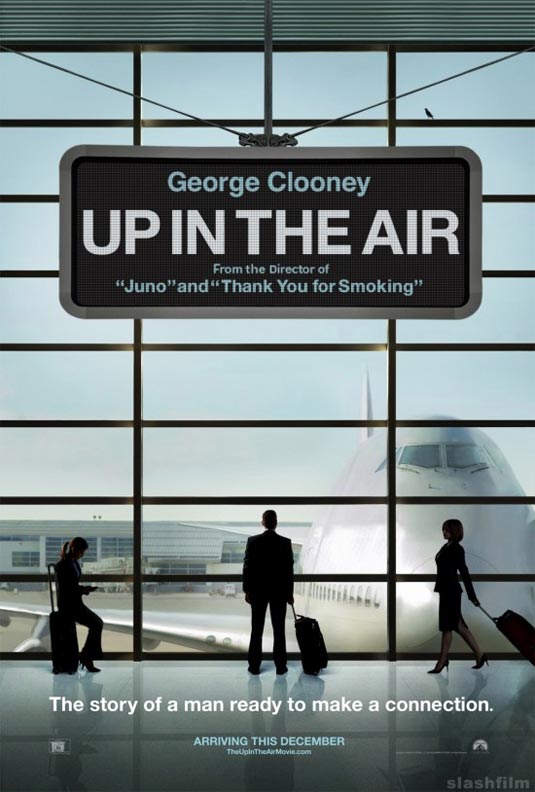 There's a lot of talk about “Up in the Air” being the movie of the year. It is being mentioned in connection with such great filmmakers as Frank Capra and Preston Sturges for its ability to blend humor and melancholy in a way that captures a specific moment in time. It is film worthy of such comparisons.
This is only director and co-writer Jason Reitman's third film, but in just three films, “Thank You For Smoking,” “Juno” and now “Up in the Air,” he has revealed himself to be an assured, smart filmmaker. While all his films have received limited releases that went wider, make no mistake, these are polished, witty and intelligent mainstream films.
As was true with Capra and Sturges, Reitman works within well-known formulas, story arcs and character types, but within the familiar he explores ideas and emotions with an uncommon honesty. His films are stories of redemption or people seeing the error of their ways, but these well worn paths are walked in ways that are often unexpected.
The main character of “Up in the Air” is Ryan Bingham (George Clooney), who works for a company that sends out people like himself to fire people when their employer doesn't have the cojones to do it themselves. Given the state of our economy, business is good.
Ryan is also a motivational speaker who tries to convince people that living without the weight and baggage of a home and family is ideal. For Ryan putting down roots is death for a human being and so he keeps in the air for all but a few weeks of a year. His home is airports, airplanes and hotel rooms and he is perfectly happy that way.
His livelihood his threatened when his boss (Jason Bateman) takes a shine to an idea presented by a young new employee (Anna Kendrick), who says expenses can be cut if they fire people via video chat. Ryan is forced to take Natalie with him on the road (or rather the air) in an attempt to prove her wrong. While flying across the country Ryan meets Alex (Vera Fermiga, “The Departed”), a woman who appears to have his same view on life and that turns him on.
On the page Ryan doesn't seem like he should be a likable character. As an audience, we shouldn't like him and yet we do, and that is largely because he is embodied by Clooney, one of the few, perhaps the last, true movie star in the classic Hollywood sense. Like Cary Grant, James Stewart or Gary Cooper, he is able to play charismatic men with a sharp wit. Even when his characters aren't cut from an everyman cloth he still manages to exude the vibe of one.
This isn't only Clooney's show, he has strong support from his leading ladies.
Kendrick, whose biggest previous credit is a small role in the “Twilight” series, gives a breakout performance. She is perfect as a very particular kind of ambitious college grad who enters the work field with something to prove. Kendrick presents a confident facade that she knows better than her elders, but also shows in quiet facial expressions and small gestures that she fears she may not be able to walk what she talks.
Fermiga has an easygoing chemistry with Clooney and matches him on every level as they flirt and banter. Fermiga and Clooney are both playing adults, and what I mean is that it is rare that characters in mainstream films are written and allowed to be played as smart, well spoken adults. Even in the third act when their relationship seems to be heading to a conventional conclusion they are both allowed to stay human rather than gears in a plot.
With the exception of a few familiar faces, all the people fired in the film are real recently fired people. Reitman told them to treat the camera like the person who fired them and respond as they did or as they wished they had. This gives an emotional realness to these scenes with reactions that range from amusing to heartbreaking.
This is often a very funny film, certainly funnier than you'd expect a film about firing people would be, but given the subject it is inevitable that there is a sense of pain and tragedy. Reitman balances this material with a fine and compassionate touch that never laughs at the misery of others.
Saturday, December 26, 2009
'Avatar' is an amazing visual achievement
 Writer/director James Cameron has always been a filmmaker that tries to improve and expand visual effects. His back-to-back films "The Abyss" and "Terminator 2" made giant leaps forward for digital effects. His last film "Titanic" utilized computers to recreate the infamous boat. Now with “Avatar,” his first narrative in 12 years, he has created an extraordinary technical and visual achievement that is a massive step forward in the burgeoning motion capture technology.
Motion capture, which uses special censors that allow computers to animate over an actor's performance, was most recently employed in Robert Zemeckis’ “A Christmas Carol. ” As was true with Zemeckis’ “The Polar Express” and “Beowulf” the technique created an eerie living wax figure effect.
The technique can be effective — as with Gollum in “Lord of the Rings” — but the way Zemeckis has been utilizing it has been less than convincing. With all this in mind, many went into “Avatar” with justifiable skepticism especially since the film is the most expensive ever made with a budget of $300 million.
That’s a lot of money up on screen, but it appears to be well spent. Cameron and his effects team have pushed the motion capture technology and computer generated effects to new and fully convincing levels. Alien creatures, both humanoid and beastly, and in many cases the landscapes in which they roam, are completely computer generated and you don’t doubt it for a second.
So, does the story justify all the technology that is thrown at it? While not the most astounding plot, the film does tell an interesting, if familiar, story. On a distant moon called Pandora, a military run settlement of Earthlings has an unease relationship with the Na’vi, the blue skinned native race. The reason for the settlement is to extract a valuable energy source.
Humans are unable to breathe on Pandora, but through avatars that are controlled through the mind and look like the natives it is possible to roam around and interact with the locals. This is great news for Jake Sully (Sam Worthington), a paraplegic Marine who gets to do all the things he no longer can in his real life as well as a few things he could only dream of doing. Jake is chosen by a local tribe to learn their ways under Neytiri (Zoe Saldana, “Star Trek”).
The Jake character follows an arc similar to “Dances with Wolves” and “The Last Samurai.” When his military decides to take the Na’vi land by force he must choose sides. It is no surprise what side he picks.
The final third of the film involves this battle and while it is thrilling it also when the film becomes the most cliché. Stephen Lang’s (“The Men Who Stare at Goats”) villainous colonel is a one dimensional gung-ho military blowhard that in some respects recalls Tom Berenger’s character from “Platoon,” but with none of that film’s substance.
All the Na’vi characters and the avatars are computer animated actors, but do not look like walking cartoons. They look, for lack of a better word, real and after a while you simply accept it. You also accept the dragon-like creatures they fly on in some of the film’s most stunning and breathtaking sequences.
Worthington, who stole this summer’s “Terminator Salvation,” but still remains relatively unknown, gives another solid performance both as Jake Sully and his avatar counterpart. He has a way of being introspective and hint at his inner thoughts. Plus he’s just one of those actors that is easy to almost instantly identify with.
The rest of cast is filled with reliable actors like Michelle Rodriquez and Sigourney Weaver, doing a variation of her tough-as-nails “Aliens” persona, which makes sense since Cameron also directed that film. Weaver has some of the best lines in the film.
The film is letdown from greatness by some of the same awkward dialogue and plotting that was in “Titanic,” but regardless this is an extraordinary looking film that is well acted. Visually this undeniably compelling and absolutely needs to be seen, especially for fans of the sci-fi and adventure genres.
Friday, December 18, 2009
10 favorite songs of the decade
As the decade comes to close let's take a moment to look back on some of the best song from the first 10 years of the 21st century.
“Yellow” - Coldplay (2000)
With Radiohead moving away from the purer joys of Brit pop on their acclaimed “Kid A” a need was left that Coldplay filled. “Yellow” is a simple and honest love song and although it only hints at what would come from the band, it remains one of their most endearing songs.
“Thank You” - Dido (2001)
The song first appeared in 1998, but wasn't officially released as a single until 2001 after the song was sampled on Eminem's “Stan.” The song became a hit in its own right and for good reason: it is a sweet, unpretentious song about how being loved can make your day.
“Fell in Love With a Girl” - The White Stripes (2002)
Clocking in at less than two minutes, the song is an infectious blast of fast, furious, raw rock that heralded the mainstream arrival of The White Stripes, a duo that can rock harder than some full bands.
“Hey Ya” - OutKast (2003)
OutKast is one of the more inventive hip hop acts of the decade and “Hey Ya” is their pinnacle, an inordinately catchy track that masks some painful break up lyrics. Of course there's also that wonderful breakdown: shake it like Polaroid picture.
“Take Me Out” - Franz Ferdinand (2004)
The song starts out with a piercing repeated basic guitar riff before making one of the most fantastic transitions of the decade. “Take Me Out” morphs into a thumping dance track for the rock crowd with ambiguously dark lyrics.
“Black Horse and the Cherry Tree” - KT Tunstall (2005)
A deceptively simple song that with some well placed “woo hoos” and a catchy beat became one of the more surprisingly hits of 2005. Featuring lyrics that are smarter than the average pop song, it reminds that pop music doesn't need to be superficial.
“Crazy” - Gnarls Barkley (2006)
Gnarls Barkley, a collaboration between hip-hop artist Cee-Lo and producer Danger Mouse, produced one of the truly great songs of the decade, a massive crossover hit that sounds both classic and modern. It is a seemingly indestructible song. I've heard at least a dozen covers in varying style and the song always works.
“1234” - Feist (2007)
Feist bounced around the indie music scene for years, but, thanks to an assist by an iPod commercial, “1234” propelled her into the mainstream in a big way. With its childlike lyrics like “1, 2, 3, 4 tell me that you love me more” and cheery acoustic sound it is an undeniable feel-good song.
“A-Punk” - Vampire Weekend (2008)
Vampire Weekend blends “Graceland”-era Paul Simon with the the quirker tendencies of artists like Peter Gabriel, who they name check in another song, to create a sound not entirely their own, but one that is sorely lacking from radio. This is a quick, fun danceable track.
“1901” - Phoenix (2009)
This French band released a few albums this decade with moderate success, but this year's “Wolfgang Amadeus Phoenix” struck a cord. “1901” is a solid pop song that hooks you quick and holds on. It will make you bop your head and feel happy.
“Yellow” - Coldplay (2000)
With Radiohead moving away from the purer joys of Brit pop on their acclaimed “Kid A” a need was left that Coldplay filled. “Yellow” is a simple and honest love song and although it only hints at what would come from the band, it remains one of their most endearing songs.
“Thank You” - Dido (2001)
The song first appeared in 1998, but wasn't officially released as a single until 2001 after the song was sampled on Eminem's “Stan.” The song became a hit in its own right and for good reason: it is a sweet, unpretentious song about how being loved can make your day.
“Fell in Love With a Girl” - The White Stripes (2002)
Clocking in at less than two minutes, the song is an infectious blast of fast, furious, raw rock that heralded the mainstream arrival of The White Stripes, a duo that can rock harder than some full bands.
“Hey Ya” - OutKast (2003)
OutKast is one of the more inventive hip hop acts of the decade and “Hey Ya” is their pinnacle, an inordinately catchy track that masks some painful break up lyrics. Of course there's also that wonderful breakdown: shake it like Polaroid picture.
“Take Me Out” - Franz Ferdinand (2004)
The song starts out with a piercing repeated basic guitar riff before making one of the most fantastic transitions of the decade. “Take Me Out” morphs into a thumping dance track for the rock crowd with ambiguously dark lyrics.
“Black Horse and the Cherry Tree” - KT Tunstall (2005)
A deceptively simple song that with some well placed “woo hoos” and a catchy beat became one of the more surprisingly hits of 2005. Featuring lyrics that are smarter than the average pop song, it reminds that pop music doesn't need to be superficial.
“Crazy” - Gnarls Barkley (2006)
Gnarls Barkley, a collaboration between hip-hop artist Cee-Lo and producer Danger Mouse, produced one of the truly great songs of the decade, a massive crossover hit that sounds both classic and modern. It is a seemingly indestructible song. I've heard at least a dozen covers in varying style and the song always works.
“1234” - Feist (2007)
Feist bounced around the indie music scene for years, but, thanks to an assist by an iPod commercial, “1234” propelled her into the mainstream in a big way. With its childlike lyrics like “1, 2, 3, 4 tell me that you love me more” and cheery acoustic sound it is an undeniable feel-good song.
“A-Punk” - Vampire Weekend (2008)
Vampire Weekend blends “Graceland”-era Paul Simon with the the quirker tendencies of artists like Peter Gabriel, who they name check in another song, to create a sound not entirely their own, but one that is sorely lacking from radio. This is a quick, fun danceable track.
“1901” - Phoenix (2009)
This French band released a few albums this decade with moderate success, but this year's “Wolfgang Amadeus Phoenix” struck a cord. “1901” is a solid pop song that hooks you quick and holds on. It will make you bop your head and feel happy.
Favorite films of the decade: Part 2
Welcome to part two of my look back at my 21 favorite films of the first decade of the 21st century.
“Shaun of the Dead” (2004)
Imagine a British romantic comedy with a slacker trying to win his ex-girlfriend back. Nothing special, right? Now add zombies into the mix. This is the movie that introduced American audiences, to the joys of Simon Pegg and his best mate on and off camera, Nick Frost. They are a dynamic comedic duo in a genre parody that doesn’t forget to create characters that we actually care about.
“Kill Bill Vol. 2” (2004)
Quentin Tarantino's tribute to chopsocky films and spaghetti westerns was originally one very long film, but in an attempt to make more money the film was split in two.“Vol. 2” is the more talky of the two with a brilliantly charismatic performance by David Carradine. What started out as just stylish fun in “Vol. 1” becomes surprisingly affecting by the end of “Vol. 2.”
“Little Miss Sunshine” (2006)
The film was advertised as a madcap road movie and a parody of beauty contests, but this look at a dysfunctional family runs deeper. The idiosyncratic family is believably brought to life by Greg Kinnear, Steve Carell, Alan Arkin, Paul Dano, Abigail Breslin and Toni Collette. This is a feel-good film that mines its humor from reality and the sort of movie that will make you laugh and cry, maybe even at the same time.
“Pan's Labyrinth” (2006)
Thanks to “Lord of the Rings” and “Harry Potter,” this was the decade that saw the return of the fantasy film. For me, though, this is the best example of the genre. A girl escapes to a dark, scary fantasy world that is still more appealing than reality: fascist Spain in 1944. The endlessly imaginative writer/director Guillermo Del Toro has crafted a fairy tale in the original, slightly twisted tradition. It is a disturbing, but beautiful film.
“Stranger Than Fiction” (2006)
“Saturday Night Live” alum Will Ferrel became a big star early on in the decade in comedies like “Anchorman” and “Elf,” but here he reveals he can be more than just a goof. The ingenious premise has a man hearing a woman (Emma Thompson) narrating his life. The film is funny and features a sweet romance with Maggie Gyllenhaal, but it is also thoughtful and philosophical in surprising and moving ways.
“Children of Men” (2006)
Few films of the decade struck me as profoundly as this one. This is science fiction deeply rooted in reality and a cautionary tale of weight and depth. In the future, women have become infertile, but hope comes from the first pregnancy in 18 years. Clive Owen, Michael Caine, Julianne Moore and others desperately fight to bring the mother to a safe haven. It isn't easy viewing, but absolutely rewarding in the end.
“No Country For Old Men” (2007)
The Coen Brothers, the quirky filmmakers behind such films as “Fargo” and “The Big Lebowski,” serve up an extremely faithful reworking of Cormac McCarthy’s novel about a man who stumbles upon a satchel of money from a drug deal gone wrong and the unrelenting killer that comes after him. With Anton Chigurh, Javier Bardem created one of the most memorable villains of this decade, or any decade for that matter.
“Juno” (2007)
In this fresh and endearing comedy, a smart, sardonic 16-year-old (Ellen Page) becomes pregnant and decides to give the baby up for a adoption to a seemingly perfect couple (Jennifer Garner and Jason Bateman). Some claim the film’s dialogue is too clever, but it is all about the delivery and the fantastic Page nails the tone. The film inches up on the predictable, but takes a sharp left into an ending that is completely satisfying.
“Across the Universe” (2007)
The musical genre was revived thanks to the success of films like “Moulin Rouge” and “Chicago,” but this is the one I keep returning to. A musical comprised entirely of Beatles songs is a dangerous endeavor to undertake, and, while Julie Taymor’s film is flawed, it is also ambitious, visually stunning and has flashes of brilliance. The film is a joy for Beatles fan, with re-interpretations of classic songs that are at times thrilling.
“The Dark Knight” (2008)
This was the decade of the superhero movie with “Iron Man” the “X-Men” and “Spiderman” all getting worthy adaptations, but “The Dark Knight” stands above the rest. The second film in director Christopher Nolan's reboot of the “Batman” franchise is a fully realized crime epic that deepens previously presented themes. The film is fueled by the late Heath Ledger’s extraordinary performance as the Joker, a performance that is the stuff of legends.
“Up” (2009)
Pixar Animation has the most consistent track of any film company working today with each film better than the last. “Up” stars a grumpy widower (Ed Asner), who when threatened with a retirement home uses thousands of balloons to convert his home into a flying house and sets off to South America. The film is bright and funny, but has an emotional resonance that few animated films achieve.
“Shaun of the Dead” (2004)
Imagine a British romantic comedy with a slacker trying to win his ex-girlfriend back. Nothing special, right? Now add zombies into the mix. This is the movie that introduced American audiences, to the joys of Simon Pegg and his best mate on and off camera, Nick Frost. They are a dynamic comedic duo in a genre parody that doesn’t forget to create characters that we actually care about.
“Kill Bill Vol. 2” (2004)
Quentin Tarantino's tribute to chopsocky films and spaghetti westerns was originally one very long film, but in an attempt to make more money the film was split in two.“Vol. 2” is the more talky of the two with a brilliantly charismatic performance by David Carradine. What started out as just stylish fun in “Vol. 1” becomes surprisingly affecting by the end of “Vol. 2.”
“Little Miss Sunshine” (2006)
The film was advertised as a madcap road movie and a parody of beauty contests, but this look at a dysfunctional family runs deeper. The idiosyncratic family is believably brought to life by Greg Kinnear, Steve Carell, Alan Arkin, Paul Dano, Abigail Breslin and Toni Collette. This is a feel-good film that mines its humor from reality and the sort of movie that will make you laugh and cry, maybe even at the same time.
“Pan's Labyrinth” (2006)
Thanks to “Lord of the Rings” and “Harry Potter,” this was the decade that saw the return of the fantasy film. For me, though, this is the best example of the genre. A girl escapes to a dark, scary fantasy world that is still more appealing than reality: fascist Spain in 1944. The endlessly imaginative writer/director Guillermo Del Toro has crafted a fairy tale in the original, slightly twisted tradition. It is a disturbing, but beautiful film.
“Stranger Than Fiction” (2006)
“Saturday Night Live” alum Will Ferrel became a big star early on in the decade in comedies like “Anchorman” and “Elf,” but here he reveals he can be more than just a goof. The ingenious premise has a man hearing a woman (Emma Thompson) narrating his life. The film is funny and features a sweet romance with Maggie Gyllenhaal, but it is also thoughtful and philosophical in surprising and moving ways.
“Children of Men” (2006)
Few films of the decade struck me as profoundly as this one. This is science fiction deeply rooted in reality and a cautionary tale of weight and depth. In the future, women have become infertile, but hope comes from the first pregnancy in 18 years. Clive Owen, Michael Caine, Julianne Moore and others desperately fight to bring the mother to a safe haven. It isn't easy viewing, but absolutely rewarding in the end.
“No Country For Old Men” (2007)
The Coen Brothers, the quirky filmmakers behind such films as “Fargo” and “The Big Lebowski,” serve up an extremely faithful reworking of Cormac McCarthy’s novel about a man who stumbles upon a satchel of money from a drug deal gone wrong and the unrelenting killer that comes after him. With Anton Chigurh, Javier Bardem created one of the most memorable villains of this decade, or any decade for that matter.
“Juno” (2007)
In this fresh and endearing comedy, a smart, sardonic 16-year-old (Ellen Page) becomes pregnant and decides to give the baby up for a adoption to a seemingly perfect couple (Jennifer Garner and Jason Bateman). Some claim the film’s dialogue is too clever, but it is all about the delivery and the fantastic Page nails the tone. The film inches up on the predictable, but takes a sharp left into an ending that is completely satisfying.
“Across the Universe” (2007)
The musical genre was revived thanks to the success of films like “Moulin Rouge” and “Chicago,” but this is the one I keep returning to. A musical comprised entirely of Beatles songs is a dangerous endeavor to undertake, and, while Julie Taymor’s film is flawed, it is also ambitious, visually stunning and has flashes of brilliance. The film is a joy for Beatles fan, with re-interpretations of classic songs that are at times thrilling.
“The Dark Knight” (2008)
This was the decade of the superhero movie with “Iron Man” the “X-Men” and “Spiderman” all getting worthy adaptations, but “The Dark Knight” stands above the rest. The second film in director Christopher Nolan's reboot of the “Batman” franchise is a fully realized crime epic that deepens previously presented themes. The film is fueled by the late Heath Ledger’s extraordinary performance as the Joker, a performance that is the stuff of legends.
“Up” (2009)
Pixar Animation has the most consistent track of any film company working today with each film better than the last. “Up” stars a grumpy widower (Ed Asner), who when threatened with a retirement home uses thousands of balloons to convert his home into a flying house and sets off to South America. The film is bright and funny, but has an emotional resonance that few animated films achieve.
Friday, December 11, 2009
Favorite films of the decade: Part 1
As we quickly approach the end of the year, we also grow closer to the conclusion of the decade. With the end of a decade comes retrospectives and I offer mine in the form of a two-part list of my 21 favorite films of whatever this decade was called. Why 21? Because this was the first decade of the 21st century. There is logic behind my madness.
“High Fidelity” (2000)
John Cusack co-produced, co-wrote and starred in this sharp adaptation of Nick Hornby's novel about music obsession and the confusion of love. Cusack's recently dumped Rob Gordon tries to figure out where he went wrong by looking back at his past disasters. The film is honest and insightful about relationships and often hilarious with Jack Black in his breakout role. This is perhaps the definitive romantic comedy of the decade.
“Almost Famous” (2000)
Writer/director Cameron Crowe's autobiographical love note to rock and roll fictionalizes his real-life experience working as a writer for Rolling Stone as a teen. Some complained this a rose-colored look at the 1970s, but it is the nature of nostalgia to remember and enhance the best parts. This is a warm and funny film with terrific performances from Frances McDormant, Jason Lee, Billy Crudup, Philip Seymour Hoffman and a never better Kate Hudson.
“The Royal Tenenbaums” (2001)
Writer/director Wes Anderson, whose “Fantastic Mr. Fox” is currently in theaters, followed up his breakthrough hit “Rushmore” with this look at a dysfunctional family of former prodigies. Anderson perfected his deadpan, quirky style and his ability to jump between comedy and drama within the same moment. The great ensemble cast includes Gene Hackman, Anjelica Huston, Ben Stiller, Gwyneth Paltrow, Luke Wilson, Owen Wilson, Danny Glover and Bill Murray.
“Ocean's Eleven” (2001)
This was the decade in which Hollywood went remake and sequel crazy, but here's a remake done pitch perfect and actually spawned two worthy sequels. Director Steven Soderbergh has made a career of balancing indie projects with Hollywood films, but luckily he brings the same vitality to all his projects. This is an all style film that works thanks to the charismatic all-star cast that includes George Clooney, Brad Pitt, Matt Damon, Julia Roberts, Andy Garcia, Bernie Mac, Don Cheadle, Elliot Gould, Casey Affleck and Carl Reiner.
“28 Days Later” (2002)
Thanks to the adaptation of the video game “Resident Evil,” the zombie genre was resurrected, but it was this English import that made the genre relevant again. Director Danny Boyle and writer Alex Garland balance social commentary with scares and add humanity and beauty to the mix. Shot on digital video, the film has a gritty, realistic feel especially in the opening scenes in which Cillian Murphy walks through a completely deserted London.
“The Bourne Identity” (2002)
A spy thriller with a twist: The trained assassin has no memory, but retains all his skills. It was no surprise that Matt Damon was able to bring a lot of humanity to the character of Jason Bourne, but what was a shock was how well Damon handled himself in the fight sequences. Along with the “Ocean” movies, this would go on to spawn one of the decade's few consistently solid franchises.
“Pirates of the Caribbean: Curse of the Black Pearl” (2003)
A movie based on a Disneyland ride could have been nothing more than an extended advertisement, but what may have been never was thanks to a brilliantly off-the-wall characterization by Johnny Depp. Depp's Jack Sparrow is a true original, one of the all-time great characters. Geoffrey Rush as his main adversary is nearly his match and their double act is a lot of fun. The two sequels attempted to replicate the magic, but largely missed the mark.
“Lost in Translation” (2003)
Writer/director Sofia Coppola's second film was a perceptive, quietly funny and lovely film about two lonely people, an actor (Bill Murray) and a photographer's wife (Scarlett Johansson), who connect while in Japan. This is a love story, but not in any conventional ways. Even familiar plot developments don't play out as one might expect. Murray is as funny as ever but also much more, and Johansson proves to be a perfect foil.
“School of Rock” (2003)
Much like Soderbergh, director Richard Linklater is a filmmaker that balances smaller projects with more mainstream work. Linklater brings an edge to all his films that rises what could be very standard material to a higher level. Jack Black, in a role written for him, is hilariously perfect as a wannabe rocker turned substitute teacher who transforms his students into a rock band. This is a prime example of a formula movie that works extremely well.
“Eternal Sunshine of the Spotless Mind” (2004)
The wonderfully weird and wholly original writer Charlie Kaufman takes on the idea of memory itself in a film about a man (Jim Carrey), who decides to have the memories of an ex-girlfriend (Kate Winslet) erased. Both actors beautifully play against their respective types with Carrey giving an understated and believable performance. Largely taking place in Carrey's mind, director Michel Gondry's execution of the film is inventive and full of imaginative visuals.
“High Fidelity” (2000)
John Cusack co-produced, co-wrote and starred in this sharp adaptation of Nick Hornby's novel about music obsession and the confusion of love. Cusack's recently dumped Rob Gordon tries to figure out where he went wrong by looking back at his past disasters. The film is honest and insightful about relationships and often hilarious with Jack Black in his breakout role. This is perhaps the definitive romantic comedy of the decade.
“Almost Famous” (2000)
Writer/director Cameron Crowe's autobiographical love note to rock and roll fictionalizes his real-life experience working as a writer for Rolling Stone as a teen. Some complained this a rose-colored look at the 1970s, but it is the nature of nostalgia to remember and enhance the best parts. This is a warm and funny film with terrific performances from Frances McDormant, Jason Lee, Billy Crudup, Philip Seymour Hoffman and a never better Kate Hudson.
“The Royal Tenenbaums” (2001)
Writer/director Wes Anderson, whose “Fantastic Mr. Fox” is currently in theaters, followed up his breakthrough hit “Rushmore” with this look at a dysfunctional family of former prodigies. Anderson perfected his deadpan, quirky style and his ability to jump between comedy and drama within the same moment. The great ensemble cast includes Gene Hackman, Anjelica Huston, Ben Stiller, Gwyneth Paltrow, Luke Wilson, Owen Wilson, Danny Glover and Bill Murray.
“Ocean's Eleven” (2001)
This was the decade in which Hollywood went remake and sequel crazy, but here's a remake done pitch perfect and actually spawned two worthy sequels. Director Steven Soderbergh has made a career of balancing indie projects with Hollywood films, but luckily he brings the same vitality to all his projects. This is an all style film that works thanks to the charismatic all-star cast that includes George Clooney, Brad Pitt, Matt Damon, Julia Roberts, Andy Garcia, Bernie Mac, Don Cheadle, Elliot Gould, Casey Affleck and Carl Reiner.
“28 Days Later” (2002)
Thanks to the adaptation of the video game “Resident Evil,” the zombie genre was resurrected, but it was this English import that made the genre relevant again. Director Danny Boyle and writer Alex Garland balance social commentary with scares and add humanity and beauty to the mix. Shot on digital video, the film has a gritty, realistic feel especially in the opening scenes in which Cillian Murphy walks through a completely deserted London.
“The Bourne Identity” (2002)
A spy thriller with a twist: The trained assassin has no memory, but retains all his skills. It was no surprise that Matt Damon was able to bring a lot of humanity to the character of Jason Bourne, but what was a shock was how well Damon handled himself in the fight sequences. Along with the “Ocean” movies, this would go on to spawn one of the decade's few consistently solid franchises.
“Pirates of the Caribbean: Curse of the Black Pearl” (2003)
A movie based on a Disneyland ride could have been nothing more than an extended advertisement, but what may have been never was thanks to a brilliantly off-the-wall characterization by Johnny Depp. Depp's Jack Sparrow is a true original, one of the all-time great characters. Geoffrey Rush as his main adversary is nearly his match and their double act is a lot of fun. The two sequels attempted to replicate the magic, but largely missed the mark.
“Lost in Translation” (2003)
Writer/director Sofia Coppola's second film was a perceptive, quietly funny and lovely film about two lonely people, an actor (Bill Murray) and a photographer's wife (Scarlett Johansson), who connect while in Japan. This is a love story, but not in any conventional ways. Even familiar plot developments don't play out as one might expect. Murray is as funny as ever but also much more, and Johansson proves to be a perfect foil.
“School of Rock” (2003)
Much like Soderbergh, director Richard Linklater is a filmmaker that balances smaller projects with more mainstream work. Linklater brings an edge to all his films that rises what could be very standard material to a higher level. Jack Black, in a role written for him, is hilariously perfect as a wannabe rocker turned substitute teacher who transforms his students into a rock band. This is a prime example of a formula movie that works extremely well.
“Eternal Sunshine of the Spotless Mind” (2004)
The wonderfully weird and wholly original writer Charlie Kaufman takes on the idea of memory itself in a film about a man (Jim Carrey), who decides to have the memories of an ex-girlfriend (Kate Winslet) erased. Both actors beautifully play against their respective types with Carrey giving an understated and believable performance. Largely taking place in Carrey's mind, director Michel Gondry's execution of the film is inventive and full of imaginative visuals.
Friday, December 04, 2009
'Fantastic Mr. Fox' is aptly named
 Much like the recent adaptation of “Where the Wild Things Are,” director Wes Anderson's take on Roald Dahl's “Fantastic Mr. Fox” is marked by a sophistication and an unwillingness to pander that is lacking for most kid-friendly entertainment.
 As with the Pixar films, this is an animated feature with substance.
“Fantastic Mr. Fox” is the latest film to utilize stop-motion animation, a technique dating back to the original 1933 “King Kong,” in which models are slowly moved one painstaking shot at a time.
This isn't the first time Dahl has been given the stop-motion treatment. That honor goes to 1996's “James and the Giant,” which was directed by Henry Salick, who also directed Tim Burton's “Nightmare Before Christmas,” one of the most popular and memorable stop-motion animated films. Salick, who provided stop-motion animated creatures for Anderson's “The Life Aquatic with Steve Zissou,” was set to collaborate with Anderson again for “Fantastic Mr. Fox,” but made “Coraline” instead.
Anderson is a rare modern director who is a true auteur. He has developed a distinct style, tone and themes that he continues to utilize. His films are marked by a dry, deadpan sense of humor and walk the line between comedy and pathos. Throughout his films, which include “Rushmore” and “The Royal Tenenbaums,” he explores how dysfunctional families manage to function in spite of deceit, distance and other dubious behavior.
Dahl's children's novels, which include such popular book-to-film adaptations as “Willy Wonka and the Chocolate Factory,” “The Witches,” and “Matilda,” always featured sinister undertones. Things would always work out, but as an author he had no problem sending his young protagonists into dark territory. Oddly enough the mash up of Dahl and Anderson's sensibilities works creating a film with a fresh voice.
The plot centers on Mr. Fox (voiced by George Clooney), a retired chicken thief turned journalist, who comes out of retirement for one last heist, or rather three: the local farmers Bean, Boggis and Bunce. The farmers don't take kindly to the pilfering and wag war against Mr. Fox and his family. Mr. Fox and the other animals in the valley are forced to literally go underground.
Anderson utilizes this framework to explore his usual themes. Anderson has transformed the titular Mr. Fox into his familiar flawed patriarch and added a rivalry between Mr. Fox's son (Jason Schwartzman) and his nephew (Eric Anderson). Lessons are learned and there's a familiar moral that we should embrace our differences. This can be an eye-rolling message when in the wrong hands, but Anderson delivers it in a way that feels honest.
Adults have a tendency to dismiss animated movies as just for kids, but this a film that will probably appeal more to parents than kids. The dialogue is very much pitched at adults. Anderson uses an amusing gimmick of substituting the word cuss in the place of all profanities. My personal favorite: cluster-cuss.
There's still plenty of bright, colorful and imaginative action and slapstick antics to keep kids in the audience appeased. The complicated game whackbat, the use of tranquilizer-laced blueberries to dispose of attack dogs and the way in which the animals ravenously eat their food should tickle the funny bone of kids and adults alike.
The voice acting, which also includes Meryl Streep as Mrs. Fox, Michael Gambon as Bean, Bill Murray, Willem Dafoe, and Owen Wilson, is splendid. Traditionally, voice-over actors are kept separated in their own little booths, but Anderson had his actors recorded together. Does this make a drastic difference in the vocal performances? It isn't hugely noticeable, but the caliber of the performances is excellent, so perhaps it did make an impact.
As for the animation, the style seems to be a throwback to stop-motion of the 1960s, similar to the kind used for such beloved holiday specials as “Rudolph the Red Nose Reindeer.” The animation here is vastly more refined and intricate with astounding detail on the puppets but at the same time is not as polished as Salick's “Coraline.” It works, though, as it gives the film a more of a homemade feel that really is delightful.
Friday, November 27, 2009
Some 'new' but mostly same old 'Twilight'
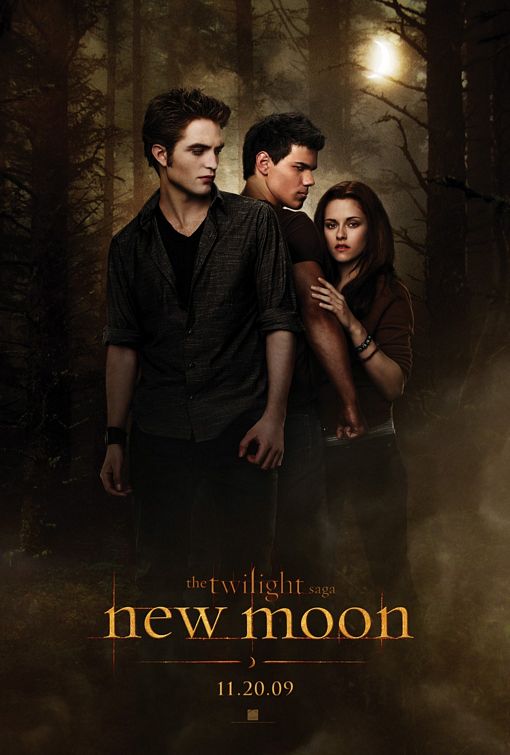 The first “Twilight” movie was a massive box office hit, making nearly $385 million worldwide. That's chump change to what its sequel, “The Twilight Saga: New Moon,” is likely to make. In just three days, “New Moon” earned $285 million worldwide. We've got a monster on our hands.
“New Moon” continues the love story of Bella Swan (Kristen Stewart) with the vampire Edward Cullen (Robert Pattinson). Events early in the film convince Edward that Bella isn't safe in his world, and so he and his vampire family leave town.
The heartbroken Bella falls into a deep depression and is only able to pull herself out of it with the help of her friend Jacob (Taylor Lautner), who turns out to be a werewolf that must hunt and kill vampires. His clan has an uneasy truce with the Cullen family.
A chain of events sends Bella to Italy to save a suicidal Edward from sacrificing himself to the Volturi, a sort of vampire royalty.
It is easy to see the appeal of the “Twilight” series to teen and tween girls. Bella not only has the obsessive love of one gorgeous supernatural being, but two — and girls can get vicarious thrills from the love triangle.
My biggest problem with the series is that Bella sends the wrong message to girls.
She's is selfish, self-absorbed, whiny and clingy. Bella doesn't have an arc in which she grows out of these traits; if anything they get worse as the series goes on. She defines herself by being with Edward and then, when that temporarily isn't an option, defines herself by Jacob.
“Twilight” was actually a reasonably well-written book. It was well paced and had a distinct voice. Author Stephanie Meyers doesn't sustain the pacing throughout the rest of the series, which becomes meandering and redundant.
Screenwriter Melissa Rosenberg missed the mark in her adaptation of “Twilight” and accentuated all the wrong things, namely the longing stares and overly dramatic declarations of love. In “New Moon” her adaptation is more focused and she removes a lot of Bella's self-loathing. There's still plenty of Bella's sorrow on screen, but not nearly as much as in the book, which says something about the book.
“New Moon,” at least as a film, is a step up from “Twilight.” There's still much of the emotional sameness that plagued “Twilight,” but director Chris Weitz (“The Golden Compass”) is more of a filmmaker than “Twilight” director Catherine Hardwicke. He manages to sneak in at least one visually poetic moment in which we see the passage of three months in a matter of moments.
Weitz also nicely visualizes when Bella has visions of Edward, and the climatic sequence in Italy, though rushed, is visually stunning.
The acting leaves something to be desired. Stewart and Pattinson play everything on one note of pained pining. Even before their breakup there seems to be no joy in there relationship. Perhaps intense brooding is more romantic.
Lautner is a bit better as Jacob. He brings a cheerful and jovial energy to the character that helps make parts of the film more palatable. There's a funny scene in which Bella takes Jacob and another friend (Michael Welch) to the movies. This scene, more so than any other, captures what being a teen is like. There are other brief moments when Jacob is goofing around with friends that approximate real teen interaction.
Unfortunately, when Lautner goes wolf midway through the movie he becomes just as serious and somber as Stewart and Pattinson. Why is everything so dire for these characters?
The best performance comes from Michael Sheen (“Frost/Nixon”) as the head of Volturi. He is an odd mixture of menacing and playful. Dakota Fanning briefly appears as a sinister member of the Volturi clan and does a good job playing against her precocious persona. Billy Burke as Bella's dad also has nice moments both tender and funny.
The movie ends with an abrupt cliffhanger, but fear not: The next film is only a few months away. “The Twilight Saga: Eclipse” is due out June 30, 2010. I'm sure the lines are already beginning.
Friday, November 20, 2009
Carrey great in overly flashy 'Carol'
 Director Robert Zemeckis brings his obsession with motion capture animation technology to Charles Dickens' beloved holiday classic “A Christmas Carol,” a story that strikes such a resonate cord that even if you've heard it a 100 times it still as the power to move.
I have yet to be convinced by motion capture, at least as employed by Zemeckis. Motion capture uses special censors that allow computers to animate over an actor's performance so not only are they providing the voice to their animated counterpart, but the movements as well.
When this is employed as a tool in a live action film it can be quite effective. The technique was used by Peter Jackson to create Gollum in “Lord of the Rings” and Kong in “King Kong.” Earlier this year, Zack Synder used it to transform Billy Crudup into Dr. Manhattan in “Watchmen.”
This is Zemeckis' third film using the technique following “The Polar Express” and “Beowulf.” As was true with those films, the way in which Zemeckis chooses to animate his actors leaves them looking like dead-eyed wax figures that look realistic and fake at the same time.
Thankfully, unlike in “Beowulf,” the actors have not been animated so they look almost exactly like they do in real life. In “Beowulf” it was easy to spot the likes of Angelina Jolie and Anthony Hopkins, which defeated the purpose of animating them in the first place.
Zemeckis does create a fabulous animated world for the actors to inhabit. In the title sequence he sends the audience on a fantastic aerial tour of 19th century London from the roof tops to the bustling city streets. He makes London just as much a character in the film as Ebenezer Scrooge.
Jim Carrey stars as the crotchety miser Scrooge as well as the three spirits who visit and tell him to get his act straight or face a rather dismal after life. Carrey makes a surprisingly good Scrooge. He dials down his more over-the-top tendencies and creates a Scrooge that is truly menacing. When Scrooge changes his ways, Carrey brings such joy to the performance that it is hard to not be taken up in the moment.
Carrey is such a physical actor with such an expressive face that he even manages to over come that dead-eyed effect. The emotion that Carrey is giving to Scrooge comes shining through the layers of computer generated animation.
As with Carrey, Gary Oldman plays multiple roles appearing as Jacob Marley, Bob Crotchit and Tiny Tim. Other familiar voices include Robin Wright Penn as Scrooge's love interest Belle, Bob Hoskins as Scrooge's former employee Fezziwig and Colin Firth as Scrooge's nephew Fred.
Zemeckis, who also wrote the script, does a faithful adaptation of Dickens' story that plays up the ghost story aspect. There are some genuinely frightening bits in this version especially the death of the Ghost of Christmas Present.
There is one sequence that feels glaringly out of tone and place with the rest of material. In the Ghost of Christmases Yet to Come sequence, Zemeckis stages an elaborate chase involving a miniaturized Scrooge. The sequence was clearly added so there could be a big action scene to best utilize the 3D that is available in some theaters.
In general, Zemeckis seems to favor showcasing his swooping 3D animation with the ghosts fly Scrooge all over London, which is admittedly is thrilling to watch. Unfortunately, he short-sheets some of the stories more human scenes simply to have Scrooge whisked away for another flight.
Very little time is spent establishing any sort of emotional connection between Scrooge and Belle, the Fezziwig party feels far too brief and the conclude scenes are rushed. This is all shame because the film is the most effective when it slows down and allows for the quiet moments. Even in their abbreviated state the concluding scenes are some of the best in any “Christmas Carol” adaptation.
Friday, November 13, 2009
A very funny group of 'men'
 With an attention grabbing name like “The Men Who Stare at Goats,” the latest George Clooney-produced film has an advantage over the competition: Your interest is piqued, you want to know more. Thankfully, the film, an offbeat military comedy, earns the interest its name garners.
“The Men Who Stare at Goats” is based on a true story, a tag that always has to be taken with a grain of salt. Hollywood is known to take a kernel of truth and blow it up into a big, puffy piece of popcorn. In this case, that truth may be harder swallow.
The film reveals that in the early 1980s, the United State military did research in psychic warfare in an attempt to create soldiers with super powers. That much is true. Whether you believe that people could do the things the film suggests is another matter entirely. The title comes from the alleged death, through the power of thought, of a goat.
The audience's point of entry into this world is Bob Wilton (Ewan McGregor), a journalist in Kuwait who meets Lyn Cassidy (Clooney), a recently re-activated self-proclaimed "Jedi warrior.” There is a lot of dialogue centered around what it means to be a real Jedi warrior, and the casting of McGregor, who was Obi-Won in the “Star Wars” prequels, becomes a joke in itself.
Bob joins Lyn on a road trip of sorts into Iraq circa 2002. Along the way we get flashbacks of how his bizarre program came to be. Jeff Bridges recalling The Dude from “The Big Lebowski” features heavily in these scenes as a hippie general who sold the military on the New Age soldier.
Kevin Spacey also makes an appearance about midway into the film as a slimy would be “warrior monk” who sabotages the program.
Directed by Grant Heslov, a frequent collaborator with Clooney making his directorial debut, the film keeps a light tone. Even while in Iraq there's no real sense of danger. The humor is often broad, but remains smart. Heslov does a nice job of balancing a tone that allows for the material's silliness to shine, but not run amok.
The script by Peter Straughan (“How to Lose Friends and Alienate People”) from Jon Ronson's book is populated with an abundance of laugh-out-loud one-liners and sight gags. Yet Straughan does allow a few moments of poignancy, as in a conversation between Lyn and an Iraqi in which both apologize for the worst of their nationalities.
Everyone plays the film straight. Yes, the actors say and do absurd things, but Clooney, Bridges and Spacey wisely play it with a conviction that let's you know their characters truly believe everything they say and do. That makes all the difference in making this material work.
Clooney, at this point a master of his charm and persona, is consistently funny in delivering his New Age monologues. Bridges does what he does and the day it is no longer funny will be a sad day indeed. That day has not yet come. Spacey seems somewhat wasted for large parts of his screen time, but gets to show off his patented snarky line in the final third.
McGregor, stuck in a straight-man role, could be easy to dismiss as “just an empty shirt” as A.O. Scott of the New York Times put it, but he’s giving a shrewd, low-key comedic performance. McGregor’s transition from skeptic to a believer who willingly participates in the “Jedi” lifestyle reminds that he has always had a fresh, offbeat approach that hasn’t always been properly utilized by Hollywood.
“The Men Who Stare at Goats” just sort of wanders about until reaching a finale that is somewhat anti-climatic, but the film has a goofy charm and remains funny from beginning to end. Days later I'm still chuckling.
Thursday, November 12, 2009
Arts In Motion's ambitious 'Narnia' disappoints
"Narnia: The Lion, the Witch and the Wardrobe” is the Arts in Motion Youth Players most ambitious project to date, but ambitious doesn't mean better. Everyone involved deserves credit for taking on such a big project, but it is clear they bit off more than they could chew.
“The Lion, the Witch and the Wardrobe” is the first book C.S. Lewis wrote in what would become a seven-book series chronicling the adventures in the magical land of Narnia. First published in 1950, it has gone on to become one of the most beloved children's books ever written with numerous adaptations on stage and screen.
The story centers on four children, two boys and two girls, who through a magical wardrobe find their way to Narnia, a world populated by talking animals and fantastic creatures. The children join forces with Aslan the lion, the former ruler of Narnia, to do battle with the evil White Witch who took over the land and covered it in a never-ending winter.
Arts in Motion's production, which continues this weekend at Loynd Auditorium at Kennett High School in North Conway, N.H., has the benefit of an excellent set designed by Marion Owen and Glenn Noble that does a nice job of creating the snow-covered world of Narnia. The centerpiece of the set is a platform and two ramps that are used for cast members to run up and then slide down. The costumes by Jackie Mercer, Kathy Ahearn and Valerie Smith and makeup by Mercer are also handled nicely.
There are two rotating casts for the five lead roles, so I can only comment on the rotation I saw. Of the cast I saw, Rebecca Lees, as Lucy, the youngest of the four children, and Hanna Paven, as Susan, fare the best.
Jake Dunham as the faun Mr. Tumnus is a standout, but unfortunately only has limited time on stage. Tumnus is the first Narnian Lucy meets, and her sweetness prevents the gentle Tumnus from turning her over to the witch.
Meagan Davis is also of note for playing Mrs. Beaver with a Sarah Palin-esque accent. It is an odd and inexplicable choice, but at least she made a choice with her line delivery. Most of the other actors' delivery is stilted and flat as if they were told the only requirement to being an actor is knowing your lines.
Are my expectations too high? They are just young actors after all, they shouldn't be held to the same standard as adult actors, right? To an extent this is true, but younger actors aren't by default bad, as evidenced by the good work done by the teen actors in M&D's “Dog Sees God.” Actors need direction, and under director Noble and assistant director Ged Owen it is unclear they got any beyond where to stand and when to say their lines.
There were also poor choices made in the staging of the show. A red and white strobe light and bass-heavy music is used during fight scenes. This is completely out of place with the look and tone of the show and is unintentionally funny rather than exciting. In addition, there are a couple dance numbers that are well choreographed by Rebecca Sciola, but that go on far too long and merely pad the running time.
The show couldn't even get basic stage direction right. A lamp post is the marker for the point of entry and exit into Narnia. It is placed on the left side of the stage and yet people would enter and exit Narnia on the opposite side of the stage. Would it have been so hard to design the set to have the lamp post on the proper side?
If you are a family member or a friend of one of the cast members, you will probably let things slide more than I did. Part of the fun of community-based theater is seeing people you know on stage, and sometimes it doesn't matter if they were good or bad as long as everyone has fun. I just didn't have much fun.
For more information visit www.artsinmotiontheater.com.
“The Lion, the Witch and the Wardrobe” is the first book C.S. Lewis wrote in what would become a seven-book series chronicling the adventures in the magical land of Narnia. First published in 1950, it has gone on to become one of the most beloved children's books ever written with numerous adaptations on stage and screen.
The story centers on four children, two boys and two girls, who through a magical wardrobe find their way to Narnia, a world populated by talking animals and fantastic creatures. The children join forces with Aslan the lion, the former ruler of Narnia, to do battle with the evil White Witch who took over the land and covered it in a never-ending winter.
Arts in Motion's production, which continues this weekend at Loynd Auditorium at Kennett High School in North Conway, N.H., has the benefit of an excellent set designed by Marion Owen and Glenn Noble that does a nice job of creating the snow-covered world of Narnia. The centerpiece of the set is a platform and two ramps that are used for cast members to run up and then slide down. The costumes by Jackie Mercer, Kathy Ahearn and Valerie Smith and makeup by Mercer are also handled nicely.
There are two rotating casts for the five lead roles, so I can only comment on the rotation I saw. Of the cast I saw, Rebecca Lees, as Lucy, the youngest of the four children, and Hanna Paven, as Susan, fare the best.
Jake Dunham as the faun Mr. Tumnus is a standout, but unfortunately only has limited time on stage. Tumnus is the first Narnian Lucy meets, and her sweetness prevents the gentle Tumnus from turning her over to the witch.
Meagan Davis is also of note for playing Mrs. Beaver with a Sarah Palin-esque accent. It is an odd and inexplicable choice, but at least she made a choice with her line delivery. Most of the other actors' delivery is stilted and flat as if they were told the only requirement to being an actor is knowing your lines.
Are my expectations too high? They are just young actors after all, they shouldn't be held to the same standard as adult actors, right? To an extent this is true, but younger actors aren't by default bad, as evidenced by the good work done by the teen actors in M&D's “Dog Sees God.” Actors need direction, and under director Noble and assistant director Ged Owen it is unclear they got any beyond where to stand and when to say their lines.
There were also poor choices made in the staging of the show. A red and white strobe light and bass-heavy music is used during fight scenes. This is completely out of place with the look and tone of the show and is unintentionally funny rather than exciting. In addition, there are a couple dance numbers that are well choreographed by Rebecca Sciola, but that go on far too long and merely pad the running time.
The show couldn't even get basic stage direction right. A lamp post is the marker for the point of entry and exit into Narnia. It is placed on the left side of the stage and yet people would enter and exit Narnia on the opposite side of the stage. Would it have been so hard to design the set to have the lamp post on the proper side?
If you are a family member or a friend of one of the cast members, you will probably let things slide more than I did. Part of the fun of community-based theater is seeing people you know on stage, and sometimes it doesn't matter if they were good or bad as long as everyone has fun. I just didn't have much fun.
For more information visit www.artsinmotiontheater.com.
Friday, November 06, 2009
Schultz' 'Peanuts' get salty in 'Dog Sees God'
Charlie Brown and Co. grow up in M&D's latest production
“Dog Sees God,” M&D Productions latest show, starts with a fantastic premise of showing Charles Schultz' “Peanuts” characters as teenagers and uses that as a springboard to address such issues as bullying, grieving and sexual discovery.
Since this is an unauthorized adaptation, many of the characters' names have been altered and when the show was first produced it was done under the label of parody to avoid copyright infringement.
The familiar characters are recognizable in Bert V. Royal's script, but they have grown up into swearing, drinking, drug-using, sexually-active teens. The content is no worse than your average R-rated teen comedy, but it is presented in a much more intelligent, thoughtful manner than most entertainment featuring teens.
The show opens with Charlie Brown, now CB (Eric Jordan), and CB's sister (Mary Moody) at a funeral for Snoopy, who had to be put down after going rabid. The death of Snoopy gets CB thinking about the afterlife, and he spends most of the show asking all his friends what they think happens after death.
Linus, now Van (Rafe Matregrano), has become a stoner, which makes perfect sense, since Linus was always going off on philosophical pontifications. Matregrano is absolutely hilarious in the role, nailing every one one of his pot-fueled rants. The best of the bunch: his hatred of Mexican pizza.
Sally, simply known as CB's sister, is constantly changing her world view, but for the duration of show is a Wiccan writing a one-woman show about a caterpillar turning into a platypus. We get to see parts of this show and they are amusing and oddly poignant as performed by Moody.
As was true in the comic strip, CB's sister antagonizes her brother, but ultimately is there for him. Moody and Jordan share a playfully barbed scene toward the end of the play that shows how siblings tease each other, but still care for one another.
Lucy (Rebekah Bushey), simply known as Van's sister, has been institutionalized for setting the Little Red Headed Girl's hair on fire, which, again makes sense. Her character was always a bit of a sadist — after all, she did always pull that football away from poor old Charlie Brown. Bushey only has one scene, but it is a good one as she offers up advice to CB even from the nuthouse.
Peppermint Patty, now Tricia (Amy Smullen), and Marcy (Ellen Hill) are catty mean girls who sit back at lunch mocking everyone. Smullen and Hill make a nice team. They are almost too good at giggling together. When events turn somber, Smullen and Hill reveal that the mean girl act is just a front.
Schroeder, now Beethoven (Matthew Stoker), still just wants to play his piano, but a dark secret from his childhood has made him a social outcast. Stoker gives a nicely restrained and believable performance as a quiet loner who is reluctant to accept CB's friendship. Stoker and Jordan share a very funny piano duet on “Heart and Soul” that scores all its laughs from their opposing facial expressions.
All of these character developments feel like a natural extension of the characters. The one exception is Pigpen, now Matt (Billy Cavanaugh), who has gone from a perpetual cloud of dust to being a germaphobic neat freak.
Matt has a perverse sense of humor and is violently homophobic and is essentially the villain of the piece. Cavanaugh is very good at portraying the character's seething anger, but at the same time hinting at the underlining hurt behind that rage.
Then there is Jordan at the center as CB holding it all together. Jordan, who has shown strength as a comedic actor in M&D's “How the Other Half Loves” and “Lend Me a Tenor,” nicely handles some heavy dramatic scenes. Throughout the show CB has monologues based on a letter he is writing to an unseen pen pal. Jordan is particularly effective in these monologues, in which he is both candid and vulnerable.
The set design by Mark DeLancy is sparse and features familiar iconic images from the comic strip including Snoopy's red doghouse, Schroeder's piano and the brick wall where Charlie Brown and Linus chat. The center piece is a giant piece of paper representing the letter CB is writing to his pen pal. Given the comic strip origins of the show, it is all the production needs.
Director Ken Martin has gotten extraordinary work out of all his actors and deals with the play's more sensitive subject matters in an honest way.
The show is running Thursdays through Saturdays until Nov. 21 at Your Theatre at Willow Commons in North Conway, N.H. There will be a talk back after the show Saturday, Nov. 7. For more information visit www.yourtheatre.com or call 662-7591.
Katy Wright-Mead brings indie film home
Katy Wright-Mead, formerly of Fryeburg, Maine, left the Mount Washington Valley in 2001 to become an actress in New York City. Now, eight years later, she is returning, but not empty handed. She brings with her “The Graduates,” featuring her first major film role, for its New Hampshire/Maine premiere.
“The Graduates,” a coming-of-age comedy about a group of friends who head to the beach for one last hurrah before heading off to college, will be playing one night only at the North Conway Twin Theater in North Conway, N.H. Thursday, Nov. 12, at 7 p.m. There will be a question and answer after the screening with the cast and crew and an after party at Flatbread. Tickets are $8.
“I'm really excited about it,” said Wright-Mead, a 2001 graduate of Fryeburg Academy. “Every time we bring 'The Graduates' to the theater again I get really excited because it is new people that I am watching it with and that energizes me to see people react to the film every time. So to bring it to my hometown and have people I know reacting to this great film and knowing that I brought it there makes me really proud.”
Although Wright-Mead's role in the film is small, she has been intimately involved with the film's post production and marketing.
“I really believe in it,” said Wright-Mead. “I also think it is a great opportunity for me to start learning the behind-the-scenes stuff, how to market. I've sort of been living in the world of 'The Graduates' for a while now.”
And it has been a world that has been good to Wright-Mead and one that she is still excited by. She is eager to see the response on her old stomping ground.
“The first reaction is: 'Oh my God, it is a real movie,' and that is compliment of course,” said Wright-Mead. “My family are all movie lovers and it is really cool to hear them dissect the film and pick out points that they really like and show respect for it as a film and not just my movie, not just something I did, but as a real professional product.”
“The Graduates” was independently produced outside of the Hollywood system for $95,000. The typical model for the distribution of Hollywood film is a saturation of advertising on TV, the Internet, newspapers and radio for a simultaneous nationwide release with a DVD release to follow a few months later. A small percentage of independent, or indie, films are picked up and given this treatment.
“You'd be amazed how many indies just die on the shelf because people have gone onto other things or they just give up or they just don't see how or if they can do it themselves,” said “Graduates” director Ryan Gielen.
But Gielen didn't give up on his film when it wasn't picked up for distribution by one of the Hollywood studios.
“He [Gielen] considered this a business that they were starting and I don't think a lot of independent films do that and that's a unique thing,” said Wright-Mead. “Ryan shot indie film tips and tricks on set thinking ahead of time that this is another way to promote the film. And I know there were other things he did right off the bat in pre-production that were meant to help promote the film done the line.”
The cast and crew have been touring with the film across the country setting up screenings similar to the one in North Conway since May and previous to that were on the film festival circuit picking up awards at the Seattle True Indie Film Fest and the Rhode Island International Film Fest.
"We jokingly refer to it as: 'We don't have a movie, we have a circus,' ” said Gielen. “You just have to flog it everywhere because you don't have the television or radio presence that major studio films do.”
In self-distributing his film, Gielen has embraced free social media outlets like Facebook, Twitter and MySpace and it has yielded him a massive online following. He also has “The Graduates” on amazon.com, iTunes, Netflix and the free video site Hulu.
“If someone is completely dedicated to watching movies through Netflix or completely dedicated to finding movies on iTunes and watching them on their hand-held device and that is how they consume movies, why shut that person out if you're an indie film?” said Gielen.
Getting on these sites wasn't difficult and, according to Gielen, it is possible with a little hustle to be in all these places within a few months of completing a film.
“The downside of those outlets is they don't give you a great turn financially,” said Gielen. “You benefit from those outlets by being available everywhere, so if someone decides to watch your movie they can and will be able to find you in all their usual places.”
Even with that downside, the easy access of his film has helped drive interest to it and push DVD sales and for Gielen, it has always been about finding new ways to keep interest in his film. In keeping with that idea, he is developing new spinoffs from the film including a making of documentary, a remixed version of movie that will be available for free in the spring and a soundtrack contest in which people can vote at www.thegraduatesmovie.com to help create a new soundtrack for the film.
“We gave away our first soundtrack for free," said Gielen. “We had over 10,000 people download it in the first six months. It did great because people really fell in love with the film before they even saw it just from the music and so we wanted to extend that.”
The next step after “The Graduates” is, naturally, another film and Gielen has begun financing a film about a troupe of young, hungry actors who decide to put on an original musical to resurrect their failing careers.
“Now that 'The Graduates' has done so well, we are going out and raising a much bigger budget to do this next one independently as well," he said.
But that doesn't mean that “The Graduates” has been kicked to the curb just yet. As long as there is interest, Gielen will keep “The Graduates” out there because for him there's no greater experience as a filmmaker than to sit with an audience and watch the film.
“Just from a film guy's perspective, the film is so much more enjoyable to watch in a crowded theater than at home,” said Gielen. “We'll tour as long as we can fill a theater, as long as there is excitement about it.”
“The Graduates,” a coming-of-age comedy about a group of friends who head to the beach for one last hurrah before heading off to college, will be playing one night only at the North Conway Twin Theater in North Conway, N.H. Thursday, Nov. 12, at 7 p.m. There will be a question and answer after the screening with the cast and crew and an after party at Flatbread. Tickets are $8.
“I'm really excited about it,” said Wright-Mead, a 2001 graduate of Fryeburg Academy. “Every time we bring 'The Graduates' to the theater again I get really excited because it is new people that I am watching it with and that energizes me to see people react to the film every time. So to bring it to my hometown and have people I know reacting to this great film and knowing that I brought it there makes me really proud.”
Although Wright-Mead's role in the film is small, she has been intimately involved with the film's post production and marketing.
“I really believe in it,” said Wright-Mead. “I also think it is a great opportunity for me to start learning the behind-the-scenes stuff, how to market. I've sort of been living in the world of 'The Graduates' for a while now.”
And it has been a world that has been good to Wright-Mead and one that she is still excited by. She is eager to see the response on her old stomping ground.
“The first reaction is: 'Oh my God, it is a real movie,' and that is compliment of course,” said Wright-Mead. “My family are all movie lovers and it is really cool to hear them dissect the film and pick out points that they really like and show respect for it as a film and not just my movie, not just something I did, but as a real professional product.”
“The Graduates” was independently produced outside of the Hollywood system for $95,000. The typical model for the distribution of Hollywood film is a saturation of advertising on TV, the Internet, newspapers and radio for a simultaneous nationwide release with a DVD release to follow a few months later. A small percentage of independent, or indie, films are picked up and given this treatment.
“You'd be amazed how many indies just die on the shelf because people have gone onto other things or they just give up or they just don't see how or if they can do it themselves,” said “Graduates” director Ryan Gielen.
But Gielen didn't give up on his film when it wasn't picked up for distribution by one of the Hollywood studios.
“He [Gielen] considered this a business that they were starting and I don't think a lot of independent films do that and that's a unique thing,” said Wright-Mead. “Ryan shot indie film tips and tricks on set thinking ahead of time that this is another way to promote the film. And I know there were other things he did right off the bat in pre-production that were meant to help promote the film done the line.”
The cast and crew have been touring with the film across the country setting up screenings similar to the one in North Conway since May and previous to that were on the film festival circuit picking up awards at the Seattle True Indie Film Fest and the Rhode Island International Film Fest.
"We jokingly refer to it as: 'We don't have a movie, we have a circus,' ” said Gielen. “You just have to flog it everywhere because you don't have the television or radio presence that major studio films do.”
In self-distributing his film, Gielen has embraced free social media outlets like Facebook, Twitter and MySpace and it has yielded him a massive online following. He also has “The Graduates” on amazon.com, iTunes, Netflix and the free video site Hulu.
“If someone is completely dedicated to watching movies through Netflix or completely dedicated to finding movies on iTunes and watching them on their hand-held device and that is how they consume movies, why shut that person out if you're an indie film?” said Gielen.
Getting on these sites wasn't difficult and, according to Gielen, it is possible with a little hustle to be in all these places within a few months of completing a film.
“The downside of those outlets is they don't give you a great turn financially,” said Gielen. “You benefit from those outlets by being available everywhere, so if someone decides to watch your movie they can and will be able to find you in all their usual places.”
Even with that downside, the easy access of his film has helped drive interest to it and push DVD sales and for Gielen, it has always been about finding new ways to keep interest in his film. In keeping with that idea, he is developing new spinoffs from the film including a making of documentary, a remixed version of movie that will be available for free in the spring and a soundtrack contest in which people can vote at www.thegraduatesmovie.com to help create a new soundtrack for the film.
“We gave away our first soundtrack for free," said Gielen. “We had over 10,000 people download it in the first six months. It did great because people really fell in love with the film before they even saw it just from the music and so we wanted to extend that.”
The next step after “The Graduates” is, naturally, another film and Gielen has begun financing a film about a troupe of young, hungry actors who decide to put on an original musical to resurrect their failing careers.
“Now that 'The Graduates' has done so well, we are going out and raising a much bigger budget to do this next one independently as well," he said.
But that doesn't mean that “The Graduates” has been kicked to the curb just yet. As long as there is interest, Gielen will keep “The Graduates” out there because for him there's no greater experience as a filmmaker than to sit with an audience and watch the film.
“Just from a film guy's perspective, the film is so much more enjoyable to watch in a crowded theater than at home,” said Gielen. “We'll tour as long as we can fill a theater, as long as there is excitement about it.”
'This Is It' reminds why Jackson was the King of Pop
 Over the last decade, Michael Jackson was more known for his bizarre, headline-making behavior than his talent as a performer. Thankful, the documentary “This Is It” is a powerful and immensely entertaining reminder of how extraordinarily talented Michael Jackson truly was.
When Michael Jackson died in June there was a lot speculation and vicious rumors surrounding his death. As in life, his death became the center of a media frenzy. Many questioned whether he was actually fit enough to perform the scheduled 50 shows in London he was rehearsing for.
“This Is It,” compiled from hours of rehearsal footage, proves without a doubt that Jackson still had it. Yes, at times he appears winded and he admits to saving his voice, but, at 50 years old, he more than holds his own against dancers who are 20 to 30 years younger than him.
It is spine-tingling to see Jackson, even in this rail thin, drastically altered form, going through all his familiar moves: the spins, the “he-hes,” the “hos” and the crotch grabs. He had a hypnotic ability to seem like he was walking on air. He still had complete control over his body and he makes it all look so effortless and graceful. No one could move like Michael Jackson.
The film, directed by Kenny Ortega, Jackson's collaborator in the elaborate production he was mounting in London, doesn't delve into any scandalous material. There are no interviews that touch upon his alleged drug use, his plastic surgery, what he may or may not have done with minors or even his death. All the interviews from crew members and performers are glowing tributes to Jackson.
It is clear that the Jackson family kept the film from portraying Jackson in a negative light, and while some viewers will be hungry for the dirt, this film isn't the place for it. Is there footage of him as an ego maniac or terribly fatigued? Perhaps, but what is on showcase here shows a man who was focused, fit, alert, generous and able to laugh at himself.
Ortega does let the audience in on Jackson's creative process, something rarely seen, and it is fascinating. Jackson was no puppet. He knew exactly what he wanted, and his need for perfection would be trying for anyone if those present didn't have so much admiration for him.
Using the rehearsal footage, Ortega approximates what the final show was going to be like and it looks like it would have been nothing short of amazing. Ortega and Jackson filmed new footage for songs likes “Smooth Criminal” and “Thriller” that would've been shown on stage and interacted with by the extraordinary dancers and musicians Jackson had surrounded himself with.
The “Smooth Criminal” footage seamlessly integrated Jackson into a gun fight with Humphrey Bogart. It is thrilling stuff, as is, appropriately enough, the new “Thriller” material. The most powerful set piece of the production was likely to be “Earth Song,” Jackson plea for ecological awareness. Filmed bits of a rainforest being destroyed would have been combined with an actual bulldozer coming out of the stage.
“The Way You Make Me Feel” would've been given a “West Side Story”-vibe, and the rehearsal footage of the song is one of the film's highlights. There also would've been smaller moments as when Jackson sings the ballad “Human Nature,” which even with Jackson restraining his voice is beautifully and movingly performed.
“This Is It” is a must-see theatrically. It is a reminder of why Jackson was the King of Pop and proof that he still reigned supreme.
Friday, October 30, 2009
Moore returns to his roots in 'Capitalism'
 Incendiary documentary filmmaker Michael Moore has become so polarizing that there almost isn’t much of a point in even reviewing his films. No matter what I say about his latest film, “Capitalism: A Love Story,” I will not sway anyone's opinion on him.
Throughout his career, Moore has been accused of being one-sided, but following “Fahrenheit 9/11,” his most controversial and slanted film, he is unable to get the opposite side of the conversation simply because they won’t talk to him. People know exactly what he stands for and what he represents.
This was not always the case. In Moore’s earlier films like “Roger and Me,” “The Big One” and even “Bowling for Columbine,” he was able to get people on camera that represented his opposing view. Unfortunately, Moore has become his own worst enemy, and his reputation precedes him.
Moore has been accused of not being a true documentary filmmaker because he doesn’t take an objective view on his subjects. There is a misconception that a documentary is a representation of life as it truly is, but all documentaries have a point of view on their subjects. Moore is just more blatant about his perspective. His films are the equivalent of an opinion page editorial.
“Capitalism,” his eighth film in 20 years, is in many ways the first true sequel to his first film, “Roger and Me,” in which he desperately tried to talk to GM CEO
Roger Smith about the harm he did to his hometown of Flint, Mich.
Many of the themes explored in that film resurface in “Capitalism,” which attempt to reveal the dangers of unchecked capitalism in the United States. Moore even quotes himself by showing footage from the earlier film.
The new film presents plenty of examples of capitalism run amok that are certainly disturbing and feel less manipulated than in his previous films. Doing your own outside research wouldn’t be a bad thing, though. Moore would probably applaud that initiative. The goals of his films are to raise issues and get people talking.
Most of the final half of the film focuses on the economic crisis that came seemingly out of nowhere this time last year. Moore offers an explanation of why it happened that is perhaps an over-simplification, but that will be helpful to those who are still confused by the whole debacle.
In getting his message across, Moore is up to a lot of his old tricks including the ironically-placed music on the soundtrack, the color commentary and stagey antics — like going to all the banks that received bailout money asking for the taxpayers’ money back.
This time around the glibness and bitterness that turned many people off in “Fahrenheit 9/11” is downplayed and the film is closer in spirit to his first films. There are plenty of cheap shots and gimmicky laughs, but it feels less mean-spirited.
It is too bad that Moore almost can’t help himself from demonizing George W. Bush and lionizing Barack Obama, as it undermines his case. Moore does a good job showing that the capitalist system in America is terribly flawed, and few would refute that, but his treatment of the former and current presidents may cause some people to dismiss him as a liberal crackpot.
No matter what your political leanings are, “Capitalism” is worth a look, if only for the discussions and debates the film will stir.
Friday, October 23, 2009
Jonze's 'Wild Things' is a movie to love
 Director Spike Jonze’s adaptation of Maurice Sendak's classic children’s book “Where the Wild Things Are” is a small miracle. It is a big budget Hollywood film that feels intimate and personal and an adaptation that remains faithful to its source material even as it expands upon it.
A film version of “Wild Things” very easily could’ve been a disaster along the lines of the adaptations of Dr Seuss’ “How The Grinch the Stole Christmas” and “The Cat in the Hat.”
As with the Seuss books, Sendak’s story is only a few hundred words long and scant on plot. It is inevitable that paddling needs to be added to the story to fill it out to feature length. Unlike the padding added to the Seuss films, which was often in stark contrast with Seuss’ spirit and tone, the new material in “Wild Things” feels like an extension of the book.
The book and the film tell the simple story of Max (Max Records), a misbehaving boy who after a fight with his mother (Catherine Keener) escapes into an imaginary land of giant monsters that name him their king.
Within this basic framework Jonze (“Being John Malkovich”) and co-screenwriter, author Dave Eggers, create conflicts between Max and the wild things that deal with real and heavy emotions including love, anger and jealousy in a way that few family films do.
Jonze is a wildly imaginative filmmaker and is the perfect choice for this material both in terms of treating it with respect and capturing Sendak’s vision. The film is often strikingly beautiful. Shots of Max walking along a desert with his monstrous friends will linger in the mind for days.
The wild things themselves are an extraordinary achievement, a seamless blend of physical and computer generated effects. These creatures aren’t merely story devices, but fully conceived characters brought to life by great voicework from James Gandolfini, Catherine O’Hara, Forest Whitaker, Chris Cooper, Lauren Ambrose and Paul Dano.
Records, as the only human character for most of the film, has a challenging role and he meets it. Most movie kids are either too precocious or too obnoxious, Records is neither. His interactions with the wild things are believable, and he keeps Max likable even as he does unlikable things.
“Wild Things” is a realistic portrayal of what it is like to be a kid. Max is shown to be a good, if mischievous kid who is dealing with emotions he doesn’t quite understand and isn’t entirely equipped to deal with yet. This is something kids, and even adults, can relate to.
Some will be quick to say that it is not a kids' movie because it is too dark, too pensive, too melancholy and too slow. That was my initial reaction too, but then I thought about the films that I watched on repeat growing up. I adored films like “The Little Prince” and “The Neverending Story,” which, like “Wild Things,” are about the power of imagination and are dark, thoughtful films.
Most films targeted at kids condescend to them and are attempts by adults to give them what we think they want, which more often than not, is slapstick foolery. Kids, of course, do eat up this kind of superficial entertainment, but they deserve better. The best kids' films will challenge them, maybe even scare them a bit, but at the same time entertain them.
“Wild Things” is full of life lessons, but in contrast to most films, even those targeted at adults, at no point does a character blatantly say what the morals are. They are simply presented and left for the audience to discover on their own.
The best example of this is a sequence in which Max decides that the wild things need to play at war to work through a conflict. There is a very clear lesson, but, as with the rest of the film, it isn’t presented in a ham-fisted or contrived way. Through and through, this is a movie that feels emotionally honest.
Not all kids are going to understand the deeper themes in “Wild Things,” but that’s OK, they will as they get older. The film is certainly not for all tastes either, but for a certain kind of kid, and adult for that matter, this is a film they will cherish and watch over and over again.
Friday, October 16, 2009
Holden's 'Capote' is a tour de force
JACKSON — I'm going to be honest: the idea of a one-man show about "In Cold Blood" author Truman Capote didn't have me jumping with joy. It sounded like the sort of vanity project that would make a good joke in a Christopher Guest movie. As the lights came up on "An Evening with Truman Capote," the return production of the recently reformed Jackson Players, I sat hoping for the best, but dreading the worst. I breathed a sigh of relief when my fears were proven to be misplaced.
"An Evening with Truman Capote," which had its world premiere at the Whitney Community Center in Jackson, N.H. Oct. 9, was written and stars Craig Holden, a local actor who will be a familiar face to regular Mount Washington Valley theater-goers.
Holden clearly spent a good deal of time researching his script, and the playbill cites several books he used during the writing process. The show appears to string together several interviews to form a narrative chronicling Capote's life from infancy to death. The play is set the day before Capote's death, with his "rational side" recounting his life directly to the audience.
Playing Capote is not easy. The danger in playing in Capote, a known homosexual, is to go over-the-top with the lisping, effeminate voice and broad hand gestures and body language. Holden obviously spent just as much time perfecting his Capote performance as he did researching Capote's life.
Holden gets the voice just right, it has the inflection, but it is effectively underplayed. The same goes for the body language. There's a fair bit of hand waving, but Holden never allows it to slip into a full-blown gay stereotype. It really is a command performance, and after a while you just accept him as Capote.
The show, directed by Gino Funicella, is less a play than an extended interview with Capote without the interviewer. Try to picture "In The Actors Studio" but without James Lipton supplying the questions. At a little over two hours, including an intermission, the show is over long and could have been tightened in places.
In the first act Holden lingers too long on gossipy subject matters like Capote's dislike of Gore Vidal. The point is made that Capote found Vidal to be a talentless writer, but then it is made again and again and each reiteration lacks the punch of the last.
There's also a lengthy section on Capote's thoughts on the Kennedys and a betrayal he felt from a member of that circle. This betrayal is the emotional end note of the first act and does deliver a powerful conclusion before the intermission, but the build-up is too lengthy and could've been even more potent with a bit of streamlining.
The second act is where the best stuff resides including the writing process of Capote's crowning achievement, "In Cold Blood." This is easily the most compelling part of the play and begins to offer some insight into Capote as a man and a writer.
The latter part of the second act shifts to Capote's downfall, a scandalous chapter of a work-in-process novel about celebrity that was published in Esquire. As with the "In Cold Blood" section, this proves to be fascinating and gripping viewing.
"An Evening with Truman Capote" may be meandering at times but it is also full of interesting tidbits such as Capote's disapproval that the film version of his novel "Breakfast at Tiffany's" starred Audrey Hepburn and not his first choice Marilyn Monroe. Capote's thoughts on Monroe are worth hearing. Portions about his childhood also add depth and power to the proceedings.
As is true with any one-man show, the success of the show falls on the shoulders of just one — and Holden's take on Capote should be seen. It is a performance that hits all the emotional notes from laughter through to tears, and he does it with no support. He is on stage alone and, at times, completely emotional exposed.
"An Evening with Truman Capote," which had its world premiere at the Whitney Community Center in Jackson, N.H. Oct. 9, was written and stars Craig Holden, a local actor who will be a familiar face to regular Mount Washington Valley theater-goers.
Holden clearly spent a good deal of time researching his script, and the playbill cites several books he used during the writing process. The show appears to string together several interviews to form a narrative chronicling Capote's life from infancy to death. The play is set the day before Capote's death, with his "rational side" recounting his life directly to the audience.
Playing Capote is not easy. The danger in playing in Capote, a known homosexual, is to go over-the-top with the lisping, effeminate voice and broad hand gestures and body language. Holden obviously spent just as much time perfecting his Capote performance as he did researching Capote's life.
Holden gets the voice just right, it has the inflection, but it is effectively underplayed. The same goes for the body language. There's a fair bit of hand waving, but Holden never allows it to slip into a full-blown gay stereotype. It really is a command performance, and after a while you just accept him as Capote.
The show, directed by Gino Funicella, is less a play than an extended interview with Capote without the interviewer. Try to picture "In The Actors Studio" but without James Lipton supplying the questions. At a little over two hours, including an intermission, the show is over long and could have been tightened in places.
In the first act Holden lingers too long on gossipy subject matters like Capote's dislike of Gore Vidal. The point is made that Capote found Vidal to be a talentless writer, but then it is made again and again and each reiteration lacks the punch of the last.
There's also a lengthy section on Capote's thoughts on the Kennedys and a betrayal he felt from a member of that circle. This betrayal is the emotional end note of the first act and does deliver a powerful conclusion before the intermission, but the build-up is too lengthy and could've been even more potent with a bit of streamlining.
The second act is where the best stuff resides including the writing process of Capote's crowning achievement, "In Cold Blood." This is easily the most compelling part of the play and begins to offer some insight into Capote as a man and a writer.
The latter part of the second act shifts to Capote's downfall, a scandalous chapter of a work-in-process novel about celebrity that was published in Esquire. As with the "In Cold Blood" section, this proves to be fascinating and gripping viewing.
"An Evening with Truman Capote" may be meandering at times but it is also full of interesting tidbits such as Capote's disapproval that the film version of his novel "Breakfast at Tiffany's" starred Audrey Hepburn and not his first choice Marilyn Monroe. Capote's thoughts on Monroe are worth hearing. Portions about his childhood also add depth and power to the proceedings.
As is true with any one-man show, the success of the show falls on the shoulders of just one — and Holden's take on Capote should be seen. It is a performance that hits all the emotional notes from laughter through to tears, and he does it with no support. He is on stage alone and, at times, completely emotional exposed.
Friday, October 09, 2009
'Zombieland' is bloody good fun
 “Zombieland” is so much better than any expectations you might have for a movie called “Zombieland.” Oh, it is by no means high art, but it is a rollicking good time with some of the heartiest laughs in a movie this year.
Clearly, “Zombieland” is not going to be for everyone. The title practically doubles as a disclaimer. If you walk into this film not expecting to see copious amounts of gore, blood and cartoonish violence, then you get what you deserve.
The zombie genre isn’t exactly a shining beacon of good cinema and the zombie comedy is even less so. The original zombie movie, George Romero’s “Night of the Living Dead,” is a classic that has rarely been replicated whether it is for scares or laughs.
One exception is the brilliant British comedy “Shaun of the Dead,” which “Zombieland” thankfully does indeed recall. The tone here is broader and there’s more action, but, like “Shaun,” the film takes the time to develop the characters and create relationships.
In “Zombieland,” the world is over run by zombies. Over the course of the film we meet seemingly the last five humans left in the United States. Each character is referred to by the city they came from because names lead to emotional attachments, at least according to Tallahassee (Woody Harrelson).
Tallahassee is a master at zombie killing and takes great pleasure in doing so in inventive ways. He also in search of a Twinkie and is quite willing to put his life in danger to find one.
Harrelson parlayed his popularity on the show “Cheers” into a successful film career in the 1990s with a string of lead roles in such films as “Natural Born Killers,” “White Men Can’t Jump,” Indecent Proposal” and “Kingpin.”
He hasn’t had a lead role in a decade instead taking supporting roles in a diverse cross-section of films. He certainly picked a juicy role in which to return to center stage and he’s absolutely perfect in it. His quirky line delivery and offbeat choices make Tallahassee a character worth remembering.
Tallahassee reluctantly teams with Columbus (Jesse Eisenberg, “Adventureland”), a geeky obsessive compulsive, shut-in. Oddly enough these traits make him an ideal candidate for surviving the zombie apocalypse. Columbus, the narrator of the film, has a list of survival rules, which amusingly pop up on screen throughout the film.
Eisenberg has a low-key, dead-pan persona that plays nicely off Harrelson’s more over-the-top style. Eisenberg comes across like a less neurotic, more naturalistic version of Woody Allen or Albert Brooks.
Tallahassee and Columbus meet up with Wichita (Emma Stone, “Superbad”) and Little Rock (Abigail Breslin, “Little Miss Sunshine”), survivalist sisters on their way to an amusement park in California where it is rumored there are no zombies. The four form an uneasy alliance.
In the movie’s best and funniest sequence, the foursome stops off in Hollywood and decides to crash a celebrity mansion, only to discover the celebrity still lives there. I won’t reveal the actor who plays himself, but it is a hoot.
The screenplay by Rhett Reese and Paul Wernick is clever and full of sharp one-liners, but also allows for a sweet relationship to develop between Wichita and Columbus. There’s also a surprisingly effective emotional moment involving Harrelson that may catch viewers off-guard.
First time director Reuben Fleischer has a keen eye for staging both action and a good sight gag. The climatic showdown at the amusement park is probably the best showcase of his talent.
Some people may have dismissed the film based upon its title alone, but if you don’t mind a bit of stomach churning imagery, you may be surprised by how much you actually enjoy this film. At around 80-minutes, the film doesn’t wear out its welcome. It is a quick, pure jolt of entertainment.
'Tenor' offers up a night of light comedy
'Lend Me a Tenor' continues its run at Your Theatre
As with its recent production of “How the Other Half Loves,” M&D Productions has decided to go for a bit of light comedy with “Lend Me a Tenor,” an effervescent throwback to the screwball comedy.
“Lend Me a Tenor,” which opened at Your Theatre in Willow Common in North Conway Oct. 8 and is play Thursday through Saturdays until Oct. 24, centers on the complications involving a performance in Cleveland by Tito
Merelli (Kevin O’Neil), a famous Italian opera singer.
Because of a string of misunderstandings, Max (Andrew Brosnan), the assistant to the opera company’s general manager (Paula Jones) must impersonate Tito, which only results in an increasingly more convoluted series of mistaken identities.
Playwright Ken Ludwig’s script, which first appeared in London in 1986 before moving to Broadway in 1989, is very much in the tradition of the screwball comedy and is even set in the decade in which they flourished: the 1930s. Screwball comedy is often used interchangeably with slapstick, but slapstick is just one of the ingredients of a successful screwball comedy.
The screwball comedy as it emerged in the 1930s was influenced by the farcical comedies of Shakespeare and Oscar Wilde. Misunderstandings, double entendres, innuendoes and rapid-fire dialogue are mixed with pratfalls and a progressively more anarchic tone. All of these elements are on display in “Lend Me a Tenor.”
There’s a misconception that drama is difficult and comedy is easy, but an exceptionally well-timed comedy is not a simple feat. As with tragedy, the tone, pacing and delivery have to be just right, especially when dealing in the fast-paced screwball genre.
Ludwig’s script ably re-creates the feel of the genre, and director Ken Martin and his cast and crew have mounted a worthy production that is laugh-out-loud funny, especially in the second act where, as is so often the case in this genre, things escalate to a whirlwind of hilarity.
The impressive set, designed by Mark DeLancey, re-creates a lavish luxury hotel and features plenty of doors for slamming as characters run around during the mounting confusion.
O’Neil as Tito and Mary Bastoni-Rebmann as Tito’s wife have a lot of fun with thick, comically over-the-top Italian accents. Bastoni-Rebmann in particular runs with the boisterous Italian stereotype to great effect, and her fights with O’Neil score some of the best laughs in the production.
Brosnan, in his first time on stage, finds his stride when the show kicks into high gear. As a man who finds himself by pretending to be someone else, Brosnan makes a congenial focal point for the insanity.
Karen Gustafson as a woman with a crush on Tito that’s so big it blinds her to the sweet and kind Max truly embraces the rat-a-tat-tat nature of her dialogue. At times she spits her dialogue out so fast it is a wonder she doesn’t pass out.
Carrie Engfer clearly relishes getting to play a vampy actress who seduces a very confused Tito in hopes of getting ahead in show business. In one of the productions best scenes the double entendres are piled on thick and Engfer and O’Neil play it just right.
Paula Jones, in a role traditionally played by a man, has a nice edge to her delivery as the tough and cynical company manager. Eric Jordan and Karen O’Neil add even more well-timed humor to the production as two more fans desperate to get face time with
Tito.
If the show has any flaw it is that in places the repartee could be delivered even faster, but, chances are, as the run of the show progresses the pace will be picked up in those rare places it does slack.
For more information visit www.yourtheatre.com or call 662-7591.
Friday, October 02, 2009
'Fame' is too tame to matter
 The latest film to come up out of Hollywood’s more-productive-than-ever remake mill is “Fame,” a partially regurgitated reincarnation of the 1980 film of the same name about the New York High School of Performing Arts, a school known for being as difficult to get into as an Ivy league college.
Unfortunately, for a film about the performing arts, this new “Fame” seems to have little interest in exploring why an artist performs, what drives them, what inspires them or what their art means. We get hints of what that discussion could sound like in all too brief monologues from the veterans in the cast including Kelsey Grammer, Bebe Neuwirth and Megan Mullally.
The film is broken up into chapters: audition day, freshman year, sophomore year and so on. Things start out promisingly enough with the audition chapter full of energy, laughs and genuinely impressive performances. My admitted skepticism about the film began to melt away only to return with a vengeance as the film progressed.
I have not seen the original “Fame,” but here’s what I know without seeing it: the 1980 version of “Fame” was rated R and was two hours and 13 minutes. In 2009, “Fame” is now PG and clocks in at one hour and 47 minute. That should give you an indication of the priorities of the people behind the scenes of the 21st century edition.
The new “Fame” is as flashy as a Britney Spears concert and about as superficial as one too, which is appropriate enough given that director Kevin Tancharoen’s biggest directing credit is “Britney Spears Live from Miami.”
Tancharoen’s time with Britney did serve him well in terms of knowing how to stage elaborate dance or song numbers. Tancharoen does have an eye for vibrantly directing dance routines and the few big dance numbers scattered throughout the film are often spectacular, especially one set in a cafeteria.
It is when it comes to scenes of drama that Tancharoen falls flat. You get the sense that Tancharoen is well aware of his limitations. A scene in which a teacher informs a student that he won’t be able to make it as a performer is intercut with several girls dancing seductively. The idea is to show their talent to his lack of talent, but it merely undermines the drama of the scene.
There is also evidence of heavy editing to reach the PG rating. Either that or the characters were severely underwritten by screenwriter Allison Burnett. Only one character, Denise (Naturi Naughton), a classical pianist who must hide her desire to be an R&B singer from her parents, has a complete story arc. Other characters' stories are brought in and then left dangling.
In the most egregious example of this the character of Jenny (Kay Panabaker) is shown to be insecure and uptight early in the film, so much so it isn’t unclear how she got past the school’s stringent audition process, but by the film’s finale she is confidently belting out a solo. We have no idea how she made the transition and that transformation could’ve made for interesting drama.
Similarly, the character of Malik (Collins Pennie) is given a back story that is never fully addressed after it is brought up. There are scenes between Pennie and his drama teacher played by Charles S. Dutton that have a spark, but there’s a sense that most of their conversations were left on the cutting room floor.
It is a shame the young cast didn’t have better material and that what they did have was hacked away because there is some real talent here. Naughton and Asher Book have striking vocal abilities and Pennie is a strong actor and a good rapper.
Perhaps somewhere there’s a more complete cut of the film that doesn’t leave so many things unanswered. Would this version be a great film? Probably not as the characters and their conflicts are too clichéd. Even so, there is chance that there may be a slightly better, longer film out there.
Subscribe to:
Posts (Atom)
