Thursday, September 10, 2009

The verdict's in: Judge's 'Extract' delivers

“Extract” — “Beavis and Butthead” and “King of the Hill” creator Mike Judge’s latest film — is a box office dud, but given his track recorded that is almost an audience seal of approval.

Judge’s first live action film, “Office Space,” was also a box office failure but has since developed a loyal following as one of the better comedies of the last decade. His second film, "Idiocracy," was barely released theatrically, but has developed some cult cred.

It is hard to say if “Extract” is destined for a similar second life on DVD. “Extract” returns to the work place setting of “Office Space,” although this time the location is a bit more obscure: an artificial flavoring factory.

The perspective has also shifted from the disillusioned cubicle dwellers of “Office Space” to the boss, in the case of “Extract,” the hands-on small business owner Joel (Jason Bateman, “Juno,” “Hancock.”)

“Office Space” struck a cord by giving a voice to disenfranchised office workers who could smile and nod at the all too familiar scenarios. Of course there was also the vicarious pleasure of watching the characters take a bat to a malfunctioning copier.

“Extract” doesn’t quite resonate the same way, but it is still often a very funny film. The plot centers on an escalating series of complications involving a sultry con-artist (Mila Kunis, “Forgetting Sarah Marshall”), a dim-witted gigolo (Dustin Milligan) and a Rube Goldberg-esque accident that robs one of Bateman’s employee’s (Clifton Collins Jr.) of his manhood.

Dating back to “Beavis and Butthead,” Judge has relished skewering the idiocy of (some) Americans, but he has always done it with an undercurrent of social commentary even if it is a deeply buried one.

Of his three live action films, “Extract” is probably his most straightforward comedy with the least to say. There is a theme of whether a small business owner should sell out or continue to fight the good fight. And given the state of economy, perhaps just broaching that subject is saying enough.

Bateman, who doesn’t look or seem like an inherently funny person, has an uncanny way of underplaying everything. His deadpan reaction to the craziness around him creates a nice comic tension and helps hold the film together.

But it’s the supporting characters who are the most fun and keep the film interesting. Ben Affleck is very funny as a bartender whose advice to everything is to take some sort of drug. His character is a firm believer of the healing power of Xanax. He even uses it for headaches.

It became fashionable to bash Affleck after a series of ill-advised career moves, but he is back on track having reinvented himself as a reliable supporting player in a series of strong performance in “Hollywoodland,” “State of Play” and now “Extract.”

There’s also nice supporting work from J.K. Simmons (“Juno,” “Burn After Reading”) and Kristen Wiig (“Saturday Night Live”). Both actors have a way of popping into a movie for one or two scenes and stealing the show.

The film’s best character is an obnoxious neighbor played by David Koechner (“Anchorman”). Koechner nails that kind of person who seems to come out of nowhere to talk your ear off about nothing no matter how much of a hurry you are in. A final confrontation with this character is the film’s biggest and most unexpected laugh and one of the funniest moments of any film this year.

“Extract” is a low-key comedy punctuated with several laugh-out-loud moments and a plot that isn’t easy to predict. Things are tidied up a bit too neatly toward the end, but overall this is an enjoyable little comedy.

Thursday, September 03, 2009

A lovely 'summer' movie

If “(500) Days of Summer” had to be given a label it would be romantic comedy, but that doesn’t really fit and implies all sorts of things that the film is not. Romantic comedies have a clear formula and expectations, but as the film’s narrator notes early on: “This is a story of boy meets girl. But you should know up front, this is not a love story.”

“(500) Days of Summer” is funny and it is romantic, but it is more thoughtful and realistic about relationships than the average assembly-line romantic comedy. The film shows both the highs and lows of being in a relationship. It will warm your heart, but it may also break it a little along the way.

Joseph Gordon-Levitt and Zooey Deschanel star as Tom and Summer. Tom falls for Summer almost instantly. Summer does not feel the same way about Tom. Tom believes in love. Summer does not. She does like Tom, though, and for all intents and purposes they become a couple even though Summer continues to claim she doesn’t want or need a boyfriend.

Gordon-Levitt and Deschanel may not be household names, but they should be familiar faces. Deschanel is the quirky actress who has brought her unique approach to such films as “Almost Famous,” “Elf” and “Yes Man.”

She has an innate likability that is crucial to this role as Summer does things that are unlikable. Deschanel makes it easy, though, to see why someone could fall for her even with her faults. As an on-screen couple, Deschanel and Gordon-Levitt are both charming and believable.

Gordon-Levitt got his start as a child actor appearing most notably in “Angels in the Outfield” before landing one of the leads in the TV show “3rd Rock from the Sun.” In the years following the cancellation of “3rd Rock,” he focused on developing his dramatic chops giving solid, brooding performances in such films as “Brick” and “The Lookout.”

It is nice to see Gordon-Levitt hasn’t lost his touch for comedy. Oh, he gets to brood when he is spurned by Summer, but he also has many funny scenes including a fantasy dance number that represents his sheer joy the night after he first has sex with Summer.

There’s also a very funny scene set at an Ikea with Tom and Summer running around all the store’s various home displays and pretending at being a couple. This scene represents their whole relationship because for Summer she was always playing at it. The problem is, for Tom it was real.

The film shuffles the order of the relationship with a counter appearing to indicate what day of the relationship we are seeing. This means a scene showing the early gleeful stages of the relationship is placed in direct contrast with a more painful scene from later in the relationship.

This approach may sound off-putting but it works, allowing the film to emulate the experience of looking back over a relationship. Memory doesn’t follow the rules of chronology and neither does this film.

In terms of structure, the movie calls to mind Woody Allen’s “Annie Hall.” Both films recall a relationship told out of order, use fantasy elements and experiment with film form.

“Annie Hall” had an animated sequence and characters from the present walking around in memories. “(500) Days of Summer” has the aforementioned dance number and Tom imagining himself in Ingmar Bergman films.

Where “Annie Hall” has a subtitled sequence revealing what characters were really saying instead of what they were actually saying, “(500) Days of Summer” has a split screen scene that shows the expectations of an event next to the reality.

These unreal moments don’t distract for the realistic approach the film has toward relationships. The dialogue by screenwriters Scott Neustadter and Michael H. Weber is sharp and witty and approximates what real human beings might say.

First-time feature director Mark Webb gets the tone just right while effectively juggling the fantasy elements of the script. His touch is light, but not too fluffy. He allows the dark elements of the relationship to seep in, but doesn’t let them sink the film.

“(500) Days of Summer” is far more imaginative and genuine than the summer’s other romantic comedy fare such as “The Proposal” or “The Ugly Truth.” If you enjoyed those films, but thought they were lacking something more, you’ll find what was missing here.

Friday, August 28, 2009

Get nostalgic with 'Forever Plaid'

As Labor Day weekend approaches The Mount Washington Valley Theatre Company has one final show, “Forever Plaid,” which has been playing on Mondays throughout their season, but is getting a proper run Sept. 3 to Sept. 6 at the Eastern Slope Inn Playhouse in North Conway, N.H.

After a season of big productions, this is a stripped-down, intimate four-piece production that is more of a concert than a musical. This is a quickie: just an hour and 20 minutes of musical nostalgia.

The premise of this off-Broadway show written by Stuart Ross is that the spirits of a harmony guy group tragically killed in 1964 have returned 45 years later to perform the one big show they never got to play.

This is all explained by Mount Washington Valley Theatre Company board of director member Rich Gray, who delivers the Rod Sterling-esque opening voice over. But this isn’t a trip into “The Twilight Zone.” It is a walk down memory lane.

The back from the afterlife set up allows for some cute between-song banter between the four leads, but it is really just an excuse to present a collection of songs from the 1950s and 1960s.

The fictional group of the title is tailored after such groups as The Four Aces and
The Four Freshman. Singing in a harmony group is not an easy feat, but the production’s four leads, James Erickson, Steve Codling, Paul Lange and Evan Smith, more than pull it off. They perform well and believably as a group. Although all their between-song conversation is scripted, they present it in a way that feels natural and spontaneous.

The intimate nature of the production makes this a good show to get tickets in the first few rows. There is audience participation in the form of a sing-a-long during the lively medley “Caribbean Plaid,” led by Smith’s Jinx.

Other highlights include “Crazy ‘Bout Ya Baby,” which features some amusing choreography involving plungers. On “Heart and Soul,” an audience member is pulled on stage to play keyboard and do some dancing.

Each performer gets at least one song to take lead, but as is the nature of a harmony group the work is evenly distributed and the ensemble works as a whole with no one trying to steal the spotlight.

The premise is never allowed to get too heavy and is mostly played for laughs. In one of the more serious moments, Erickson delivers a great monologue about the power of being in the moment as a group and feeding off one another until greatness is captured, if only briefly.

Although younger generations may not be familiar with such songs as “Three Coins in the Fountain,” “Love is a Many Splendored Thing” and “Shangri-La,” they are performed so well and with such energy that this production should have broad appeal to all age groups.

For more information and tickets, call the box office at 356-5776 or visit www.mwvtheatre.org.

'Basterds' is a mess, but it is a glorious one

Writer/director Quentin Tarantino’s “Inglourious Basterds,” a revisionist riff on World War II that plays like the ultimate revenge fantasy against Nazis, is a mishmash of tones, styles and ideas, which is practically the definition of a Tarantino movie. This time his penchant for pastiche slightly gets away from him, but even Tarantino not at his best is still better than most movies.

The advertising focuses, not surprisingly, on the film’s biggest star, Brad Pitt, but this is misleading as this is very much an ensemble piece. Pitt’s Lt. Aldo Raine is the leader of the titular group of (mostly) Jewish-American soldiers. Raine has ordered each of his men to kill and scalp 100 Nazi soldiers.

Although the film bears their group’s name, the Basterds are almost incidental for large parts of the film as if they are supporting players in their own movie. Half of the Basterds don’t even have dialogue. It seems like Tarantino became distracted by other characters and plot lines and this isn’t necessarily a bad thing.

The film opens with a brilliant sequence set in German occupied France. This first segment, the film is broken up into chapters, centers on Col. Hans Landa (Christoph Waltz), a German officer nicknamed the Jew Hunter, interrogating a French dairy farmer (Denis Menochet) about whether he is hiding a Jewish family.

Landa has a deceptively jovial way about him that is unsettling. He is like a cat gleefully pawing at his prey deciding whether and how to go in for the kill. Waltz, who won the Best Actor award at the Cannes Film Festival, is astounding in this scene and throughout the film.

Waltz steals the film with his effortless charm. Some have claimed it is in poor taste to make a Nazi so charismatic, but his allure is lethal. The way Waltz switches from a pleasant grin to a deadly grimace is disturbing. It is an inspired characterization that reminds that sometimes evil comes with a smile.

This opening is largely played straight with Tarantino creating an atmosphere of taut suspense. The next chapter shifts gears and gives a first taste of the flamboyantly gory exploits of the Basterds.

The film switches back and forth between the two tones, and it is jarring. The conclusion morphs into an over-the-top caricature that is in stark contrast to the opening. The film is still hugely entertaining for large sections, but the tonal issues mar it from greatness.

Each of the film’s chapters work as self-contained pieces, but as a whole the film feels disjointed even when the plot threads presented in each segment come together in the final act involving the screening of a German propaganda film at a French cinema run by a vengeful Jew (the luminous Mélanie Laurent).

Tarantino has become increasingly in love with his words and his ideas so much so that he has a hard time sacrificing any of it, and this has become a liability. In “Kill Bill” he had so much material that the film was broken up into two separate volumes, which turned out to be a master stroke.

As one film, “Kill Bill” would have suffered from the same problems in tone that “Inglourious Basterds” does, but Tarantino’s two impulses were split with the most outrageous stuff going into “Vol. 1” while the more dialogue driven material went into “Vol. 2.” The same approach could’ve aided “Inglourious Basterds,” which was originally developed as a mini-series thus explaining the episodic nature of the film.

Even with its faults, when it is works, it works extremely well. Tarantino has an undeniably keen ear for dialogue. No one working today can write quite like he does. There is a gem of scene set in a tavern that is as good as anything in “Pulp Fiction” or “Reservoir Dogs.”

Mike Myers makes a great cameo appearance as a British general, and there’s a good performance from Diane Kruger showing more depth than she was afford the opportunity in the “National Treasure” movies.

Pitt continues to reveal himself as an astute comic character actor, and his Aldo Raine is another vivid and very funny characterization similar to, but completely different from, his work in “Snatch” and “Burn After Reading.” His introductory monologue is classic.

“Inglourious Basterds” is an overly ambitious film, but I’ll take a film with too many ideas over one with none any day. What Tarantino does here is certainly not for everyone, but for people on his same often warped wavelength there is much entertainment to be had.

Friday, August 21, 2009

Make a point to say hello to this 'Dolly'

Every year the Mount Washington Valley Theatre Company presents at least one classic old favorite and this year it is “Hello, Dolly,” which opened Tuesday at the Eastern Slope Inn Playhouse in North Conway, N.H. and will be performed daily, except Monday, through Aug. 30.

Having not seen “Holly, Dolly” in any form, I came to this production a newbie not really sure what to expect and, admittedly, a bit skeptical. I was ultimately won over by the big, bright, buoyant production.

“Hello, Dolly” is based on the play “The Matchmaker,” which itself was based on the play “Merchant of Yonkers,” the source material of which can be traced back to an 1835 English play titled “A Day Well Spent.”

That’s a lot of reworking, and you’d think by the time it became “Hello, Dolly” the material would’ve been become overly diluted. That was not the case, and the 1964 production of “Hello, Dolly” starring Carol Channing went on to win 10 Tony Awards.

The role of Dolly Levi, a matchmaker and self-proclaimed meddler with a business card for every possible need, has been played by such greats as Ginger Rogers, Betty Grable, Pearl Bailey, Phyllis Diller, Ethel Merman and Barbara Streisand in the 1969 film version. Elyse Wolf, who takes on the role on the Eastern Slope Inn Playhouse stage, makes a first-rate addition to that list.

Wolf has a commanding stage presence and an easy rapport with the audience, which she addresses on several occasions. Her dry, rapid fire delivery of the show's many one liners is impeccable. Wolf has a powerhouse voice that is showcased throughout the production, but most prominently on the showstopping title song.

Set in New York in 1890, the story focuses on Dolly’s elaborate schemes to wed the half-a-millionaire Horace Vandergelder (Wolf’s real-life husband, Scott Davidson, who proposed to her on the Eastern Slope Inn Playhouse stage in 1996). This takes some juggling, with Dolly presenting other options first in an attempt to make herself look all the more luminous.

Davidson recalls Walter Matthau, who played the role in the film, in terms of presence, inflection and attitude. His gruff interaction with the more cheery ensemble around him creates a nice comedic tension. Wolf and Davidson’s real-life chemistry transfers onto the stage well and has the audience rooting for them to get together.

Into the mix are added Cornelius Hackl (Chris Handley) and Barnaby Tucker (Matthew Patrick), clerks in Horace’s shop who sneak into the city instead of minding the shop. There they meet two hat shop girls, Irene Malloy (Alison Rose Munn) and Minnie Fay (Anna Malone). Confusion ensues in a hilarious scene when Horace visits the same shop to court Miss Malloy.

The Cornelius and Irene romantic subplot is one of the most charming aspects of this production. After watching the film version, I can honestly say Handley is vastly superior in the role than Michael Crawford, who was too broad and hammy to be taken seriously in the more tender moments.

Handley, as he proved in “The Producers,” is a fine comic actor who knows how far to push it without going over the top. Handley has a tangible chemistry with Munn who is charming as Irene. Their duet “It Only Takes a Moment” is surprisingly sweet and affecting. Patrick and Malone are essentially sidekicks in this subplot and ably provide support and comic relief.

The choreography by director Andrew Glant-Linden is truly spectacular. A dance of waiters at a club, including fencing with skewers, is a show highlight. All the choreography has underlining graceful comedy to it. The visual punchline to the song and dance routine “Elegance” is priceless.

“Hello, Dolly” is light, fluffy entertainment done very well. This cast and this production really makes the material shine, making for a thoroughly enjoyable night of theater.

For more information and tickets, call the box office at 356-5776 or visit www.mwvtheatre.org.

'District 9' is a piece of great science fiction

“District 9” is about aliens. If you read that sentence and your knee-jerk response was to dismiss the film, please keep reading because “District 9” is so much more than your average action-packed creature feature.

Great science fiction is about an idea and can be used to make statements about the world we live in. That isn’t to say something like “Star Wars” isn’t great entertainment, but that is more of an adventure story in space dealing in a traditional story of good versus evil than true science fiction.

“District 9” is set in South Africa where a spaceship hovers over Johannesburg. The aliens inside mean no threat, their ship has simply broken down. They are found starving and in a humanitarian act are brought down to Earth and put in a refugee camp that keeps them separate from humanity. The camp quickly turns into a slum.

The plot is driven forward by a plan to relocate the aliens, who are given the derogatory nickname of prawns because of their appearance, to a supposedly new and safer location.

This move is facilitated by a bumbling bureaucrat (Sharlto Copley) who got the job simply because he’s the son-in-law of the head of the organization in charge of the move. This organization could care less about the prawns and is far more interested in their weaponry, which only the prawns can operate.

That is all just the set up, and to say anymore would ruin the experience of watching how this story unfolds. This is a movie that is full of surprises and the advertising for the film has bucked the recent trend in movie trailers of revealing key plot twists. Unfortunately, a lot of critics have been loose in their plot descriptions and do reveal developments involving Copley’s character.

Copley, in his acting debut, gives a strong and layered performance. His character goes through a complete character arc. He is the film’s protagonist, but the film, co-written and directed by Neill Blomkamp, is willing to make him do loathsome things.

The material is taken seriously, and the way the film is set up is about as realistic as possible. If a scenario like this occurred, this is probably what would really happen.

The film adopts a faux documentary style that is mixed with a traditional narrative. Everything blends together seamlessly. The fake news footage feels genuine and gives an intense authenticity to the film.

Then there are the aliens, which if they looked phony or cheap could turn a serious film into something unintentionally hilarious. Blomkamp, who has done special effects for such TV shows as “Stargate SG1” and “Smallville,” has created unique looking CGI creatures that are completely believable.

So often films addressing the arrival of aliens have them making contact with Americans, so it is refreshing to have aliens arrive somewhere else. The fact that it is South Africa adds a whole other layer of subtext to the film.

The film becomes an allegory for the now defunct apartheid system in South Africa and deals with themes of racism. This is ultimately what the film is really about.

The final third of the film transitions into a more traditional action film. Viewers taken in by the more credible, thoughtful approach to the subject matter may be disappointed by the more Hollywood-style ending. On the other hand, filmgoers who were perhaps made antsy by what could be perceived as a slow opening should be thrilled by the bombastic ending.

On an action level, the conclusion does deliver the goods and does so in a way that is an extension of the story and furthers the development of the characters. The final shot of the film is surprisingly poignant.

Warning: There is some graphic violence and imagery that squeamish moviegoers should be prepared for.

Friday, August 14, 2009

John Hughes: Don't you forget about him

Last Thursday, filmmaker John Hughes died in New York following a heart attack. Hughes was one of the more prolific filmmakers of the 1980s. From 1983 to 1994, Hughes, on average, wrote two films a year.

My first introduction to Hughes would come late in that cycle with 1989’s “Uncle Buck” and 1990’s “Home Alone.” For a 7-year-old kid, “Home Alone” was the be-all-end-all of movies. It was the ultimate kid fantasy: home alone with no one to tell you what to do and when baddies come around you get to beat them up like they are characters in a cartoon.

The Hughes formula was to balance slapstick humor with clever dialogue and a sense of pathos, the zenith of which was “Home Alone,” his most financially successful film and still the highest grossing live action comedy of all time. But even though it made him the most money, Hughes legacy will not be “Home Alone,” but rather a series of perennial teen films in the 1980s.

When I outgrew “Home Alone,” I discovered such teen classics as “The Breakfast Club” and “Ferris Bueller’s Day Off,” both of which should be required viewing upon turning 13. These movies helped me through my formative years as I’m sure they will for future generations.

Hughes got his start as advertising writer in Chicago in the 1970s before trying his hand as a comedy writer. He landed a job at National Lampoon magazine, which led to writing the 1983 hit “National Lampoon’s Vacation.” A year later he would make “Sixteen Candles” — his first film as writer and director and his first foray into the teen film genre.

Up to this point teen films had been either sex comedies or slasher movies and were not much more than exploitation films. Although there were a few bright spots including “WarGames,” “Risky Business” and “Fast Times at Ridgemont High,” for the most part the teen movie was bottom of the barrel junk.

Hughes changed that by writing dialogue that sounded real and by creating characters and situations that were relatable and recognizable. He had an ear for how teens spoke and he spoke to teens in a way that rang true to them.

Although he was in his mid-30s, Hughes seemed to have a clear recollection of what it was like to be an adolescent. He was able to accurately depict all the insecurities, the awkwardness and newly discovered desires for love and lust. Through his film, he was able to offer a bit of escapism and let teenagers know they weren’t alone in the how they felt.

“Sixteen Candles” introduced the world to Molly Ringwald as the girl whose family forgets her birthday and Anthony Michael Hall as the definitive geek. Ringwald and Hall would appear together again in Hughes' next film as writer and director, “The Breakfast Club.” Where “Sixteen Candles” was a broad comedy, “The Breakfast Club” was a more thoughtful film with teens from different high school cliques bonding over Saturday detention.

“The Breakfast Club” was quickly followed by “Weird Science,” easily Hughes silliest, strangest and least effective teen movie, but its goofball charm still makes it more endearing than most teen films.

“Ferris Bueller’s Day Off” followed, and it represents a teen dream come true: being able to get away with skipping school for a day of fun in the city. It is a film that is full of classic scenes and lines and with Matthew Broderick at his most charismatic in the title role.

Hughes would also write winning the teen romances “Pretty in Pink” and “Some Kind of Wonderful.” In the late 1980s, Hughes shifted away from teens and made “Trains, Planes and Automobiles,” the comic teaming of John Candy and Steve Martin. Hughes proved to be just as assured at writing observant, funny dialogue for adults.

Hughes became disillusioned with Hollywood in the mid-1990s and slowed his output substantially, only writing the occasional kids movie including “Dennis the Menace,” “Beethoven,” “101 Dalmatians” and "Flubber."

Hughes’ best films will remain timeless. Sure, many are dated by their 1980s music and their now quaint references to computers, but they tapped into universal feelings in a way few films can. Hughes was more than just a voice of a generation. He was the voice of the adolescent experience.

Teen angst gets a twist in M&D's 'Kimberly Akimbo'

Dysfunctional families and teen angst have always been great fodder for stories whether in movies, on TV, on the page or on stage, but Pulitzer Prize winning playwright David Lindsay-Abraire offers a new twist on familiar formulas in “Kimberly Akimbo,” which opened Thursday night at M&D Productions’ Your Theatre at Willow Commons in North Conway, N.H.

The title character is your average 16-year-old girl in attitude and personality, but not in appearance. Kimberly (Stacy Sand) has a disease that causes her to age four and a half times faster than a normal person, giving her the appearance and the aliments of a 72-year-old woman.

If the premise sounds familiar that’s because it was also the basis of the 1996 Robin Williams movie “Jack,” but the treatment of the scenario is handled with a lot more care and sincerity by Lindsay-Abraire.

The late 1980s were full of body switch movies with a teen inhabiting an adult body, the best of which was “Big.” In some respects “Kimberly Akimbo” recalls these movies, but there’s more at stake: The average life expectancy of someone with Kimberly’s disease is 16.

The success or failure of the show falls squarely on whether Sand is believable as a teenager in an older body, and she is. Sand captures that angst-ridden teen whine, the awkwardness and the sarcastic attitude. She has the look right too, with slumped shoulders and shoveled feet.

Kimberly’s family is quirky to say the least. Dad (Ken Martin) is an alcoholic, but a lovable one at least. Mom (Dawn Marra) is a pregnant hypochondriac who thinks she’s dying of cancer and is dealing with bandaged hands following a surgery for carpal tunnel syndrome.

Then there’s Debra (Shana Myers), Kimberly’s drifter/grifter aunt, who comes crashing back into her life from a past that the family has not fully addressed and would care to leave alone.

Into Kimberly’s chaotic life enters Jeff (Andrew Clark), a curious fellow classmate who shows interest in Kimberly initially for a school project, but then as more.

All this reads as fairly standard stuff until you add Kimberly’s disease into the mix, but Lindsay-Abraire’s script and director Dan Tetrealt never use it as a gimmick. Instead it is used to look at what it means to age and our perceptions of young and old.

Kimberly’s appearance is simply accepted. It is too painful for Kimberly’s family to directly address the fact that she could die very soon. But that fact, even when ignored, is always lingering.

Lindsay-Abraire has an astute way of finding humor in tragic situations. In this case there is some very broad humor, but even when the antics border on madcap, Lindsay-Abraire’s dialogue has a realistic rhythm.

The family conversations at the dinner table feel authentic as does the sweet “Harold and Maude”-esque relationship that develops between Kimberly and Jeff. Clark is very good as Jeff who is able to see Kimberly as the 16-year-old girl she is rather than the older woman she appears to be.

Kimberly’s mom and especially her sister are big, boisterous personalities played to the hilt by Marra and Myers. Martin as the blue collar father is less broadly comedic, but gets laughs with his dry deliver of obscenity laced dialogue.

Set design by Mark Delancey emulates the panels of a black-on-white comic strip and in its odd way this perfectly encapsulates the tone of the material, which is indeed a comedy in spite of the bleaker implications of the premise.

This is the second play penned by Lindsay-Abraire that M&D has produced following last year’s production of “Rabbit Hole,” and it is no surprise that the company is drawn to the author’s materials. He presents recognizable characters in a fresh, naturalistic way that is thoughtful, moving and at times very funny. What more could you want in a piece of theater?

For more information call 662-7591 or visit www.yourtheatre.com.

Thursday, August 06, 2009

'Hurt Locker' is a taut, powerful war movie

Edge of your seat is a rather tired and overused description for a movie, but if ever a film deserved that description, “The Hurt Locker” is definitely it.
“The Hurt Locker” in a nearly unremittingly intense film set during the Iraq War circa 2004. To call it an action film or a thriller would be accurate on a visceral level, but somehow given the content that seems to sell the material short.

The film wastes no time and drops the audience in the middle of a situation involving a bomb on a street and the bomb squad preparing to disarm it. This opening establishes an anything-is-possible tone that leaves the viewer off balance.
From the opening to the closing credits there are only fleeting moments of relief.

There is one suspenseful sequence after another as the bomb squad the film follows is called out again and again. A sniper shoot out is a particularly taut sequence. It would seem the film’s intention is to approximate the sensation of being in war: You are always on edge.

This is by no means a gung-ho war movie. It respects soldiers, but does not glorify the things they have to do. This is a film about the effect war has on its warriors. The film opens with the quotation, “War is a drug" — and that’s the primary theme.

The film’s lead character, Sgt. James (Jeremy Renner, “S.W.A.T,” “28 Weeks Later”), is a bomb specialist who is exceptionally good at his job, but he is also reckless and cocky. He is addicted to the adrenaline of war to the point of which he’ll put his men in danger.

This is not a new characterization for a war movie, but here it is a little different. Renner’s Sgt. James is arrogant, at times frustratingly so, but has moments, especially involving a young Iraqi boy, that reveal him to be a good guy.

Too often adrenaline junky characters are portrayed as sociopaths, and, while that type absolutely exists, it is nice to see a variation of that persona.

Other soldiers we get to know include Specialist Eldridge (Brian Geraghty, “We Are Marshall”), who is convinced he’s going to die in Iraq, and Sgt. Sanborn (Anthony Mackie, “Notorious”), a by-the-book soldier who butts heads with James.

Sanborn is a good soldier, who in one of the film's hardest scenes to watch, breaks down realizing he can’t handle being at war any more. It is a powerful scene that is exceptionally well acted by Mackie.

The whole cast, including a couple familiar bigger name actors in smaller roles, is excellent, but the real star of the film is director Kathryn Bigelow. Every once in a while a director will make a movie that you didn’t know they had in them. This is definitely one of those cases.

Bigelow has been a reliable action director for nearly 30 years, with at least one cult classic in the form of “Point Break” on her resume, but nothing she’s done hinted that she had this in her. Perhaps the subject matter focused her film making, which is assured, well paced and never slackens its tension.

This is not an easy film to watch, but it is rewarding one. It is a non-stop action film, but one with a purpose and meaning — and that is something rare. “The Hurt Locker” will stay with you long after you leave the theater.

Full 'blood'ed entertainment

'Blood Brothers' continues run at Eastern Slope Inn Playhouse


“Blood Brothers,” which opened Tuesday, Aug. 4, at the Eastern Slope Inn Playhouse in North Conway, N.H. and will be running through Aug. 15, is a rich and complex musical that mixes comedy, tragedy and class conflict into an entertaining and deeply moving social parable.

This is another high-quality production from the Mount Washington Valley Theatre Company. Director Andrew Glant-Linden ably balances the shifts in tone and stages engaging music numbers with musical director Chris Tilley.

The show, which has been playing in London’s West End for 21 years, opens with the gun shots killing fraternal twin brothers, who were separated at birth only to become friends later in life never knowing the truth. Things rewind back to before their birth and slowly builds back to the opening.

Their lower-class English mother Mrs. Johnston (Alison Rose Munn) already had a litter of kids when she was left by her husband with two more buns in the oven. With her new job as a cleaning lady for high-class Mrs. Lyons (Liz Clark-Golson) she could make ends meet with just one more child but not two. Mrs. Lyons offers to take one of the children, but due to certain circumstances, no one could ever know the truth.

Mickey (Matt Kacergris), the lower-class brother, and Edward (Matthew Patrick), the higher-class brother, meet at age 7 playing in the streets and become instant friends despite the protests of their mothers. When they discover they were born on the same day they make a pact to be blood brothers and always be there for each other.

A third musketeer throughout the years is Linda (Eben Logan) who both boys fall in love with, but who seems destined to be with Mickey because they share the same social standing. Class and how it can determine your life is the issue that the show, written by Willy Russell, skillfully tackles.

As Mickey and Edward enter their teen years it seems that the strength of their friendship will transcend the roles that their backgrounds set for them, but even in the brightest moments the tragedy the show is building toward looms.

Lest you forget the tragic implications of the opening, a narrator (Dennis O’Neil) reminds us of the pending doom with the reoccurring song “Shoes Upon the Table,” which preys on the superstitions of the two mothers.

O’Neil, a local literature teacher, musician and actor, acts as both narrator and as a one-man Greek chorus commenting on the events. In one of the show's best sequences he provides a wistful commentary for Mickey, Edward and Linda’s carefree summers as teens.

The same actors play the characters from age 7 to 23, which may seem like a gimmick except that the leads are so good. Kacergis, Patrick and Logan all capture the happy-go-lucky energy of childhood. This particularly holds true in the lively ensemble number, “Kids Game.”

The three leads have a great chemistry together and genuinely seem to be friends. They transition well into the awkwardness of teen years and then the harsher realities of adulthood and manage to keep the same character thread throughout.

Munn and Clark-Golson are also exceptional as the mothers. Clark-Golson, in a very different performance from those who saw her as Ulla in “The Producers,” is full of insecurities and paranoia about her adopted son. It is a brave performance because Mrs. Lyons is at times a very unlikable person.

Munn has the warmer, more outwardly motherly character to play. She brings a quiet pain to scenes she shares with Patrick’s Edward. At times, like O’Neil, she provides commentary through the song “Marilyn Monroe,” which compares the unfolding events to the looks and life of Marilyn Monroe.

Despite the tragic opening and closing that bookend the show, this isn’t full of despair. There are many moments of comedy and an affectionate sense of nostalgia for childhood and adolescence.

When things turn dark, it isn’t forced, but a natural extension of the characters and plot and all the more painful because we’ve shared moments of joy and laughter with the characters.

For more information call the box office at 356-5776 or visit www.mwvtheatre.org.

Thursday, July 30, 2009

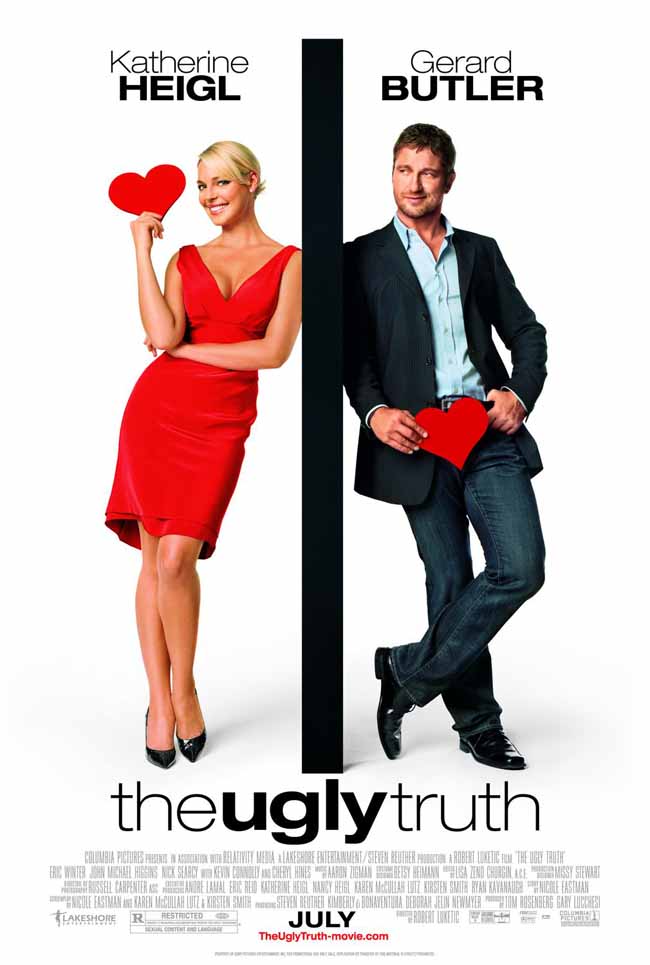
'Ugly Truth' is a thoroughly average romantic comedy

“The Ugly Truth,” the new romantic comedy starring Katherine Heigl and Gerald Butler, is thoroughly average. It isn’t an awful experience and it is pleasant enough, but it certainly doesn’t fill one with the desire to tell people, “Oh, you’ve got to see this one.”

The romantic comedy by its nature is formulaic, so it isn’t fair to throw that criticism at entries in the genre. Opposites meet and bicker at first, but slowly grow to like each other and eventually fall in love.

In a way, the predictability of the romantic comedy is part of its appeal. It is comforting that love always prevails. As is true with any story, even if the outcome is known, it is the journey to reach that conclusion that makes it a story worth telling.

The better romantic comedies mask their formula with fresh characters and sharp dialogue. “The Ugly Truth” has no original characters and limited supply of memorable dialogue.

The premise here is Abby (Heigl, “27 Dresses”), an uptight producer of a TV morning show, is saddled with Mike (Butler, “300”), a new guest commentator who claims to speak the truth about men and women. Mike is a chauvinist that oozes testosterone and Abby finds his point of view on women degrading.

In their early scenes together, Heigl and Butler have some nice barbed exchanges and it seems like the film will be a biting look at the way men and women see love. Instead the film has Abby cave very quickly and basically accept Mike’s view point as he coaches her on how to win over a cute doctor that has moved into her apartment complex.

There’s a lot of vulgar dialogue in the film. It is clear that the film is trying to emulate the appeal of the Judd Apatow produced films. For the most part the use of profanities is supposed to be funny unto itself. Very few jokes are actually written. If you giggle when someone says a naughty word then you’ll find much of the film’s dialogue hilarious.

This isn’t to say there aren’t some genuinely funny scenes. Abby bringing a printout of an online profile and background check on a date is good for a quick laugh as is her rant about how tap water is the same as bottled water. Heigl gets the film’s biggest laugh in a scene that recalls a certain scene from “When Harry Met Sally.”

Things move along well enough, but the film just never quite builds much energy or has anything to say. Romantic comedies don’t need to be profoundly deep, but “The Ugly Truth” stays in the kiddie pool.

The script views gender in the most basic and board stereotypes ultimately concluding that deep down all men only care about sex and want a woman that will never question or criticize them, which is unfortunate since all women are really controlling, judgmental harpies. This is certainly ugly, but not necessarily the truth.

It’s the appeal of the two leads that holds attention. They are likeable together. Butler, who is known more as an action guy, showcases an assured ability to deliver a comedic line. Heigl is cute, perhaps not the highest praise, but it is the word that fits. She does an adorable little happy dance.

As far as a date movie goes, you can do far worse. There are some smiles and laughs, but nothing special. It is safe to say you could wait for DVD on this one. If for some reason it becomes necessary for you to see it in theaters, make sure it is a matinee.

Thursday, July 23, 2009

Errol Flynn: The definitive Robin Hood

Last night just as I was about to go to bed, I got pulled into watching a movie on TV, 1938’s “The Adventures of Robin Hood” starring Errol Flynn. I decided reviewing that film would be a far more pleasurable endeavor than what I had originally intended to write about.

From time to time, I think I’ll forgo reviewing a new movie and point people to a classic. I was going to write about “Bruno” this week. I’ll sum up for you what I would’ve said: skip it. Even if you liked “Borat” I can’t guarantee you’d like “Bruno,” so better to save your money.

Now back to last night and my adventures with Robin Hood. Watching Flynn in all his swashbuckling glory reminded me of my childhood. No, I wasn’t a swashbuckler, but as a boy I had a Flynn phase.

I loved him in such films as “Captain Blood” and “The Sea Hawks,” but it was “Robin Hood” that had the most profound effect on me. I’d take walks in the forest with friends and family pretending to be merry men. When we came to bridges crossing streams staff battles would inevitably ensue.

It was around this time that 1991’s “Robin Hood: Prince of Thieves” came out, a fine film, but even at 8 years old I knew Kevin Costner was no Errol Flynn. Flynn’s Robin Hood, with his jovial laugh, mischievous grin and sharp tongue, is the defining image of the iconic hero from Sherwood Forest.

Flynn was a true movie star and too often they get dismissed as not being genuine actors. What Flynn did was hardly easy. He had believable physicality to his fight scenes, but wasn’t a stiff bore when it came to line delivery. Far from it. He was a charmer who could deliver a one-liner with the precision of a great comic and who could sweep any girl off her feet.

“The Adventures of Robin Hood” was release in Technicolor more than a year before “The Wizard of Oz,” the film that generally gets acknowledged as the first color film. Technicolor makes colors seem brighter and more brilliant than they are in reality and helps the films it is employed in seem as if they come from a magical other world.

It is clear that the producers of “Robin Hood” were excited to use color and grabbed every color they could find. The film is populated with bright greens, reds, blues and purples.

In addition to Flynn's charismatic portrayal of Robin, the film is populated with great actors. Claude Rains as Prince John and Basil Rathbone as Sir Guy of Gisbourne provide excellent villainy. Rathbone and Flynn’s climatic sword fight is the stuff of film legend.

Olivia de Havilland is a lovely Maid Marion, who holds her own against the saucy Robin. Flynn’s frequent sidekick Alan Hale is a delightful Little John as is Eugene Pallette’s Friar Tuck. Flynn’s initial encounters with both these characters are classic scenes as is the archery contest.

There is an idea that kids won’t like or watch old movies. I say poppycock, that’s right you heard me, poppycock. “The Adventures of Robin Hood” captured my imagination as a kid and how could it not? It has adventure, humor and romance, but not too much of that icky kissing stuff. No matter your age, if you haven’t seen this timeless piece of cinema than seek it out. If you have seen it, perhaps the time has come to revisit it.

Brooks' 'Producers' provides big, bawdy laughs

After eight long years, the Mount Washington Valley is finally getting the opportunity to see Mel Brooks’ gloriously goofy musical “The Producers” as it should be seen: live.

The Mount Washington Valley Theatre Company’s production of “The Producers” will continue its run at the Eastern Slope Inn Playhouse in North Conway, N.H. through Aug. 1.

Brooks’ “Producers” first showed up as his debut film as a writer/director in 1968.
It starred Zero Mostel and Gene Wilder and would go on to win an Oscar for best original screenplay. In 2001, Brooks’ musical version starring Nathan Lane and Matthew Broderick made its Broadway debut and would later win a record-breaking 12 Tony Awards

The premise, the same in both the movie and musical, is inspired: a down and out Broadway producer teams up with a meek accountant to cook up a scheme to raise more money than is needed to produce a surefire flop and take the extra money and run.

I saw “The Producers” in London’s Broadway, The West End, and this production absolutely holds up to that big city version, which is impressive given the size of the theater and budget restraints. The show is full of several big, bawdy numbers including the infamous showstopper “Springtime for Hitler” and director Clay James and his cast pull it off.

Throughout his career as a film critic Roger Ebert has shared the following anecdote about Mel Brooks many times. Ebert was sharing an elevator with Brooks a few months after the original “The Producers” film was released. A woman got onto the elevator, recognized Brooks and said, “I have to tell you, Mr. Brooks, that your movie is vulgar.” Brooks smiled and replied “Lady, it rose below vulgarity.”

It is a clever line that perfectly encapsulates the experience of seeing the original film as well as the musical. Sure, “The Producers” is crude and in bad taste but is presented with a certain level of sophistication and wit that allows it to transcend low brow even as it trades in it.

It also helps that it is all delivered with good cheer. The humor, which includes sex jokes, gay jokes, Jew jokes and, naturally, Nazi jokes, is never mean spirited. It is hard to be offended by even the potentially offensive because it is all so amicable.

This cast is absolutely spot-on in getting the tone of the material right. George Piehl, so good last year as Tevye in the Mount Washington Valley Theatre Company’s “Fiddler on the Roof,” is ideally cast as the scheming, boisterous Max Bialystock. Piehl has to be a larger-than-life personality and he is just that. He manages to channel both Mostel and Lane.

Chris Handley is very much Piehl’s equal as timid, high strung Leo Bloom who slowly comes out of his shell under the tutelage of Max. Falling in love with their sexy secretary Ulla (Liz Clark-Golson) certainly helps too. Handley is hilarious in the classic “I’m hysterical” scene. Piehl and Handley have great chemistry.


Grant Golson gets to ham it up in a big way as the gay director turned star of “Springtime for Hitler” as does Thomas Schario as the author of “Springtime” and Ryan Fitzgerald as Golson’s “assistant.” These actors take their supporting roles and run with them stealing scenes whenever they are on stage.

The show is full of great songs that all slightly skewer the traditional musical. Even ballads like “That Face” and “Til Him” are given twists.

Every number is well mounted, but easy highlights include “I Wanna Be a Producer,” “If You’ve Got it Flaunt It,” “Along Came Bialy,” “Der Guten Tag Hop Clop,” “Betrayed” and “Prisoners of Love.” Heck that’s half the show right there.

Those who have seen the flat 2005 film version of the musical may feel they can safely skip this, but they’d be mistaken. Live is the best way to the splendid silliness of this musical comedy gem.

For more information visit www.mwvtheatre.org or call 356-5776.

Thursday, July 16, 2009

Saying goodbye to Nikki Martinez

Magic 104 morning show host heads back to Texas for a new job


CONWAY, N.H. — The valley is losing a key member of its community. Nikki Martinez, the morning show co-host at Magic 104, is moving back to her home state for a position at a radio station in McAllen, Texas. Martinez moved to the Mount Washington Valley in September 2007 and quickly became more than just a radio personality. She joined the Mount Washington Choral Society as well as the Young Professionals and acted in two M&D Production musicals. She was the emcee for this year’s Miss Mount Washington Valley Teen and Pre-Teen and most recently organized a Locks of Love event in which she personally donated 18 inches of hair. On a personal level, she was my friend and collaborator for youtube shenanigans. She will be missed.

Alec Kerr: All right. We’ve come to the exciting part now. I’ve always wanted to do this. I’m going to do the questions that James Lipton uses to close out the “In the Actor’s Studio,” so here we go. What is your least favorite word?

Nikki Martinez: There are some curse words that are my least favorite words, but hate. It is a four-letter word, it is a simple word, but it has a lot of meaning to it if someone really means it. So "hate" would probably have to be my least favorite word.

AK: And what is your favorite word.

NM: Scrumtrilescent. (Laughs) No. I can’t do that.

AK: Oh, it is done. It is done.

NM: Oh OK, scrumtrilescent has to be my favorite word.

AK: What turns you on?

NM: That’s one of the questions?

AK: It is not a dirty question. It is just what gets you going?

NM: What I’m passionate about?

AK: Yes.

NM: Oh this is so hard. Thank you James Lipton. Music. Music has always been my thing.

AK: What turns you off?

NM: There are so many things. I’d say frozen fish sticks.

AK: What sound do you love?

NM: A baby’s laugh.

AK: Oh that’s a good one. What sound do you hate?

NM: Oh, nails on a chalkboard. That is my worst. Oh! And I think about it now. Oh! Next question!

AK: What is your favorite curse word, but of course in this case it is going to be the TV edited version of your favorite curse word.

NM: I personally usually say: “What the…” and that’s where I stop. I do that a lot because I don’t curse a lot.

AK: And I know you’re fond of holy schnike.

NM: Holy schnikes. I totally forgot about that, yes, holy schnikes probably would be my favorite.

AK: What profession other than yours would you like to attempt?

NM: I would love, love, love to go to culinary school and be a chef. I love Food Network. I am not even going to lie: I love Food Network and I could be the next Food Network star if I had those skills. I can cook, but it is definitely not like them because they’re awesome.

AK: What profession would you not like to do?

NM: I give them a lot of respect because they do this, but I could never be a garbage collector. I could never do it. I give them respect for doing it. Props to them.

AK: OK, here’s the big one. If heaven exists, what would you like God to say when you arrive at the pearly gates?

NM: Welcome my child. It is simple, easy, but that’s what I’d love to hear him say and I think I will. No, I know I will, what am I saying, I know will.

'Potter' series still full 'blood'ed entertainment

The time has come for another “Harry Potter” film, which is something I say with great joy versus a heavy sigh. “Harry Potter” is not only the most financially successful franchise of all time — it is one of the most consistently entertaining.

The “Harry Potter” series may have completed its seven book arc two year ago, but the film series has a few more laps to go. With the release of “Harry Potter and the Half Blood Prince,” the count is at six with book seven being split into two films.

By the time of the final film’s release in 2011, it’ll be a full decade of J.K. Rowling’s beloved characters on the silver screen. We’ve seen the young wizards Harry, Ron and Hermione grow up, and the actors that bring them to life, Daniel Radcliffe, Rupert Grint and Emily Watson, grow into fine actors.

This installment focuses on Professor Dumbledore (Michael Gambon) recruiting Harry to extract a memory regarding Voldemort from the eccentric returning potions professor Slughorn (Jim Broadbent). This memory is the key to the undoing of the all powerful evil that is Voldemort.

The film also involves an assassination plot of a key central character. That someone dies in this film is no surprise to the followers of the book series, but you’ll see no spoilers here for those who haven’t read the book.

Speaking of those who haven’t read the book, I fall into that group. This allows me to look at the films on their own merits. The key to their success has been a willingness to explore the dark corners of the story and to not simply make a dumbed-down version for the masses.

I can’t say what has or hasn’t been changed, but obviously there has been condensing. It has been my understanding that, though details have been changed or removed, the series has largely been faithful to its source material.

The films themselves have been getting better the more willing the filmmakers have been to create their own vision instead of simply trying to mimic line for line what is on the page.

After going through several directors ranging from the workman-like Chris Columbus to the visionary Alfonso Cuarón, the series has settled on David Yates to finish the job. He directed the previous installment and is directing the concluding films.

As with “Order of the Phoenix,” Yates brings a foreboding tone to the proceedings.
This time he creates sequences that are tense and suspenseful. Even with a two and a half hour running time, the film moves briskly, yet takes enough to time to give room for the characters to breathe.

At one point Harry remarks he never noticed how beautiful The Hogwarts School of Witchcraft and Wizardry was. The same holds true of the films set there. It is easy to become immersed in this world and take for granted the painstaking craft that went into creating the look and feel of the film.

“Half Blood Prince” in particular is beautiful to behold with gorgeous cinematography by Bruno Delbonnel (“Amélie”) that uses defused earthy tones crucial in creating the film’s uncertain atmosphere.

The proceedings aren’t all gloom and doom; there’s plenty of low-key comedy as the three young leads deal with adolescent crushes. Grint, who was always reliable comic relief and has increasingly developed into a fine comic actor, is particularly good in these scenes.

There’s also the first sparks of romance between Harry and Ron’s sister Ginny (Bonnie Wright). These scenes are handled delicately and Yates proves to be a director who is assured in both the small moments and the more elaborate set pieces such as the stunning opening destruction of London’s Millennium Bridge.

It is impossible to name check the entire cast of veteran British actors. Alan Rickman’s Professor Snape as always remains a standout. Rickman has brought an ambiguous sinister edge to the role that becomes even murkier as his true intentions seem to finally come to the fore.

Gambon, who had the unfortunate task of taking over the role of Dumbledore from the late Richard Harris, gives his best performance the fourth time out — perhaps because Dumbledore has a more active role in the plot this time around. He imbues the performance with humor, wisdom and heart.

For those who haven’t followed either the books or the films, entering the series now would probably be a confusing endeavor. That being said, this is such a visually rich and well told installment that maybe even the uninitiated should give it a try.

Thursday, July 09, 2009

M&D offers change of pace

'How the Other Half Loves' delivers big laughs


M&D Productions has a reputation of doing provocative, challenging material that can be difficult and emotionally draining to watch. This is by no means a bad thing, it very often makes for excellent theater, but some may breathe a sigh of relief that the theater company has taken a turn into farce for its latest production, “How the Other Half Loves.”

“How the Other Half Loves,” which opens at Your Theatre at Willow Common in North Conway, N.H. Thursday July 9, first appeared on Broadway in 1971 and deals with an increasing level of confusion between three sets of couples.

The play’s staging and set is quite ingenious. The households of the middle class Philipses and the upper class Fosters share the stage with half being dedicated to each home. Scenes of the two couples play out simultaneously with criss-crossing dialogue often creating amusing juxtapositions. It sounds confusing in description, but on stage works beautifully.

As the play opens it is the morning after Bob Philips (David Freedman) and Fiona Foster (Paula S. Jones) have come home from late nights and their spouses, Theresa (Janette Kondrat) and Frank (Richard Russo) are not pleased, although they show it in drastically different ways.

Theresa is a door slammer with a sharp tongue. Frank is chronically absent minded, maybe even a bit senile, so it is hard to tell if his approach with his wife is passive aggressive or just blissful aloofness.

Bob and Fiona both claim to have spent the night consoling one half of another couple, William and Mary Detweiler (Eric Jordan and Katie Gustafson), each claiming that one member of the couple is cheating on the other.

This little lie leads to layers of mix-ups and misunderstandings that pile higher and higher especially when the Detweilers are invited to dinners at both of the other couples’ homes. Although the dinners happen a night apart they take place at the same time on stage like a movie cutting between two different scenes.

Jordan and Gustafson come in about half way through the first act and inject the show with a new vigor. Up to this point the humor has been largely verbal, but Jordan and Gustafson as the nervous, socially awkward Detweilers bring a physicality to the humor that accentuates the dialogue.

Both Jordan and Gustafson show sharp comedic timing and a wide range of hilarious facial expression and body language in reaction to the unfolding events.

The rest of the cast should not be shortchanged though. Russo absolutely nails a very particular sort of scatterbrained person. The way he attempts to recount a story and gets hung up on the names of people rings all too true. Russo’s spot-on line delivery recalls Alan Alda or Woody Allen.

Kondrat is great at fuming. When she catches Freedman in a lie her anger is palpable, but it is always played for laughs and never turns sour. Her drunken serenading of the Detweilers is one of the show’s bigger laughs.

Freedman’s Bob is probably the least likable character. There are some nasty misogynistic notes to the character that Freedman is able to dull some so he isn’t a completely unsavory person.

The show is structured in such a way that the show continues to build. Grins become broad smiles then give way to chuckles and conclude with guffaws. This holds most true of the dinner scenes in which the comedic energy builds to a fever pitch.

English playwright Alan Ayckbourn’s script is approaching 40 years in age, but it still feels fresh and only lines referencing a percolator and getting together for cocktails show any signs of dating.

Even though the show borders on madcap, this isn’t just a bunch of silliness and barbed one-liners. Ayckbourn gets in some truths about relationships that with a switch of tone could be quite painful. Instead “How the Other Half Loves” reminds that life is a tragedy until you laugh at it.

For more information visit www.yourtheatre.com or call 662-7591.

Depp shines as Dillinger

Coming out of “Public Enemies,” the one thing that is abundantly clear is that Johnny Depp is a master at his craft. It is unlikely at this point in his career anyone doubts that, but his talent still astounds.

Depp stars as depression-era bank robber John Dillinger in director Michael Mann’s account of the gangster’s final year. Though the title implies that the film is about all the numerous high-profile gangsters of the era, this is very much Dillinger’s story. Other familiar names such as Pretty Boy Floyd and Baby Face Nelson make what feel like guest appearances.

Mann as a director has been fascinated by criminals and cops in films such as “Manhunter,” “Heat” and “Collateral.” He has also shown a keen eye for period detail in “Last of the Mohicans.” Both of these qualities come together nicely in making an engaging gangster movie.

Instead of focusing on Dillinger’s glory days, Mann focuses on his final days leading up to his death outside a movie. Although more of a drama than an action flick, Mann stages some exciting gun battles that should keep action fans pleased.

Dillinger is being actively pursued by the fledging FBI led by J. Edgar Hoover (well portrayed by Billy Crudup) with agent Melvin Purvis (Christian Bale) heading up the investigation.

“Public Enemies” was based on a book of the same name subtitled “America's Greatest Crime Wave and the Birth of the FBI, 1933-34.” Mann’s films shows some of the early behind-the-scenes activities of what would become the FBI, but again this film is most interested in Dillinger. He is the foreground — everything else is merely the background.

In many respects, “Public Enemies” is a love story between Dillinger and Billie Frechette (Marion Cotillard), the coat-check girl he instantly falls for.

Cotillard is not a household name in spite of the fact that she won an Oscar for Best Actress in 2008. Having missed her award-winning performance as Edith Piaf in “La vie en rose” this was my first time seeing her and she is nothing short of amazing. It is hard to take your eyes off of her.

The world is full of beautiful actresses, but most, such as “Transformers” babe Megan Fox, are all surface. Cotillard’s beauty runs deeper. She has that allusive movie star quality. Even though her role is standard love interest stuff, she is able to give the role vibrant life and give the film its heart.

Depp plays such quirky and offbeat characters that it is easy to forget the sheer wattage of his star power, but here there is no question of that. He is magnetically charismatic as Dillinger.

Depp makes it easy to see how Dillinger was able to become a Robin Hood-like figure to the pubic. Dillinger was savvy about how the public perceived him because he knew he had to live amongst them and if they liked him they’d be less likely to rat on him.

The rest of the film is populated by familiar faces all giving solid performances, but rarely being given enough time to develop them. Keep an eye out for Lili Taylor, Stephen Dorff, Giovanni Ribisi, Leelee Sobieski, Rory Cochrane and others.

Bale does good work, but isn’t developed into a full character. Depp and Bale share one scene of confrontation. It is short, but effective.

Some critics have complained that the film offers no insight into Dillinger. The great gangster movies of the 1930s and 1940s didn’t feel the need to get into their gangsters heads, so why is it necessary now?

I don’t need some dime-store psychology involving a flashback of Dillinger getting beaten by his father, and chances are that’s the sort of thing we’d get. Would the film be richer and better for having gotten into Dillinger’s head? Perhaps, but it isn’t a bad film because it doesn’t.

Others have ragged on Mann’s choice to shoot the movie on hand-held high-definition digital video and state that the shaky camera work could make people queasy. Ty Burr of The Boston Globe went as far as to claim that the film looks as if it were shot like an episode of “Cops” or a bar mitzvah video. It is a clever line, but hardly accurate.

There are plenty of films shot on hand-held camera — the “Bourne” movies come to mind — that could make some nauseous, but “Public Enemies” is definitely not one of them. The digital video is only noticeable in low-light night scenes. This very much looks like a full-fledged, well-shot film, not the amateur hour Burr’s comment implies.

Wednesday, July 01, 2009

'Transformers' sequel is an overlong headache

If you went to camp as a kid, you might remember a song that went like this: “You can’t ride in my little red wagon, the axle's broken and the wheels are sagging. Second verse, same as the first, a little bit louder and a little bit worse.” That basically sums up the experience of seeing “Transformers: Revenge of the Fallen.” Each scene is a little bit louder and a little bit worse.
The sequel to 2007’s “Transformers” made $200 million in just five days in the United States and has already made nearly half a billion dollars worldwide. By Hollywood’s standards that makes the movie a roaring success, but money made and quality of a film is not always an equal mathematic equation.

Obviously with a movie about warring robots that can shape shift into anything mechanical, the expectations aren’t for something deep, thought provoking and meaningful. This is meant to be mindless entertainment, and that’s fine, but the biggest problem with “Revenge of the Fallen” is it just doesn’t know when to quit.

Director Michael Bay is known to be a filmmaker of excess who likes to blow stuff up real good. His films are populated by women who look like supermodels and are photographed as such. For 14-year-old boys, he is probably the best director ever. If you can connect with that inner child, it can be fun to a point, but there’s definitely too much of a good thing including Megan Fox running in slow motion.

Both “Transformers” films are produced by Steven Spielberg, and the first time around it seemed like he was a steadying hand to Bay’s more excessive impulses. Some moments of grace were even allowed to slip in. That’s not the case this time. Perhaps Spielberg was off planning how to further ruin the “Indiana Jones” franchise.

The first “Transformers” was a chaotic noisemaker too, but it entertained, almost in spite of itself. It had novelty going for it. There was a thrill and a bit of awe in watching cars, planes and trucks turn into giant talking robots. Sure, it was silly, but it seemed to be aware of that fact.

The second time around, the tone is far too serious. There is some goofiness supplied by the invaluable John Turturro returning as Agent Simmons. He always has a quirky line reading or an offbeat reaction that cuts through the bombastic noise and self important tone.

Shia LaBeouf is still an amicable lead as the movie’s human hero, Sam Witwicky, and there are some amusing scenes early on with Sam dealing with his parents’ reactions to him leaving for college. Fox as Sam’s girlfriend definitely has a screen presence, but all Bay requires of her is to look hot.

As the movie progresses, moments of human interaction become fewer and fewer — but then, you aren’t paying for human drama. We are paying to see robots smash each other to bits.

A little of the crunching robot battles goes a long way. The fight scenes that take over the last 30 minutes and that are spread out through the rest of the running time are messy and confusing.

To make matters worse, the film can’t even follow its own rules when it is revealed that there is a transformer that can take human form. The scenes play like a particularly bad “Terminator” knock-off.

At two and a half hours, the latest “Transformers” is only a few minutes longer than its predecessor, but it feels much longer. It is as if Bay has discovered how to slow the passage of the time. If only we can apply this technology to humanity we could add years to our lives, or at least the hours Bay stole away from us.

From screen to stage

'High School Musical' at the Eastern Slope Inn Playhouse


“High School Musical,” which will be at the Eastern Slope Inn Playhouse through July 12, is what you call critic proof. No matter what I say, the core audience — preteen and teen girls — is going to see it even if they have to drag their parents along with them.

The Mount Washington Valley Theatre Company is putting this on for one reason and one reason only: money. And who can blame them? In this economy, they need a surefire hit — and “High School Musical” is it.

The film that inspired the stage version was the most viewed Disney Channel original movie at the time of its release in 2006. The film’s soundtrack was the highest selling album of that year. There have been two sequels, the last of which was released theatrically and went onto gross more than $250 million worldwide. If opening night at the Eastern Slope Inn Playhouse is any indication, the “High School Musical” money train is still chugging along.

“High School Musical” is basically a reworking of “Grease” with two high schoolers from opposite cliques never expecting to see each other again after meeting over a break only to find the girl has transferred to the boy’s school. In this case the cliques are the jocks and the brainiacs.

Troy (Matt Kacergis) and Gabrielle (Noellia Hernandez) shake the foundation of the school by breaking away from their respective cliques to try out for the high school musical, a rewrite of “Romeo and Juliet” with a happy ending. I laughed at that line, but apparently it wasn’t a joke and “High School Musical” is essentially just that, a modern update of “Romeo and Juliet” with none of the tragedy, plenty of music and everyone learning to get along.

Before proceeding with a critique of the content, I should make it absolutely clear that I am not faulting director Clay James' production, which was well choreographed, designed and performed by a talented cast that rises above the slight material and gives vibrant performances. Fans of the movie will not be let down.

Leads Kacergis and Hernandez, stepping into the roles played by Zac Efron and Vanessa Hudgens, are appealing and have powerhouse vocals that genuinely impress. There is some nice comedic work put in by Alison Rose Munn as the drama teacher; Alex Lafrance as the student who does the school announcements; and Michael Luongo as the put-upon brother of Sharpay, the show’s villain. Their quirky performances kept me most interested.

“High School Musical” is inoffensive, harmless fluff that spoon feeds the audience its message to be who you truly are. The message is probably what appeals to young viewers and it is a good message, but does it have to be delivered in such an obvious, formulaic way? Come on, the writers couldn’t even give the show a proper name.

The writing doesn't have any edge, but there is one line delivered by Sharpay (Merissa Czyz) that surprised me. It was an insult that went like this: “I’d rather suck the snot out of a dog’s nose until his skull caved in.” I wanted more dialogue with that sort of bite. Even though the target audience likes it just fine the way it is, they deserve better.

But I’m clearly not the target demographic for this. The preteen and teen girls in the audience seemed to love it. During intermission they could be found at the bulletin board with the cast headshots debating who the cutest actors were.

Even for all my complaining, seeing musicals live is always more dynamic than seeing them on TV. A well performed live performance of even so-so material is almost always more compelling than a filmed version, and this is certainly well performed. And maybe, just maybe, some “High School Musical” fans will get hooked to live theater in general. One can dream.

For more information visit www.mwvtheatre.org.

Friday, June 26, 2009

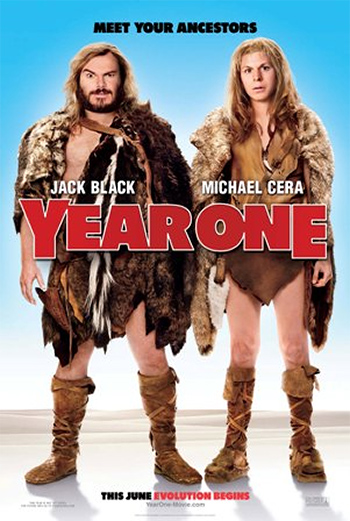
'Year One' is a tremendous let down

There are few movie going experiences more disappointing than being let down by a film you were anticipating. With “Year One,” in spite of all the negative reviews, I was ready to laugh, but alas I have to join the majority in saying that “Year One” is a dud.

“Year One” stars Jack Black (“Tropic Thunder”) and Michael Cera (“Juno,” “Superbad”) as a couple of hapless Neanderthals who essentially start off on the first ever road trip after Black eats the forbidden fruit and gains the knowledge of good and evil.

In this case this knowledge is to make an idiot an arrogant, insufferable know-it-all even though he is no smarter. That sounds funnier on the page than it does in execution.

The characters use modern slang and language, and the juxtaposition with the setting, in theory, can be fun. Mel Brooks and Monty Python have done this well in the past. The plot jumps around the early days of Biblical history and includes run-ins with Cain and Abel and Abraham and Isaac.

Just as the film seems on the path to being a Biblical satire along the lines of Monty Python’s “Life of Brian” it veers off and settles on having Black and Cera go on a rescue mission to save their potential girlfriends.

To be sure, there are a few big laughs, but they are stretched very thin. Most of the best bits are in the trailer and, in some cases (the stoning scene comes to mind) are better edited in the trailer.

The invaluable Hank Azaria, most recently seen in “A Night at the Museum 2,” is a welcomed presence in the film and squeezes every bit of humor out of his appearance as Abraham. He has a funny bit involving circumcision that recalls a similar routine in Brooks’ “Robin Hood: Men in Tights.”

The fight between Cain (David Cross) and Abel (Paul Rudd) is also amusing. Don’t worry, there will be no spoilers as to who wins. Aside from the occasional clever one-liner, that’s pretty much it in terms of laughs as the film gets bogged down by plot.

It is hard to say what went wrong here as the film has an excellent comedy pedigree. The film is directed and co-written by Harold Ramis with two of the writers of “The Office," and produced by reigning comedy king Judd Apatow.

Ramis is clearly trying to make a throwback to the films he directed and/or co-wrote in the late 1970s and early 1980s. With films like “Animal House,” “Vacation,” Caddyshack,” “Stripes” and “Ghostbusters,” Ramis helped to create the slob humor this film is trying to emulate, but there was a certain degree of sophistication to those earlier films. You have to be smart to do stupid humor well.

Too often the gags in “Year One” are simply gross and cringe inducing. This holds most true for a character played by the normally reliable Oliver Platt. His character likes to have oil rubbed into his hairy chest. If reading that sounds bad, then you don’t want to see the visual which is at least 10 times worse.

Aside from better jokes, for a comedy like this to work you need to take the
“Airplane” approach of throwing as many jokes at the screen as possible and hope more stick than don’t. Here the energy is slack and meandering and the humor relies too heavily on what could be called the four Ps: pratfalls, poop, piss and penis.

The film also leans too heavily on Black’s shtick. Black can be a very funny performer, but he needs to be reined in and be given good material. Ramis allows him to roam free far too much, and his mugging becomes more irritating than amusing.

Cera fairs better, and his deadpan, dry delivery goes a long way, but he can only create so much goodwill with the audience.

I really wanted to like “Year One,” but this is just not worth a trip to the theater. If you must see it, wait for DVD.

Friday, June 19, 2009

New 'Pelham' doesn't hold up to original

Some films get better the longer they linger in your mind. The original 1974 version of “The Taking of Pelham 123” starring Walter Matthau and Robert Shaw is one of those films. Other films that went down OK during viewing turn rancid bouncing around your cranium. Unfortunately that is the case for the new version of “The Taking of Pelham 123.”

I need to thank director Tony Scott for making “The Taking of Pelham 123” if only for bringing to my attention the original film, which I had not heard of or seen. It is an excellent thriller. Doing a direct comparison with this new version only further accentuates its flaws.

The remake of “Pelham 123” isn’t an awful film. It has some good qualities, largely supplied by the always interesting Denzel Washington, but it just doesn’t hold up to scrutiny.

The premise, involving hijackers taking a subway car and giving the city one hour to get them $10 million in ransom money or they kill a passenger for every late minute, is intrinsically interesting and hard to foul up entirely.

Washington stars as Walter Garber a career transit employee who is slumming it as a dispatcher because he is suspected of taking a bribe. John Travolta, who has provided excellent villainy in films like “Face/Off,” is Ryder the mastermind behind the hijacking.

Remaking a film successfully is tricky business. Being slavishly faithful to the original – like Gus Van Sant’s ill advised shot-by-shot remake of “Psycho” – makes the new film pointless. A fresh spin to the material needs to justify the redo, but different doesn't mean better.

Scott’s version of “Pelham” adds needless back stories for Garber and Ryder and subtracts the original film’s cynical, sarcastic humor. The attempts at subtext to the plot are unnecessary. Instead of being a story of a heist it becomes the story of Garber’s redemption.

The screenplay by Brian Helgeland (“Mystic River”) tries hard to establish the tired idea that Garber and Ryder are different sides of the same coin. The cliché line: “you and I aren’t so different” is even thrown in for good measure.

The film should be focused solely on the heist, how to get the money to the hijackers and how Ryder and cohorts are going to escape unnoticed from an underground tunnel. That’s all the film needs to grip.

Scott is a talented director that in his last string of films including “Man on Fire” and “Domino” has developed his own unique, aggressive visual style, but it doesn’t fit this material. His shaky, blurred camera work and over editing is distracting as are freeze frames telling you how much time is left before the deadline lapses.

The film is at its strongest when the camera work becomes less frantic and focuses in on the back and forth between Washington and Travolta. In these scenes, Scott creates some genuine tension. There’s a taut scene in which Travolta threatens to kill someone unless Washington admits something.

Once the initial deadline passes the film doesn’t seem to know where to go and rushes through the escape. The end sequence just de-evolves into a by-the-numbers chase and the final moments of the movie send a bizarre message that leaves a nasty taste in the mouth.

It is the acting that carries the film over its shortcomings and at times makes the film work when it shouldn’t. Washington is just so good at playing cool and composed under pressure. Travolta is at times too manic, but as in the past he makes a good villain. There is also strong support from John Turturro as a hostage negotiator and James Gandolfini as the mayor.

My best advice would be to wait until the film comes out on DVD and do a double feature with the original. That could be a lot of fun and could stir lively debate as to what works and doesn’t work in each film.

Friday, June 12, 2009

This 'hangover' provides big raunchy laughs

Ever since “Animal House” became a huge comedy smash in the summer of 1978, the low-brow gross-out comedy has been a mainstay of the summer movie season. There have been many pale imitators, but some have been riotously funny. Luckily, “The Hangover” falls mostly in the latter category.

“The Hangover” is set in Las Vegas the morning after a bachelor party that went way over the top even by Vegas standards. The problem is no one involved can remember what happened, and the groom (Justin Bartha, “National Treasure”) is missing. In his place
are a baby and a tiger.

The film’s set-up gives it a bit of an edge over the many others films that deal in the debauchery of Vegas or trade in frat boy humor. Instead of seeing the exploits of the main characters, we are left joining them in piecing together the aftermath of what turns out to be very strange evening.

There aren’t really characters in the film so much as there are familiar archetypes: the snarky ringleader (Bradley Cooper, “Yes Man”), the uptight geek (Ed Helms, “The Office) and the lovable slob (Zach Galifianakis). It is to the actors’ credit that they find some fresh angles in which to play their roles.

Cooper, Helms and Galifianakis have a believable chemistry together. They seem like friends. Galifianakis steals the movie several times as Alan, the bride’s socially awkward, perhaps slightly deranged, childlike brother. He desperately wants to be liked, and his awkward attempts at male bonding score some of the films biggest laughs.

The film is funny, but in mere description some of the better jokes probably will seem flat. The performances and the execution are what make the film work. Director Todd Philips has been one of the few directors to successful rehash this sort of frat boy humor with his films “Road Trip” and “Old School.”

The screenwriters, Jon Lucas and Scott Moore, have written films like “Four Christmases” which have been amusing, but felt collared by a PG-13 rating. Here with an R rating the comedy seems less restrained, and it is all the better for it.

There is one aspect of the film that is likely to leave a nasty taste in many people’s mouths. A character played by Ken Jeong (“Knocked Up”) is both simultaneously a gay and Asian stereotype that, with the exception of the character’s surprising introduction, isn’t very funny. These sort of films are suppose to deal in political incorrectness and pushing the boundaries of good taste, but this characterization seems too broad and out of place with the rest of the film.

The above shortcoming isn’t enough to detract from the film overall. Even so, if you aren’t a fan of low-brow humor then you may want to take a pass on “The Hangover.”
This certainly isn’t a subtle film — after all, this is the sort of film that has jokes involving being tasered in the face and genitals — but the mystery aspect of the story does hold interest.

There is also a weird energy to the events unfolding, and the film goes to unexpected places. There is a celebrity cameo that has been revealed in the trailers that I won’t spoil here for those who have managed to avoid the previews. Let’s just say that that it is oddly inspired.

Friday, June 05, 2009

Pixar is 'up' to wonderous things again

“Up” is the perfect title for Pixar’s 10th feature length film because uplifted is exactly how you feel as the final credits roll. This is one of the most emotionally satisfying, engaging and funny films of this or any other year. “Up” is something truly special.

Starting in 1995 with “Toy Story,” the first entirely computer animated feature film, the Pixar animation studio has made consistently rewarding films with equal measures of heart and humor. Computer animation has since become the standard, but competing studios rarely match Pixar’s body of work in terms of character and story.

Their last three films in particular, “Ratatouille,” “WALL-E” and now “Up,” are on another level. As was true with its two direct predecessors, “Up,” is not simply a great animated feature — it is a great film.

“Up” starts by introducing two young wannabe adventurers named Carl and Ellie who worship explorer Charles Muntz (Christopher Plummer). Young Carl makes a promise to take Ellie to Paradise Falls, a fictional region in South America.

In a beautiful, impossibly sweet and heartbreaking montage we are shown the arc of the couple’s life including the setbacks that prevented their trip and ultimately Ellie’s death. It is an amazing few minutes and hooks you for the rest of the film. From that moment on you are deeply emotionally invested in Carl.

Carl (Ed Asner) is left a grumpy widow and retired balloon salesmen, who when threatened with a retirement home uses thousands of balloons to convert his home into a flying house and sets off on the adventure he promised to take. When that house first lifts off there’s a genuine sense of wonder and magic that is so rare in modern cinema.

Along his trip Carl keeps picking up companions. First is Russell (Jordan Nagai), a boy scout that was unwittingly on his porch during lift off. Once they arrive in Paradise Falls they are joined by a prehistoric bird dubbed Kevin and Dug (Bob Peterson), a dog that thanks to a special collar can speak. Dug is part of a pack of talking dogs, but not all of them are as nice as Dug.

Many films, both animated and live action, have had talking dogs, but what is refreshingly unique and funny about the dogs here is they still speak with dog logic. They are easily distracted by squirrels and tennis balls.

Carl and his comrades also encounter the long missing Muntz, but he isn’t what he seems. It may appear as if I’ve revealed a lot of the plot, but there’s so much more. The plot has some predictable elements, but it is in the execution and details that the film soars. Directors Pete Docter and Peterson create moments of striking imagination and surprising invention. It wouldn’t be fair to cite specific examples because they deserve to be discovered on their own.

What makes this more than just an adventure story is the characters. You will truly grow to love and care about Carl, Russell, Kevin and Dug as if they were flesh and blood characters. Your humanity is thrown into question if the film doesn’t at least make you tear up a little.

The film is by no means a total downer. The film has laughs both big and small, but the humor is mined from the story and the character rather than the pop culture references that often over populate other animated features.

The voice work, though limited, is splendid. Asner is wonderfully gruff as Carl and he allows for nice shading of the character as his inner childhood adventurer returns to the fore. The dynamic that develops between Carl and Nagai’s Russell is sweet and sincere. Plummer also provides a full bodied voice performance although he hits entirely different notes than Asner.

Some younger viewers may grow restless as this is more character driven than gag driven. I heard lots of kids asking questions in the theater I was in, but they were clearly involved. I’m sure “Up” will be a film watched repeatedly by kids on DVD and that parents will gladly and willingly watch it with them.

Saturday, May 30, 2009

Worthington makes this new 'Terminator' worthy

Another week, another sequel, prequel or reboot. The cynic in me wants to dismiss “Terminator Salvation” — the fourth film in the “Terminator” franchise — but damned if the film isn’t actually pretty good.

Coming 25 years after the first “Terminator,” this is the first film in the series to not star Arnold Schwarzenegger. This is also the first in the franchise — with the exception of a brief prologue — to be set entirely in a future in which humanity is battling an army of self-aware machines known as Skynet.

Christian Bale stars as John Connor, taking over the role previously played by Nick Stahl and Edward Furlong. Connor is a leader in the resistance who has been told all his life that he will lead humanity to victory over the machines.

Another key returning character is Kyle Reese (Anton Yelchin). Reese was sent into the past in the first film to protect John Connor’s mother Sarah from a terminator and in the process became John Connor’s father.

In this film, Skynet has targeted Reese for termination because they somehow know this whole sordid timeline and if you kill Reese you therefore kill Connor. Confused? Just go with it.

Although Bale gets top billing and in an opening title card it is implied that Connor is the salvation of the title, the real star of the film is the relative unknown Sam Worthington as Marcus, a mysterious man from the past with no knowledge of this new terrible future.

Trailers, commercials, clips, interviews and reviews have revealed a plot development involving the Marcus character that comes about an hour into the film. If you’ve somehow managed to avoid all promotion for the film, don’t watch or read any of it as it ruins the uncertain tension of the first hour.

Worthington steals the film. He has that allusive “it” factor that draws you to him as a performer. As Marcus, a man trying to forgive himself for a dark past and understand an uncertain future, he has a compelling, introspective screen presence.

The screenplay by John D. Brancato and Michael Ferris doesn’t exactly give Worthington, or the rest of the cast for that matter, the most compelling dialogue, but he makes it count and is able to say so much more in what he doesn’t say.

Bale is good here as a hardened warrior, but unfortunately is forced to shout clunky, cliché dialogue like, “If we stay the course, we are dead! WE ARE ALL DEAD!” He is better in the quieter moments as when he is delivering radio broadcasts to the resistance.

Yelchin is having a good summer with this following on the heels of “Star Trek.” As with that film, he is very good. He is believable as a young survivalist and he brings warmth and humor to the performance.

Another standout in the cast is Moon Bloodgood who is Marcus’ love interest. She shares several key scenes with Worthington and they play off each other nicely. Bryce Dallas Howard as Connor’s wife doesn’t fare quite as well. She gives a solid enough performance, but doesn’t get much time to develop it.

At times the film tries too hard to reference the previous films. A callback to the immortal “I’ll be back” line works surprisingly well, but Schwarzenegger’ face digitally placed over a body double’s face is less effective. It is a moment meant to please the fans, but it is more of a distraction.

Directed by McG (“Charlie’s Angels”) the film has an appropriately bleak post-apocalyptic atmosphere. The tone and much of the action scenes recall the “Mad Max” films more so than the “Terminator” series, which works in the film’s advantage.

McG has constructed some good action scenes particularly a chase involving motorcycle terminators and a wrecker. Luckily, this is more than just a special effects film. Although the film doesn’t quite have the strong character connections of the first two, it is given a real human connection thanks to Worthington’s Marcus.

There are reportedly two more “Terminator” films to come, but I was left content with this one. I really don’t need to see another. But there is more money to be made, and therefore more sequels will come.

Saturday, May 23, 2009

Take a trip to 'La Mancha' with Arts in Motion

“Man of La Mancha” is a lighthearted comedic musical romp that isn’t afraid to go to dark corners and raise philosophical questions about facing reality and the necessary need for escapism.

Arts in Motion opened its energetic production of “Man of La Mancha” at the Eastern Slope Inn Playhouse Friday, May 22. Director Susie Mosca has mounted a handsomely produced production with a lively cast and an effective period set designed by Roger Clemons.

Based on Miguel de Cervantes’s classic 17th century novel “Don Quixote,” “Man of La Mancha” first appeared on Broadway in 1965. The show is self-reflexive with a fictionalized version of Cervantes (Craig Holden) being thrown into a prison to await trial by the Inquisition.

Cervantes’ fellow prisoners have their own trial for him and accuse him of being an idealist. To defend his case he acts out the story of Don Quixote, a simple man who has read so many tales of chivalry that he has driven himself mad and created a fantasy world in which he is a knight. Cervantes asks those around them to fill parts as needed.

This play-within-a-play conceit is a clever device that allows for book writer Dale Wasserman and lyricist Joe Darion to comment on theater and performance. We get to see Cervantes transform himself into Don Quixote with a fake beard, a bit of glue and some make up. It is also factors into the musical’s theme of fantasy versus reality and whether bursting Don Quixote’s bubble is what is truly best for him.

“Don Quixote” was originally written as a satire of chivalrous adventure stories. Written in two parts, the first was farce, but the second was more serious and bleak with Quixote seen as a madman who was cruelly ridiculed.

“Man of La Mancha” explores these two sides of Cervantes’ work, but while Quixote is still seen as a madman, his idealized view of the world is openly embraced. The message seems to be that in a world that is cruel and unfair, no one’s dream, however absurd, should be squashed.

All this makes the show sound very somber and while there are certainly darker moments, including a rape that happens off stage, there is also plenty of sly humor that is well played by the cast.

Holden is effective in the dual role of Cervantes and Quixote. As Quixote he gets the tone just right of a man happily living in a delusion. He shines brightest on the show’s most famous song “The Impossible Dream,” which is sung with great conviction.

Holden makes Quixote’s passion infectious, and when his loyal “squire” Sancho Panza (Frank Smith) sings “I Really Like Him” it is easy to see why. Smith has nice comic timing as Sancho, who puts up with the wild antics, while at the same time enjoying the absurdity of it all.

Anna Mosca, as a barmaid who Quixote believes is his lady Dulcinea, is a great foil to both Holden and Smith. She brings a forceful snarky energy to the character, especially on the song “It Is All the Same” in which she fends off several men on the prowl.

Other highlights in the large cast include Gino Funicella in the duel role of governor and the innkeeper, and Rob Owen as a barber. Both actors play their role for broad laughs and get them.

If the production has a shortcoming it is that at times it is unclear where the drama and comedy line is. There is nothing wrong with show walking the ambiguous line of humor and pathos, but some scenes that seem to be intended be dramatic are unintentionally comic or perhaps it is the other way around. These moments are few and don’t undermine the show’s overall quality.

For more information visit www.artsinmotiontheater.com or call 356-5776.